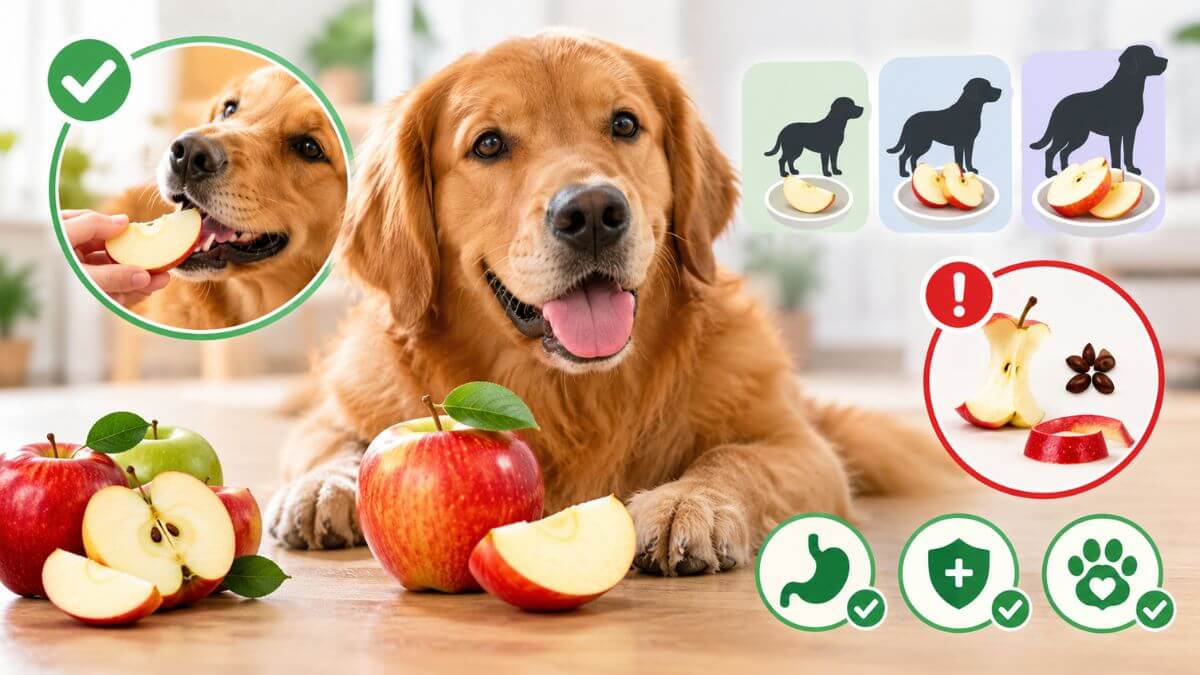
Can dogs eat apples? Yes. Fresh apple flesh and skin are safe for most healthy dogs, but the seeds, core, stem and leaves must come off first. Apples are low in fat and calories, so they are one of the easier human foods to share. Most problems come from how they are served: a whole apple tossed to a small dog, a core dropped on the floor, a slice of apple pie, or fallen fruit in the yard.
Can dogs eat apples safely? The short answer
Yes, dogs can eat apples when you serve plain, washed slices with the core, seeds, stem and leaves removed. Keep apples to a small treat that stays within 10% of daily calories, start with one piece, and skip apple products with added sugar or spices.
| Question | Quick answer |
|---|---|
| Safe parts | Flesh and skin, washed |
| Remove first | Core, seeds, stem and leaves |
| Calories | About 52 per 100 g; a medium apple is about 95 |
| Daily limit | All treats together under 10% of daily calories |
| Skip | Apple pie, caramel apples, apple juice, sweetened applesauce |
Are apples good for dogs? What one slice gives them
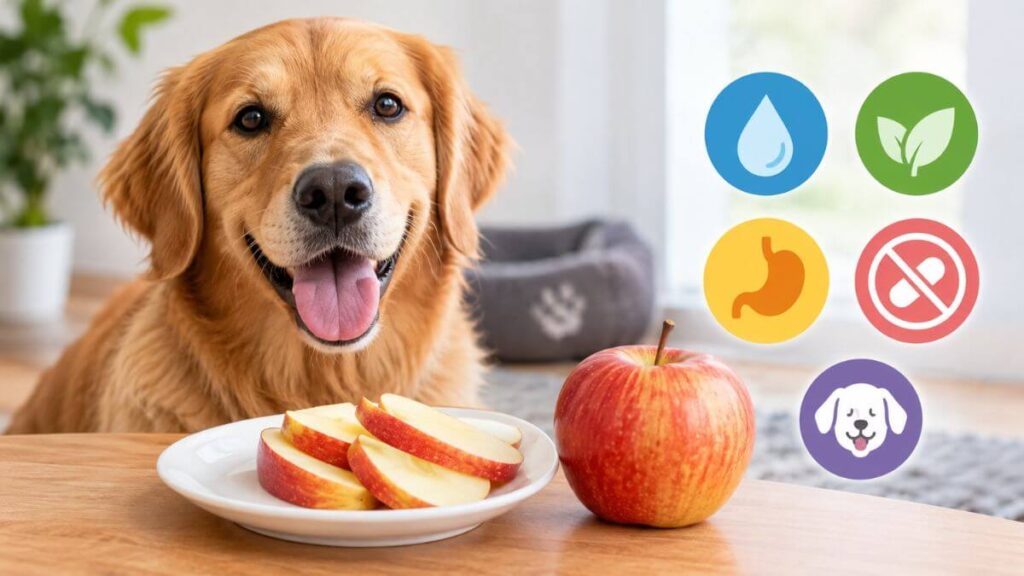
Apples are good for dogs as a low-calorie, high-water snack with some fiber, but they are not a meaningful vitamin source. One slice of a medium apple has roughly 12 calories, so it works as a training reward or a swap for richer store-bought treats.
| Per 100 g, raw with skin | Amount | What it means for your dog |
|---|---|---|
| Calories | 52 kcal | Low; a medium apple (182 g) is about 95 kcal |
| Water | 86 g | Filling for very few calories |
| Fiber | 2.4 g | Includes pectin; too much loosens stool |
| Natural sugars | 10.4 g | Matters for diabetic dogs |
| Fat | 0.2 g | Close to fat-free |
| Vitamin C | 4.6 mg | Small, and dogs make their own |
Figures from USDA FoodData Central. Apple’s main value is as a swap: two slices give a crunchy reward for about 24 calories, which suits dogs that need to lose weight.
Do dogs need the vitamin C in apples?
No. Dogs make their own vitamin C in the liver, which is why most healthy dogs do not need it from food or supplements. The 4.6 mg in 100 g of apple is harmless, but it should not be the reason you feed apples.
Which parts of an apple can dogs eat?
Dogs can eat the flesh and the skin. The seeds, core, stem and leaves should never go to your dog: the seeds, stem and leaves contain cyanide-releasing compounds, and the hard core is a choking and blockage risk, especially for small dogs.
| Apple part | Safe for dogs? | Why |
|---|---|---|
| Flesh | Yes | Low in calories and easy to digest in small amounts |
| Skin (peel) | Yes, washed | Holds nearly half the fiber; peel it for sensitive stomachs |
| Seeds | No | Contain amygdalin, which releases cyanide when chewed |
| Core | No | Tough, holds the seeds, and can cause choking or a blockage |
| Stem and leaves | No | The ASPCA lists them as toxic to dogs |
Are apple seeds poisonous to dogs?
Apple seeds contain amygdalin, which releases cyanide when a seed is crushed or chewed. A few swallowed seeds are very unlikely to harm a dog, but large amounts can, so remove the seeds every time rather than counting on that safety margin.
A vet-verified Dogster guide estimates a medium-sized dog would need to chew up about 3 ounces of seeds, roughly 200 apples’ worth, to reach a toxic dose. The realistic danger is repeated access, such as a dog eating fallen apples all autumn.
Why is the apple core dangerous for dogs?
The core is tougher than the flesh, so dogs tend to swallow it in one piece. In small breeds it can lodge in the throat, and in any dog a large piece can get stuck in the stomach or intestines, which sometimes needs surgery.
How many apples can dogs eat? Portions by dog size
Most dogs can have one to eight apple slices on a treat day, depending on size. Apple counts toward the 10% treat rule, which means all treats, chews and table food together should stay under 10% of your dog’s daily calories.
| Dog size | Example breeds | Daily treat budget | Apple portion |
|---|---|---|---|
| Toy, under 10 lb (4.5 kg) | Chihuahua, Yorkshire Terrier | Up to about 35 calories | 1 to 2 slices, diced small |
| Small, 10 to 25 lb (4.5 to 11 kg) | Pug, Shih Tzu | About 35 to 70 calories | 2 to 3 slices |
| Medium, 25 to 50 lb (11 to 23 kg) | Bulldog, Border Collie | About 70 to 115 calories | 3 to 4 slices |
| Large, 50 to 75 lb (23 to 34 kg) | Labrador, Golden Retriever | About 115 to 160 calories | 4 to 6 slices |
| Giant, over 75 lb (34 kg) | Bernese Mountain Dog, Great Dane | 160 calories or more | Up to 8 slices (one medium apple) |
One slice is one-eighth of a medium apple, about 12 calories. Budgets assume a healthy, neutered adult with normal activity. Worked example: a 50 lb (23 kg) Labrador mix needs roughly 1,160 calories a day, so its treat budget is about 116. Half an apple (about 48 calories) fits with room to spare, while a whole apple (about 95) uses most of it.
7 essential rules for feeding your dog apples safely
Wash the apple, remove the core, seeds and stem, cut pieces to your dog’s size, start with one piece, stay within the 10% treat rule, serve it plain, and watch the next day’s stool. Together these steps cover choking, blockage, seed exposure and stomach upset.
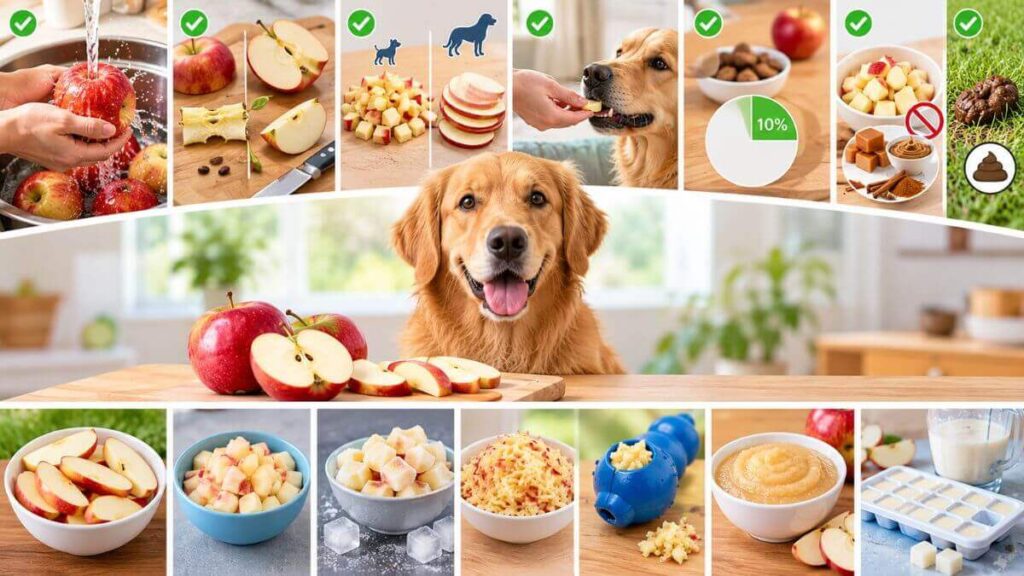
- Wash it well. In a University of Massachusetts study, a 12 to 15 minute soak in water with baking soda (about 1 teaspoon per 2 cups) removed more surface pesticide than tap water. Rinse afterward.
- Remove the core, seeds, stem and leaves. Quarter the apple and cut the core out of each piece, which makes stray seeds easy to spot.
- Size the pieces. Pea-sized cubes for toy breeds and puppies, thin slices for bigger dogs.
- Start with one piece. Wait 24 hours to see how the fiber agrees with your dog.
- Stay inside the 10% rule. Give less of another treat on apple days.
- Serve it plain. No caramel, sugar or nutmeg, and no peanut butter that contains xylitol.
- Watch the stool. Gas, soft stool or vomiting means cut back, or peel the apple next time.
Easy ways to serve apples to dogs
Serve apple fresh as slices or diced cubes, frozen for a cold summer chew, grated over regular food as a topper, or mashed into a stuffed chew toy. Homemade applesauce with no sugar works too. Keep every version plain and seed-free.
For a quick frozen treat, blend one cored, peeled apple with half a cup of plain unsweetened yogurt, freeze it in an ice cube tray for about four hours, and give one or two cubes to a medium dog. Leave out the yogurt if dairy upsets your dog.
Which dogs should not eat apples?
Dogs with diabetes, dogs on a prescription or elimination diet, and dogs with very sensitive stomachs should only get apple with a vet’s approval. Puppies and seniors with dental problems can have apple, but in smaller, softer pieces and under supervision.
| Dog | Why it matters | What to do |
|---|---|---|
| Diabetic dogs | Natural sugar affects blood glucose | Only with vet approval, counted into the plan |
| Prescription or elimination diet | Extra food can upset the balance or spoil an allergy trial | Ask your vet first |
| History of pancreatitis | Apple is nearly fat-free, but these dogs need a strict plan | Follow your vet’s treat list |
| Sensitive stomach | Fiber and acidity can cause gas or loose stool | Peel it and give one small piece |
| Overweight dogs | Apple is a good low-calorie swap | Replace a biscuit with a slice, do not add on top |
| Puppies and seniors with dental pain | Gulping or hard chewing leads to swallowed chunks | Tiny pieces, or grate or steam the apple |
For most dogs, the answer to “can dogs eat apples” is a simple yes. Apple is almost fat-free and low in calories, but for any dog under medical care, the vet’s diet plan comes first.
What to do if your dog ate an apple core or seeds
Stay calm. One core or a few seeds rarely poisons a dog, so the main risks are choking now and a blockage over the next few days. Call your vet right away if your dog is small, ate several cores, or shows any warning signs.
| Problem | When it shows | Signs to watch for |
|---|---|---|
| Choking | Immediately | Pawing at the mouth, gagging, noisy or blocked breathing, pale or blue gums |
| Intestinal blockage | Hours to a few days | Repeated vomiting, refusing food, a sore belly, straining with little or no stool |
| Cyanide toxicity (rare) | Minutes to hours | Brick-red gums, dilated pupils, trouble breathing, panting, shock |
Do not make your dog vomit unless a vet tells you to. If you cannot reach your vet, the US-based ASPCA Animal Poison Control Center, (888) 426-4435, and Pet Poison Helpline, (855) 764-7661, answer 24 hours a day and may charge a fee. Outside the US, call your nearest emergency vet.
Fallen apples in the yard: the autumn risk
Windfall apples are riskier than slices from your kitchen. A dog under an apple tree can eat several whole apples, cores, seeds and leaves included, and fruit left on the ground can rot, grow mold or ferment into alcohol as it sits.
Apple products: which ones are safe for dogs?
Plain fresh apple, plain cooked apple and unsweetened applesauce are fine in small amounts. Dried apple is safe only unsweetened and in tiny pieces. Skip apple juice, apple pie, caramel apples, candied apple chips and anything with xylitol, nutmeg or added sugar.
| Product | Verdict | Why |
|---|---|---|
| Fresh apple slices | Safe | About 52 calories per 100 g |
| Plain baked or steamed apple | Safe | Softer for seniors; no butter, sugar or spice |
| Unsweetened applesauce | Small amounts | 1 to 2 teaspoons for small dogs, 1 to 2 tablespoons for large dogs |
| Dried apple, unsweetened | Tiny amounts | About 243 calories and 57 g of sugar per 100 g, nearly five times fresh apple |
| Apple juice | Avoid | No fiber and about 24 g of sugar per cup |
| Apple pie and crumble | Avoid | Sugar, butter and pastry; nutmeg is toxic in larger amounts |
| Caramel apples and apple chips | Avoid | Sugar, fat, salt, and sometimes xylitol |
Before sharing a packaged treat that lists apple, run its ingredients through our Dog Treat Ingredient Checker to catch things like xylitol that are easy to miss on a label.
Other dog-safe fruits to rotate with apples
Bananas, strawberries, watermelon and blueberries all work as occasional treats for most healthy dogs, each with its own prep rule. Rotating fruit keeps treats interesting without adding much sugar from any one source, and the same 10% treat rule applies to every fruit.
Bananas are softer and higher in sugar, so check our guide on whether dogs can eat bananas for portions. Strawberries need the green tops trimmed, as our strawberries guide explains, and watermelon needs the rind and seeds removed, as shown in our watermelon guide.
Keep grapes, raisins and currants away completely, because the ASPCA links them to kidney failure in dogs. For everything else, see our full list of human foods dogs can eat.
Can dogs eat apples? Frequently asked questions
These are the questions dog owners ask most often about apples, answered briefly. Each answer assumes a healthy adult dog. If your dog has a medical condition or takes regular medication, check with your vet before adding apple or any other new treat.
Can dogs eat apples every day?
Yes, a healthy dog can eat a little apple every day if the daily amount stays inside its treat allowance and its stool stays normal. A few times a week is also fine and leaves room to rotate other fruits and treats.
Can dogs eat apples with the skin on?
Yes. Apple skin is safe and holds nearly half the fiber, so most dogs can eat washed slices with the peel on. If your dog gets gas or soft stool after apple, peel it next time, because the skin is the harder part to digest.
Can dogs eat green apples?
Yes. Green apples such as Granny Smith are as safe as red ones. USDA figures show only small sugar differences between varieties, about a gram per 100 g, so pick whatever your dog likes. Granny Smith is more tart, and some dogs turn it down.
Can puppies eat apples?
Yes, once a puppy is weaned and eating solid food, it can have tiny pieces of peeled, seed-free apple. Keep pieces about pea-sized for toy breeds, supervise every bite, and let complete puppy food supply nearly all of its daily calories.
Do apples clean a dog’s teeth?
Not in any reliable way. Crunching apple may scrape a little soft debris off the teeth, but apples also contain natural sugar and acid. They do not replace brushing or vet-approved dental chews, so treat any cleaning effect as a small bonus.
Can apples give dogs diarrhea?
Yes, too much apple can cause diarrhea, gas or bloating, mainly from the fiber and natural sugar. Mild upset usually settles once you stop. Call your vet if diarrhea lasts more than 24 hours or comes with vomiting, blood or lethargy.
Can dogs eat apples with peanut butter?
Yes, if the peanut butter is plain and has no xylitol, a sweetener toxic to dogs that may be listed as birch sugar. Use a thin smear, because one tablespoon of peanut butter has around 95 calories, about the same as a medium apple.
Can dogs eat apples with cinnamon?
A light dusting of cinnamon is not toxic to dogs, but it adds nothing useful. Cinnamon apple foods such as pies, chips and sauces usually bring sugar or nutmeg, and loose cinnamon powder can irritate a dog’s airways, so plain apple is the better habit.
The bottom line on dogs and apples
Apples are one of the safer fruits to share with a dog. Serve washed flesh and skin, remove the core and seeds, cut pieces to size, and stay inside the 10% treat budget. Dogs with diabetes or on prescription diets need a vet’s go-ahead first.
So, can dogs eat apples? For most healthy dogs, yes. The trouble usually starts with the parts people forget: a core left on the floor, a dog alone under an apple tree, or apple pie passed under the table. Deal with those, and apple is a cheap, low-calorie reward. Start with one piece and adjust from there. For more options, see our list of human foods that are safe for dogs, and check any packaged apple treat with the ingredient checker before it goes in the bowl.
Sources
- ASPCA Animal Poison Control: Apple
- ASPCA: People foods to avoid feeding your pets
- USDA FoodData Central: Apples, raw, with skin
- Journal of Agricultural and Food Chemistry: washing pesticide residues off apples
- PubMed Central: vitamin C synthesis in dogs
- Dogster: Can dogs eat crab apples? (vet-verified)
- American Kennel Club: Can dogs eat apples?