Can dogs eat eggshells? Yes, but only when they are baked and ground into a fine powder, then given in small measured amounts. An eggshell straight from the kitchen is a different story. Raw shells can carry salmonella, and sharp fragments can cut a dog’s mouth, throat, or digestive tract. Prepared the right way, eggshell powder is a concentrated source of calcium that some dogs, especially those eating homemade diets, genuinely benefit from. This guide walks through the safe preparation method step by step, how much suits your dog’s size, and the situations where you should skip eggshells entirely.
Are eggshells safe for dogs? The quick answer
Yes, dogs can eat eggshells, but preparation decides whether they are safe or risky. Bake the shells to kill salmonella, grind them into a fine powder with no sharp flakes, and sprinkle only a small measured amount over food. Skip these steps and the shells can carry bacteria or injure your dog’s mouth and throat.

PetMD’s vet-reviewed feeding guide lands in the same place: dogs can eat eggshells only when prepared properly, which means baking or boiling them, grinding them into a fine powder, and adding just a small amount to food, ideally with a veterinarian’s guidance. You can read PetMD’s guide to feeding eggs to dogs for the full breakdown.
Most dogs eating a complete, balanced commercial diet already get all the calcium they need. Extra calcium is mainly useful for dogs on homemade or raw diets formulated without bone or a mineral mix. If your dog eats regular kibble from a reputable brand, eggshell powder solves a problem your dog does not have. And the form is non-negotiable: powder only, never chunks or rough flakes.
Why eggshells appeal to dog owners: calcium and minerals
Eggshells are about 95 percent calcium carbonate, which makes the powder one of the most concentrated natural calcium sources in a home kitchen. Calcium supports bones, teeth, muscle movement, and nerve signaling. The catch is that most complete dog foods already provide enough, so extra calcium only helps dogs whose diet lacks it.

A level teaspoon of fine powder holds roughly 1,800 mg of calcium carbonate, about 720 mg of elemental calcium, the part the body can use. That is a large dose in a small spoon, which is why portions are measured in fractions of a teaspoon.
Shells also carry small amounts of magnesium, phosphorus, and potassium, but not enough to balance the calcium. Heavy-handed scoops skew the calcium-to-phosphorus ratio, which should sit near 1.2 to 1. Meat-heavy homemade diets tend to run high in phosphorus and low in calcium, which is exactly the gap this powder can fill once a vet or nutritionist has done the math.
How to prepare eggshell powder for dogs, step by step
Rinse clean shells, bake them at 300°F (150°C) for about 10 minutes, let them cool fully, then grind them into a very fine powder with no visible flakes or sharp edges. Store the powder in an airtight jar and measure every serving. The heat treatment and the fine grind are the two steps that make eggshells safe for dogs.
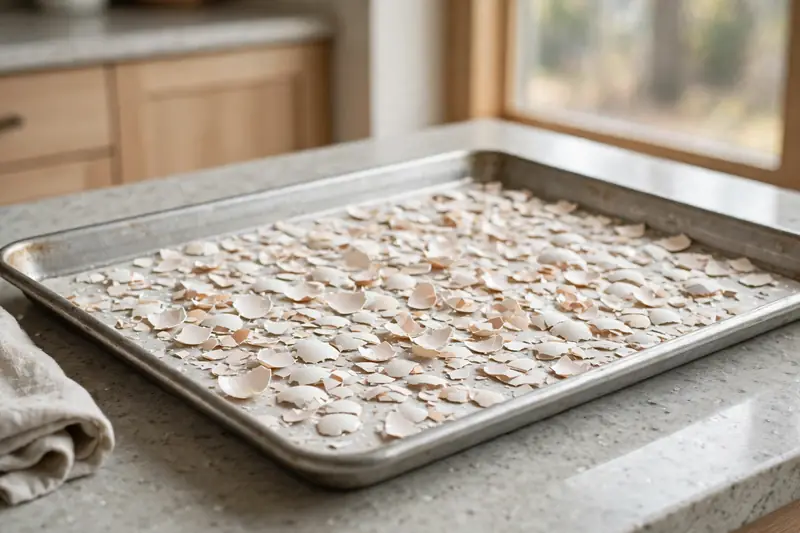
Use shells from eggs you cooked for yourself and rinse off clinging egg white. There is no need to remove the membrane. Spread the shells in a single layer on a baking sheet and bake at 300°F (150°C) for about 10 minutes, until they look dry, then cool them completely. Grinding warm shells makes a gummy mess.
Grind in a clean coffee grinder or blender in short pulses until the result is uniform and flour-fine. Rub a pinch between your fingers. If you feel grit or see flakes, keep grinding. If you would rather not use the oven, boil the rinsed shells for 10 minutes, dry them fully, then grind the same way. Heat is the step that kills salmonella, and rinsing alone cannot do it. The FDA’s egg safety guidance explains why heat treatment matters for eggs in every form. Store the powder in an airtight jar in a cool, dry spot and use it within about two months.
Why whole or roughly crushed shells are dangerous
Whole shells and coarse crushed pieces have sharp edges that can cut your dog’s gums, mouth, and throat or irritate the stomach lining. Larger fragments also carry a choking risk for small dogs and fast eaters. If you want the calcium benefit without the danger, a fully ground powder is the only form worth feeding.
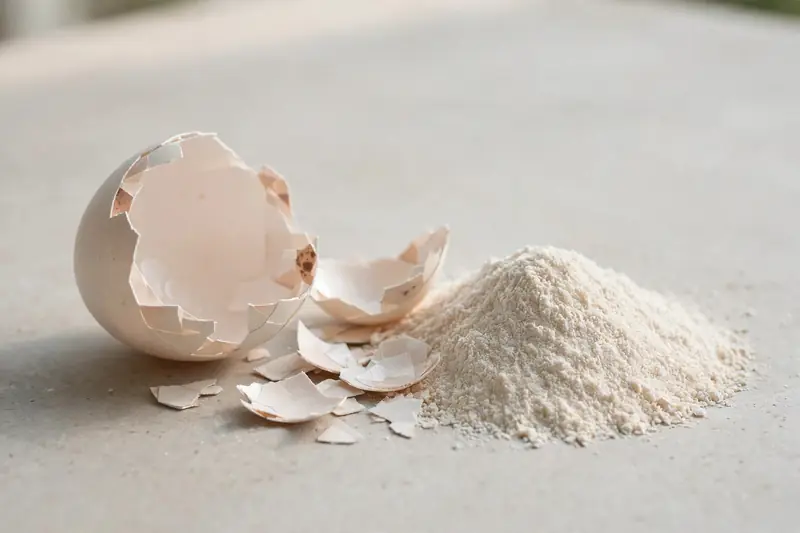
Shells are thin and brittle, which is what makes the fragments hazardous. A dog crunching a shell can cut its gums and tongue, scratch its throat, or irritate its esophagus. Bigger pieces can lodge in the throat of a small dog or a fast eater, and pieces that reach the stomach can irritate the lining or, rarely, cause a blockage.
Watch for drooling, pawing at the mouth, gagging, repeated vomiting, blood in vomit, belly pain, or a sudden loss of appetite after a dog gets into shells. Small bits often pass without trouble, but any of those symptoms means calling the vet. This is the same reason cooked bones are dangerous: cooked bones can splinter and injure the gut in much the same way shell fragments can.
How much eggshell powder can a dog have?
Start from your vet’s advice, since the right amount depends on what your dog already eats. A commonly used guideline for adult dogs on homemade diets is roughly 1/4 teaspoon daily for small dogs, 1/2 teaspoon for medium dogs, and 1 teaspoon for large dogs, mixed into food. Dogs on complete commercial food usually need none at all.
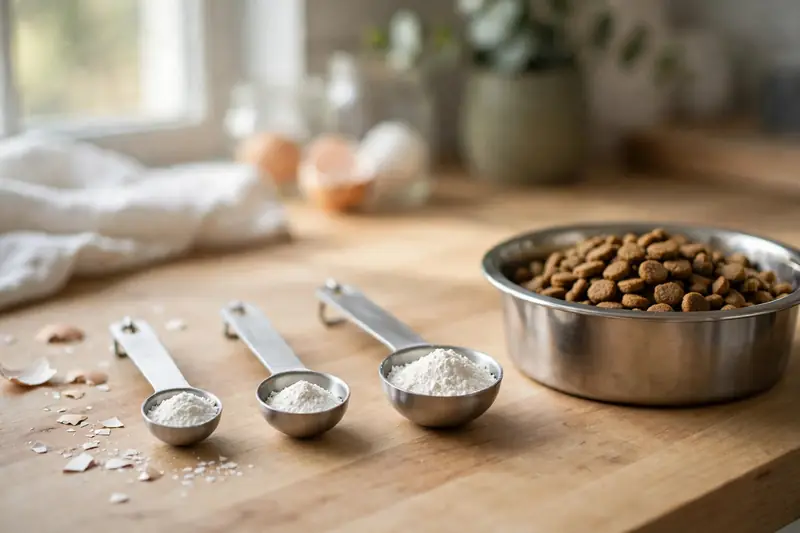
Here is that guideline laid out by size, as a starting point for adult dogs whose vet has approved supplementation:
| Dog’s weight | Eggshell powder per day |
|---|---|
| Under 20 lb | About 1/4 teaspoon |
| 20 to 50 lb | About 1/2 teaspoon |
| Over 50 lb | About 1 teaspoon |
Remember how concentrated this powder is: one teaspoon carries roughly 1,800 mg of calcium carbonate, so even the large-dog amount is a real mineral dose. That is why measuring spoons are not optional, and “a sprinkle” is not a measurement.
Mix the powder into the food instead of serving it on top. Some dogs dislike the chalky texture, and stirring it through wet food hides it well. If your dog eats a complete commercial diet, the honest amount is zero. Adding calcium to an already balanced diet does not improve it. And if you cook for your dog, get the recipe checked: homemade dog food recipes need proper formulation, because guessing at minerals is how imbalances start.
Eggshell powder versus commercial calcium supplements
Eggshell powder is cheap and free of additives, but every batch varies and measuring it precisely at home is hard. Commercial calcium supplements carry exact doses on the label, and products like bone meal add phosphorus as well. If your vet wants a precise daily amount, a labeled supplement is the more reliable choice.

The case for eggshell powder is simple: it costs nothing, has no fillers, and the raw material is already in your kitchen. For a healthy adult dog on a homemade diet, with a vet-signed amount, it does the job.
The case for commercial supplements is precision. A calcium carbonate tablet or a vet-formulated mineral mix states exactly how much calcium each dose contains, and bone meal brings phosphorus along too, which helps the mineral ratio. If you buy a commercial product, pick one made for dogs or approved by your vet. Some human calcium products contain xylitol, which is toxic to dogs, so never assume a human supplement is interchangeable.
Puppies, senior dogs, and pregnant or nursing dogs
Growing puppies, especially large breeds, should not get extra calcium on top of a complete puppy food, because excess calcium can disrupt normal skeletal development. Senior dogs rarely need it either. Pregnant and nursing dogs do need more calcium, but the amount must come from your vet, since both too much and too little cause problems.

Puppies are the group where extra calcium does the most harm. Complete puppy food is already balanced for growth, and large and giant breeds are sensitive to mineral excess while their skeletons form. Too much calcium at this stage is linked to developmental bone disorders such as osteochondrosis, and the Merck Veterinary Manual notes that supplementing beyond a complete growth diet is rarely necessary and may be contraindicated.
Senior dogs are simpler: their calcium needs do not rise with age, and declining kidney function makes balance trickier. Pregnant and nursing dogs do need more calcium, especially while nursing, but the amount and timing must come from a vet. Mismanaged calcium around whelping can cause eclampsia, a dangerous drop in blood calcium.
Raw shells versus baked shells
Baked shells win on safety. Raw shells can carry salmonella on the surface, and the AKC advises cooking eggs fully before feeding them to dogs. Baking at 300°F (150°C) for about 10 minutes kills the bacteria that rinsing cannot reach. Boiling the shells for 10 minutes works as a backup method.

Salmonella is the main concern with raw shells. The bacteria can sit on the shell surface, and sometimes it is inside the egg before the shell even forms. Dogs can develop salmonellosis from contaminated eggs, and handling raw eggs exposes the owner too.
The AKC advises cooking eggs fully and serving them plain; read AKC’s guide to eggs for dogs for the details. Raw whites bring a second problem: avidin, a protein that blocks biotin absorption. Our guide to cooked eggs are safe for dogs covers serving rules, and the piece on the risks of raw eggs for dogs goes deeper. Pasteurized eggs lower the risk, but baking the shells remains the reliable step.
Signs your dog is getting too much calcium
Too much calcium can cause constipation, vomiting, loss of appetite, and unusual thirst or urination. Over time, excess calcium contributes to bladder stones and interferes with how the body absorbs other minerals. Growing large-breed puppies face the highest risk, since excess calcium can damage developing bones and joints.

The early signs look like ordinary stomach trouble: straining to pass stool, occasional vomiting, a duller appetite, unusual tiredness, or drinking and urinating more than usual. None of these proves a calcium problem alone, but alongside a daily scoop of shell powder they point one way.
Longer term, excess calcium is linked to calcium oxalate bladder stones and can block absorption of zinc and iron. Dogs with kidney disease in dogs need particular caution, since failing kidneys already struggle with minerals. The Merck Veterinary Manual on calcium disorders in dogs explains how these imbalances develop. If you suspect excess, stop the powder and call your vet with the amount, frequency, and duration.
When to ask your vet before feeding eggshells
Ask your vet before adding eggshell powder if your dog eats a complete commercial diet, has kidney disease or a history of bladder stones, is a growing large-breed puppy, is pregnant or nursing, or takes a prescription diet. Bring your dog’s weight, current food, and the amount you plan to give so the vet can do the math.

Come prepared and the conversation is short. Tell the vet exactly what your dog eats each day, including treats and table scraps, plus the dog’s weight and health conditions. Ask two questions: does my dog need extra calcium, and if so, how much per day in plain measurements. Write the answer down.
If the vet says the diet is already complete, believe it. Many owners add supplements to balanced food with good intentions and create the imbalance they wanted to prevent. Prescription diets are the strictest case: they are formulated for a medical condition, and anything added can work against the treatment. For homemade diets, a board-certified veterinary nutritionist can write a full formulation.
Frequently asked questions
Are boiled eggshells safe for dogs?
Yes. Boiling the shells for about 10 minutes kills salmonella just as baking does. Let them dry completely, then grind them into a fine powder the same way. Boiled shells sometimes grind a little more easily because the heat softens them slightly, but the powder still needs to be fully fine with no flakes.
How should I store eggshell powder, and how long does it keep?
Keep it in an airtight jar in a cool, dry spot, away from the stove and the sink. Properly stored powder stays good for about two months. If it picks up moisture and clumps, or develops any off smell, throw it out and make a fresh batch. A small jar made often beats a big jar stored too long.
My dog ate a piece of eggshell off the floor. What should I do?
Small bits of shell usually pass through without trouble, so do not panic. Watch your dog for the next day or two for gagging, repeated vomiting, drooling, straining, loss of appetite, lethargy, or blood in vomit or stool. If any of those appear, call your vet. Do not try to make your dog vomit sharp fragments at home.
Can I give my dog eggshell powder every day?
Only if your vet has tied it to your dog’s diet. Daily calcium on top of an already complete food builds up over time and can cause constipation, mineral imbalances, and bladder stones. Think of eggshell powder as a prescribed supplement for a specific dietary gap, not as a daily health tonic.
Is the eggshell membrane good for dogs?
The membrane is sold as a joint-support ingredient in processed pet supplements, but those products are concentrated and standardized, which is very different from the thin film inside a kitchen eggshell. There is no solid reason to feed shells for the membrane. Feed shells for calcium, with vet guidance, or not at all.
Can puppies have eggshell powder?
Not on top of a complete puppy food. Growing puppies, and large breeds in particular, can suffer skeletal harm from excess calcium. The only scenario where a puppy gets eggshell powder is a homemade growth diet formulated by a veterinary nutritionist, with the amount calculated for that specific recipe.
Eggshells are safe for dogs only as a baked, finely ground powder in small measured amounts, and only when the diet needs the calcium. Most dogs on complete commercial food need none. When the diet does need it, usually a homemade one, your vet sets the amount. See our guide to human foods that are safe for dogs for what else from your kitchen is fair game.
*Disclaimer: This article is for general information only and is not veterinary advice. Every dog is different, and dogs with health conditions, puppies, and nursing dogs may need different guidance. If you are unsure, or if your dog shows symptoms after eating eggshells, contact your veterinarian.*