

Yes, dogs can eat peanut butter, and most of them love it. It is a useful training treat, a pill-hider, and a Kong-stuffer par excellence. But peanut butter has one non-negotiable rule that makes it different from every other treat on this site: the jar must be xylitol-free. Xylitol, a common sweetener in sugar-free products, is lethally toxic to dogs, and it hides on labels under several names. Get the label right and the portion right, and peanut butter is a fine occasional treat. This guide shows you how.
The xylitol rule: read this first
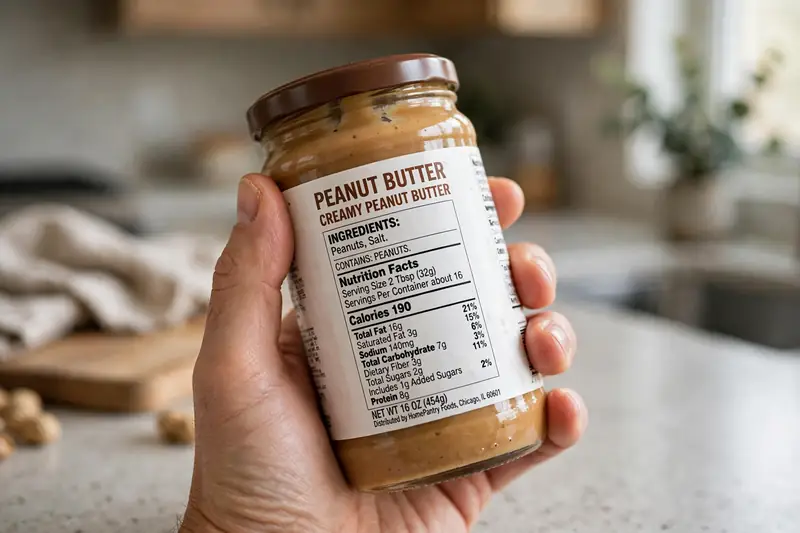
Xylitol (also sold as “birch sugar,” “wood sugar,” or “birch bark extract”) is a sugar substitute used in sugar-free gum, candy, baked goods, toothpaste, and some peanut butters. In humans it is harmless. In dogs it triggers a rapid, massive release of insulin, crashing blood sugar within 10 to 60 minutes. Signs of xylitol poisoning include vomiting, weakness, collapse, difficulty walking, and seizures, followed, in severe cases, by liver failure. The FDA and the AKC both treat it as an emergency: even small amounts can be life-threatening.
Here is what to do, concretely:
- Read the ingredient list on every jar, including brands you have bought before, because recipes change. Look for xylitol, birch sugar, wood sugar, or birch bark extract.
- Avoid “sugar-free,” “diet,” “light,” and “reduced sugar” peanut butters unless you have verified the full ingredient list. Regular peanut butter is usually the safer pick.
- “Natural” on the front means nothing for xylitol purposes. Flip the jar over.
- If your dog eats xylitol: do not wait for symptoms. Call your vet, an emergency clinic, or animal poison control immediately. Note the product name and roughly how much was eaten.
This is the single most important paragraph on this page. Everything below assumes a xylitol-free jar.
What to look for on the label
The ideal peanut butter for dogs has a very short ingredient list: peanuts, and maybe salt. That is it. Dry-roasted, unsalted peanuts are the gold standard; a small amount of salt in regular peanut butter is not a crisis, but unsalted is better, especially for small dogs.
Beyond xylitol, skip jars with: chocolate or cocoa (toxic), added sugars and corn syrup (empty calories), palm oil (unnecessary fat), and preservatives like BHA/BHT where avoidable. Honey-roasted and flavored varieties add sugar you do not need. Some owners make their own peanut butter, just peanuts in a food processor, which gives full control over salt and oil content. Pet-specific peanut butters exist too; they cost more but remove the label anxiety entirely.
Creamy vs crunchy: both are fine. Crunchy is not a choking hazard for normal dogs, though very tiny or very young puppies do better with creamy.
Nutritional benefits, honestly stated
Peanut butter is not empty calories. Per the AKC’s peanut guidance, peanuts are loaded with protein, vitamin B6, vitamin E, and niacin, plus healthy unsaturated fats. As an occasional treat, those nutrients are a genuine plus, protein supports muscle maintenance, vitamin E acts as an antioxidant, and the fats help with fat-soluble vitamin absorption.
Keep perspective, though: the amounts in a teaspoon of peanut butter are small. Nobody should think of peanut butter as a health food for dogs. Its real value is behavioral, it is high-value, long-lasting, and endlessly useful for training, enrichment, and medication. The nutrition is a bonus, not the reason.
The fat and calorie problem

Here is the other side of the jar. Peanut butter is calorie-dense, roughly 95-100 calories per tablespoon, and high in fat. That creates two problems:
Weight gain. Treats should stay within 10% of daily calories. For a small dog, a single tablespoon of peanut butter can blow the entire day’s treat budget. Fat dogs face joint pain, heart strain, and shorter lives; the treat that trains them should not be the treat that fattens them.
Pancreatitis. The AKC warns that high-fat foods eaten regularly or in large quantities can trigger pancreatitis, a painful, potentially fatal inflammation of the pancreas. Dogs with a history of pancreatitis, or breeds prone to it, should get peanut butter only with explicit veterinary approval, if at all.
The fix is portion discipline, covered in detail below. Peanut butter is a sometimes food, measured in teaspoons and tablespoons, never a free-pour.
How much peanut butter is safe

Use the 10% treat rule as the ceiling, then go smaller, peanut butter is rich enough that “less is more” is the right instinct:
- Small dogs (under ~10 lbs): half a teaspoon, 2-3 times a week.
- Medium dogs (~10-30 lbs): one teaspoon, every other day at most.
- Large dogs (~30-60 lbs): one tablespoon, once a day at most.
- Giant breeds (60+ lbs): up to two tablespoons, once a day at most.
These are maximums, not targets. Start smaller the first time and watch for soft stools or stomach upset, rich foods announce themselves quickly. If your dog has a sensitive stomach, smear rather than scoop: a thin layer on a lick mat delivers the joy at a fraction of the calories.
Serving ideas that work
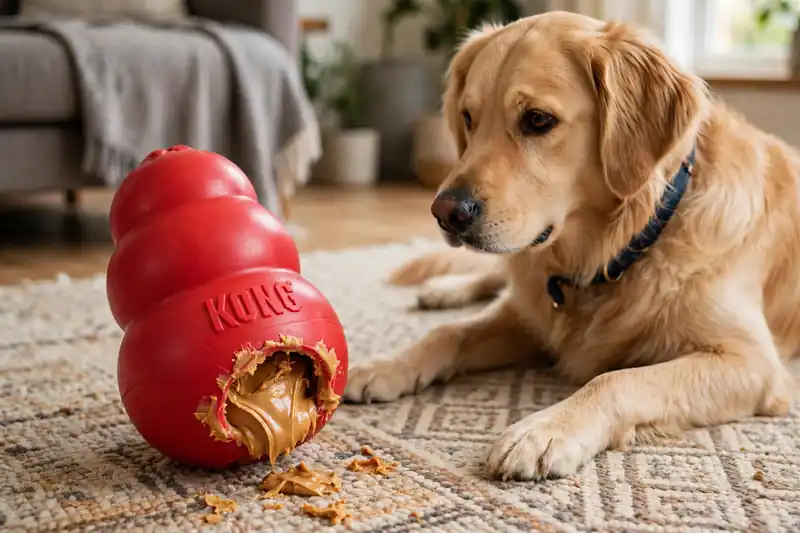
Peanut butter’s superpower is duration, it takes dogs time to work through it. Use that:
- Kong stuffing: the classic. Smear inside, add a few kibbles, freeze for an hour, it becomes a 20-minute project. (Confirm your Kong is the right size; the wrong size is a jaw-stuck hazard, not a peanut butter problem.)
- Lick mats: thin smear, optionally frozen. Slower eating, calmer dog.
- Pill pockets: a pea-sized dab hides most pills better than commercial pill pockets.
- Training rewards: a fingertip dab for high-value recalls. Reserve it for the big wins so it stays special.
- Frozen treats: blend xylitol-free peanut butter with plain yogurt or banana, freeze in molds, a summer enrichment snack.
Avoid giving it by the spoonful straight from the jar as a routine; that is how portions creep. Measure it, serve it with a purpose, and put the jar away.
Homemade peanut butter for dogs
The surest way to control the jar is to make it. Homemade peanut butter takes five minutes and one ingredient:
- Buy dry-roasted, unsalted peanuts (check they are just peanuts, no flavor coatings).
- Blend in a food processor for 3-5 minutes, scraping down the sides, until it goes from crumbs to a ball to smooth butter. The peanuts’ own oils do the work; add nothing.
- Store in a sealed jar in the fridge for up to a month.
The result is automatically xylitol-free, salt-controlled, and additive-free, and usually cheaper than premium “natural” brands. The texture will be a little grittier than commercial smooth, which dogs do not mind in the slightest. One caution: homemade has no preservatives, so the fridge life is shorter, make small batches. And the same portion rules apply; “homemade” does not mean “unlimited.”
Allergies and sensitivities
Dr. Jerry Klein, the AKC’s chief veterinary officer, puts it plainly: “Peanut butter is fine for most dogs in small amounts. But watch for signs of allergies like itching or ear infections.” Peanut allergies in dogs are uncommon but real.
Introduce peanut butter with a tiny amount first. Watch for itching, paw chewing, ear redness, vomiting, or loose stools over the next day. Dogs with known food allergies should clear any new treat with the vet first. And remember the label rule compounds here: a dog reacting to a new jar might be reacting to an additive, not the peanuts, which is one more reason to keep the ingredient list short.
Making it last: the enrichment angle
Peanut butter’s real gift is duration, and duration is enrichment. A dog working a frozen Kong for twenty minutes is a dog not barking at the window, chewing the sofa, or rehearsing anxiety. To maximize the project:
- Layer it: smear, kibble, smear, freeze. Layers take longer than a single blob.
- Freeze everything: a frozen Kong lasts 3-4x longer than room temperature.
- Use lick mats for calm: licking releases calming endorphins; a peanut butter lick mat before a thunderstorm or vet visit takes the edge off.
- Rotate the vehicle: Kong one day, Toppl the next, a silicone muffin tray frozen the day after. Novelty extends engagement.
For shelter dogs and new rescues adjusting to a home, these long-duration food puzzles are among the highest-value tools available, and peanut butter is the classic medium. Just keep the daily total inside the portion guide above.
Puppies and peanut butter
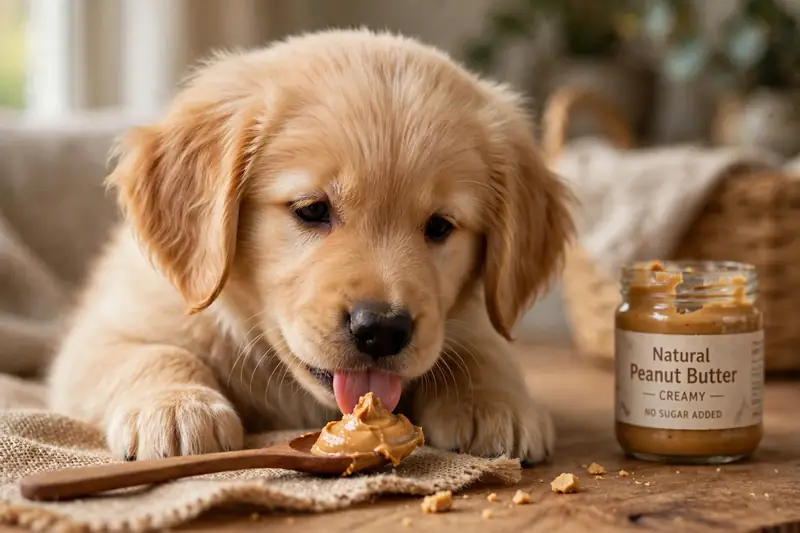
Puppies can have peanut butter once weaned (around 6 weeks and up), with the same rules tightened: xylitol-free, tiny amounts, creamy rather than crunchy for the smallest mouths. It is genuinely useful for crate training and early enrichment, a frozen Kong with a peanut butter smear can turn crate time from protest into project.
Keep puppy portions minimal: a quarter-teaspoon is plenty for a small pup. Their growth diet is precisely formulated, and treats dilute it. And supervise: puppies explore with their mouths, and a Kong given unsupervised to a determined chewer can become a swallowed-plastic problem.
If your dog eats the wrong peanut butter
Two scenarios:
Xylitol-containing: emergency. Do not wait for symptoms, they can start within 20 minutes. Call your vet or emergency clinic immediately with the product name and estimated amount eaten. Time matters enormously with xylitol; early treatment (IV dextrose, monitoring) saves lives.
Too much regular peanut butter: uncomfortable but rarely an emergency. Expect possible vomiting, diarrhoea, or abdominal discomfort from the fat load. Withhold food for 12 hours, offer small sips of water, and watch. Call your vet if vomiting repeats, if there is abdominal pain or bloating, or if your dog has a pancreatitis history, a big fatty meal in a susceptible dog warrants professional judgment.
The honest summary: peanut butter is one of the most useful treats in the dog owner’s toolkit, high-value, versatile, and loved by nearly every dog. Its safety hinges on two things: a xylitol-free label and a measured portion. Nail those, and it earns its place. Get either wrong, and it does not.
For the same plain-only, small-portion thinking across the foods dogs meet most often, see our wider guide to what human food dogs can eat. For another snack-time favorite that pairs with peanut butter, see our celery guide, and for a sweet treat alternative, our honey guide.
Frequently Asked Questions
How do I know if peanut butter has xylitol?
Read the full ingredient list, look for xylitol, birch sugar, wood sugar, or birch bark extract. Avoid “sugar-free” and “diet” varieties unless verified. When in doubt, choose a jar whose only ingredient is peanuts, or buy a pet-specific peanut butter.
Can dogs eat crunchy peanut butter?
Yes. Crunchy peanut butter is safe for normal dogs, the small peanut pieces are not a choking hazard. For very tiny puppies, creamy is the gentler choice.
Is peanut butter good for dogs every day?
It can be, in tiny measured amounts for larger dogs, but most dogs do better with it as a few-times-a-week treat. The calories add up fast; daily use demands strict portion control inside the 10% treat allowance.
What should I do if my dog ate xylitol peanut butter?
Treat it as an emergency: call your vet or emergency clinic immediately, even if your dog looks fine. Note the product name and how much was eaten. Do not wait for symptoms, early treatment is critical.
Can puppies have peanut butter?
Yes, once weaned, xylitol-free, in tiny amounts (a quarter-teaspoon for small pups), preferably creamy. It is excellent for crate training and enrichment. Always supervise with toys like Kongs.
Does peanut butter help hide pills?
Very well, a pea-sized dab of xylitol-free peanut butter conceals most pills, and dogs rarely notice. It is one of the most reliable pill-administration tricks owners have.
Are there alternatives if my dog is allergic to peanuts?
Yes, xylitol-free almond butter or cashew butter in the same small portions, or non-nut options like plain pumpkin puree or banana for Kong stuffing. Introduce any new food gradually and watch for reactions.
Can dogs eat peanut butter with honey?
In small amounts, yes, if both are xylitol-free and plain. Honey adds sugar without benefit, so it is an occasional flavor twist, not an upgrade. Check both labels; “honey roasted” peanut butter usually means added sugars you do not need.
This article is general information only and is not a substitute for veterinary advice. If your dog has a health condition, is on a prescription diet, or you are unsure about any food, check with your veterinarian first.
10 thoughts on “Can Dogs Eat Peanut Butter? The Xylitol Rule & Safe Serving”