On April 20, 2018, OC Raw Dog announced two voluntary recalls on the same day. One covered roughly 1,560 pounds of Chicken, Fish and Produce raw frozen food after a state agriculture lab found Listeria monocytogenes. The other covered freeze dried sardines that measured longer than an FDA size guideline, with no contamination found in the product at all. Those two events, plus two salmonella recalls in 2015 and a 2022 FDA warning letter, make up the entire verified OC Raw dog food recall history. No new OC Raw recall appears in the FDA database through the latest check.
Search interest for this keyword keeps climbing, which usually means a fresh recall or old news circulating as if it were fresh. With OC Raw, the evidence points to the second: a widely shared recent “breaking news” article describes lot 1819 with a use-by date of 05/05/16. That is the 2015 recall, repackaged. This guide separates the verified record from the recycled headlines and shows how to check your bag in two minutes.
Has OC Raw dog food ever been recalled?
OC Raw Dog has four verified recalls on record: two in 2015 for potential salmonella, and two in April 2018, one for potential listeria and one for oversized sardines. A 2022 FDA warning letter followed a facility inspection, which is an enforcement action, not a recall. Every one of these events is closed, and the FDA lists the 2018 recalls as completed and terminated.
All four involved raw or minimally processed products, all were triggered by state or federal lab testing rather than sick dogs, and none reported any illness in dogs, cats, or people. That does not make them trivial. Salmonella and listeria in raw pet food threaten the people who handle the food as much as the dogs who eat it, because the bacteria transfer from hands, bowls, and countertops. The FDA’s animal and veterinary recalls page keeps the official record for this brand and every other, and it is the only source that settles arguments about what really happened.
April 2018: the Chicken, Fish and Produce recall (lot 3652)
OC Raw Dog recalled about 1,560 pounds of Chicken, Fish and Produce Raw Frozen Canine Formulation on April 20, 2018, after the New Jersey Department of Food and Agriculture found Listeria monocytogenes in a sample. The affected product was manufactured on 10/11/2017, carried lot number 3652, and had a use-by date of 10/11/18. No illnesses in dogs, cats, or people were reported in connection with this product.

The distribution list tells you how a regional raw brand moves product. Lot 3652 shipped to independent specialty retailers in seven states: California (356 lbs), Colorado (153 lbs), Florida (195 lbs), Maryland (320 lbs), Minnesota (429 lbs), Pennsylvania (78 lbs), and Vermont (30 lbs). Minnesota received the largest share, a reminder that recall geography rarely matches where a company sits: OC Raw is based in Rancho Santa Margarita, California.
Two testing details from the company announcement deserve attention. The same lab that found listeria also tested the 3-pound Meaty Rox bag from that lot for salmonella, and that test came back negative. And the company stated that all of its subsequent samples returned negative for listeria. The FDA notice for the lot 3652 recall now carries the status every manufacturer wants to see: recall completed, FDA terminated.
The same-day sardine recall that confused everyone
On that same April day, OC Raw Dog issued a second, stranger recall: its Freeze Dried Sardines, in 3.2-ounce bags with UPC 095225853043, because the fish measured 6 to 6.5 inches long. The FDA compliance guideline caps un-eviscerated salt-cured, dried, or fermented fish at 5 inches, because larger whole fish carry a higher botulism risk. The sardines never tested positive for Clostridium botulinum, and a salmonella test also came back negative.

The Minnesota Department of Food and Agriculture collected the sample that started it. Their finding was purely dimensional: whole, un-gutted fish longer than the guideline allows. The FDA’s logic comes from botulism outbreaks linked to oversized un-eviscerated fish between 1981 and 1987 and again in 1991: the spores live in the fish gut, and a larger fish cures unevenly inside.
This recall confuses people because it looks like a contamination event and was not one: no toxin was found, and the product was pulled on a technical measurement. It still counts in the brand’s recall history, and searchers deserve the full picture rather than a scary headline. The FDA notice for the sardine recall shows the same closed status as the other.
The 2015 salmonella recalls: lots 1819 and 1511
OC Raw Dog’s earliest verified recalls both date to 2015 and both involved potential salmonella. In September 2015, the company recalled Chicken, Fish and Produce Raw Frozen Canine Formulations packed as Doggie Dozen Patties, Doggie Sliders, and Meaty Rox, lot 1819, with a best-by date of May 5, 2016. Distribution was limited to Colorado, Vermont, and Pennsylvania. In May 2015, the company recalled Turkey and Produce Raw Frozen Canine Formulations packed as Doggie Dozen Patties and bulk bags, lot 1511, with a best-by date of October 8, 2015. No illnesses were reported in connection with either 2015 recall.

These two recalls matter now mainly because one of them keeps coming back from the dead. The recent article that drove the spike in “oc raw dog food recall” searches describes lot 1819, the Colorado/Vermont/Pennsylvania distribution, and the May 2016 use-by date. Every detail matches the September 2015 announcement. Recycled recall news is a known pattern in pet food: an old announcement gets a fresh publish date, social media does the rest, and owners panic over food that left shelves a decade ago.
The 2022 FDA warning letter, explained
In February 2022, the FDA sent OC Raw Dog a warning letter following an inspection of its Corona, California facility conducted from April to May 2021. The inspection followed a Class I recall of a lot that tested positive for both salmonella and Listeria monocytogenes, and it found violations of the FDA’s preventive-controls requirements for animal food. A warning letter is an enforcement action, not a recall, though it often follows one.

Inspectors document violations on a Form FDA 483, the company responds, and if the agency finds the response inadequate, it issues the public letter with a deadline to correct the problems or face further action. The public version of the OC Raw letter redacts the product name, lot number, and dates of the triggering recall, which limits what an owner can do with it. You cannot check your freezer against a redacted lot number, but the full warning letter remains public for anyone who wants the details.
Is there a new OC Raw recall right now?
As of the latest check, no. The FDA’s recall database shows no new OC Raw Dog entry this year, and independent recall trackers that audit the FDA’s notices monthly list no OC Raw item. Those trackers do name other raw brands with recent actions (Raaw Energy, Albright’s, Oma’s Pride, Northwest Naturals), which makes the absence more meaningful. The rising search interest appears to be driven by the recycled 2015 story, not by a new event.
One honest limit: a recall announced only on a company’s own site, or one still working through the FDA’s pipeline, might not appear in those sources yet. The honest way to handle that gap is a routine, not a one-time search. The section below gives you a two-minute check you can repeat whenever a headline worries you, and subscribe to the FDA’s email alerts so new announcements reach you directly.
What to do if your bag matches a recalled lot
Stop feeding the product immediately, even if your dog looks fine. Dogs can carry salmonella without symptoms and shed it in their stool, which puts everyone in the household at risk. Keep the bag, because the lot number, use-by date, and UPC are your proof for a refund and your evidence if your dog gets sick. Do not throw the packaging away until the situation is fully resolved.

Return the unused portion to the place of purchase for a refund, or dispose of it where children, pets, and wildlife cannot reach it. Then clean: wash your hands, scrub the bowl, and sanitize any freezer shelf, countertop, or scoop that touched the food. Raw-food bacteria survive freezing and spread through contact, so the cleanup matters as much as the disposal. Watch your dog for vomiting, diarrhea, loss of appetite, or unusual tiredness over the next several days, and call your vet promptly if any of those appear. If you want the incident on the official record, file a report through the FDA’s Safety Reporting Portal for pet food complaints. Your report helps regulators spot patterns across brands.
How to check any dog food recall in two minutes
Open the FDA’s animal and veterinary recalls page and search the brand name. Read the newest entries first; old recalls dominate search results. Match three things against your bag: the exact product name, the lot number, and the best-by or use-by date. A recall only applies to the listed lots. The same product with a different lot code is not recalled.
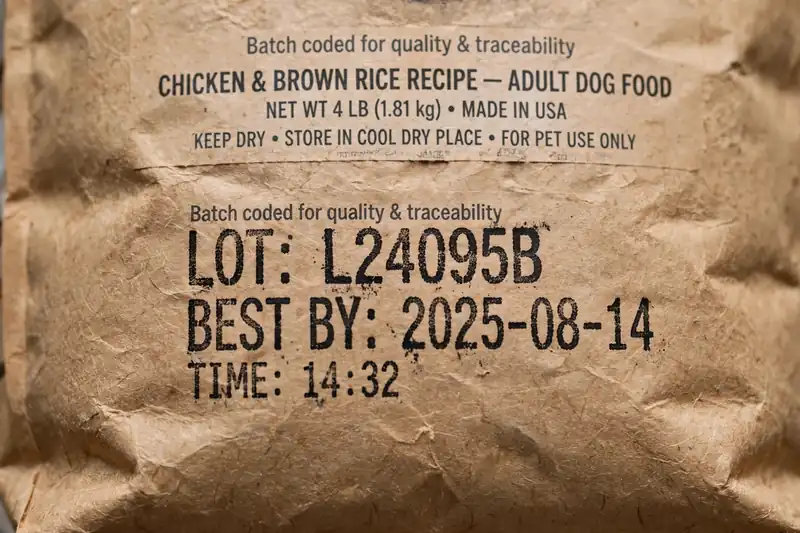
Photograph the lot code of every new bag the day you open it. Ink-jetted codes smudge, bags get tossed, and a photo takes five seconds. If a recall drops six months later, you will have a time-stamped record instead of a memory. For broader context on how recalls work across brands, the FDA dog food recall guide on this site walks through the process, and the brand-specific histories for Purina, Nulo, Pedigree, Raaw Energy, and frozen chicken dog food recalls cover the other names that come up most often in searches.
Why raw frozen food gets recalled more often
Raw pet food has no kill step. Kibble and canned food pass through heat that destroys salmonella, listeria, and E. coli; raw food goes from ingredient to package with the bacteria still viable. That single fact explains why the FDA’s recall lists skew so heavily toward raw, frozen, and freeze-dried products. Raw-food recalls trace back to bacterial contamination almost every time, with no kill step between the ingredient and the bag.

The veterinary establishment’s position is blunt. The American Veterinary Medical Association discourages feeding dogs any animal-source protein that has not been treated to eliminate pathogens, citing risk to both animals and people. The AKC’s guide to raw, fresh, and kibble diets notes that frozen raw dog foods have been recalled for E. coli and salmonella, and advises owners who feed raw to stay current on recall information for their brands. Raw feeding is a deliberate choice many owners make, but the recall history of OC Raw, with all four events tied to pathogen testing, fits the industry pattern rather than standing out from it.
Feeding raw more safely: handling habits that matter
Handle raw dog food the way you handle raw chicken for your own dinner. Wash your hands with soap for 20 seconds after touching it, and use separate cutting boards and utensils from the ones you use for human food. Thaw frozen portions in the refrigerator, never on the counter, and serve them promptly. Discard any raw food your dog leaves uneaten after 30 minutes, and never save it for the next meal.

The AKC’s food poisoning guide for dogs adds the household side of the routine: store raw food according to the manufacturer’s directions, keep it away from ready-to-eat human food in the freezer, and stay informed about recalls for your brand. Puppies, senior dogs, and dogs with weakened immune systems face higher risk from contaminated raw food, as do the humans in the house. Young children and immunocompromised people should not handle raw pet food at all.
Frequently asked questions about OC Raw dog food recalls
The answers below stick to the verified record.
Should I throw away all my OC Raw food?
Recalls apply only to the specific lots named in the announcements. Check your bag’s lot number and use-by date against the four verified recalls above. Food from other lots was never implicated.
Has any dog gotten sick from OC Raw’s recalled food?
No illnesses in dogs, cats, or people were reported in connection with any of the four recalls, according to the company announcements posted by the FDA.
What does a Class I recall mean?
The FDA classifies recalls by risk. Class I means the agency considers the product likely to cause serious health consequences. It describes the hazard level, not the number of people or animals affected.
Does freezing kill salmonella or listeria?
Freezing preserves these bacteria; it does not destroy them. That is why frozen raw pet food carries the same pathogen risk as fresh raw meat.
Is OC Raw still selling dog food?
The company continues to operate. All four recalls are historical, completed events, and the FDA marks the 2018 recalls as terminated.
How do I get FDA recall alerts automatically?
Use the FDA’s recalls and safety alerts page to subscribe to email updates. You will hear about new announcements the day they post, without relying on social media.
The verified record is short: two 2015 salmonella recalls, two April 2018 recalls, and a 2022 warning letter, all closed. Check your bag’s lot code, photograph every new bag when you open it, and subscribe to the FDA’s alerts.
Disclaimer: This article is for general information only and is not veterinary advice. Recall information changes over time, so verify the current status on the FDA’s official recall pages before making decisions about your dog’s food. If your dog shows symptoms after eating a recalled product, contact your veterinarian promptly.