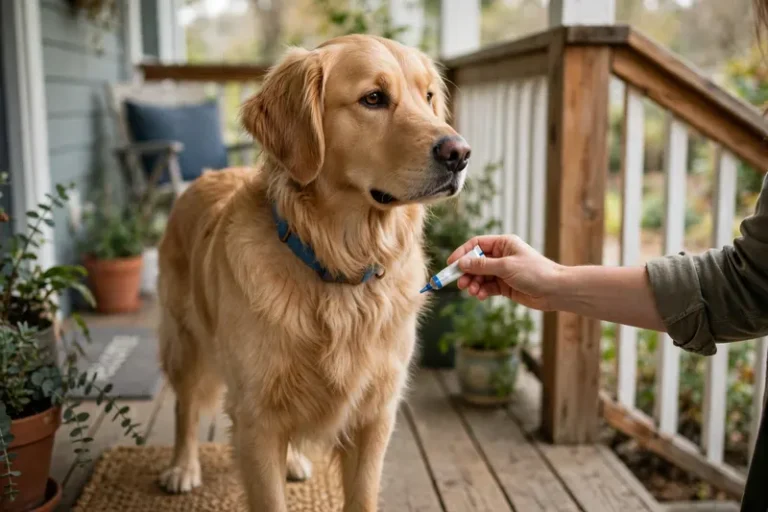
Dogs see blue and yellow clearly, plus shades of gray, brown, and white, but red and green look gray or brown to them. Dogs see some colors and miss others. They have two types of color detecting cones in the eye, while people have three, so their world is narrower in color but sharper in low light and motion.
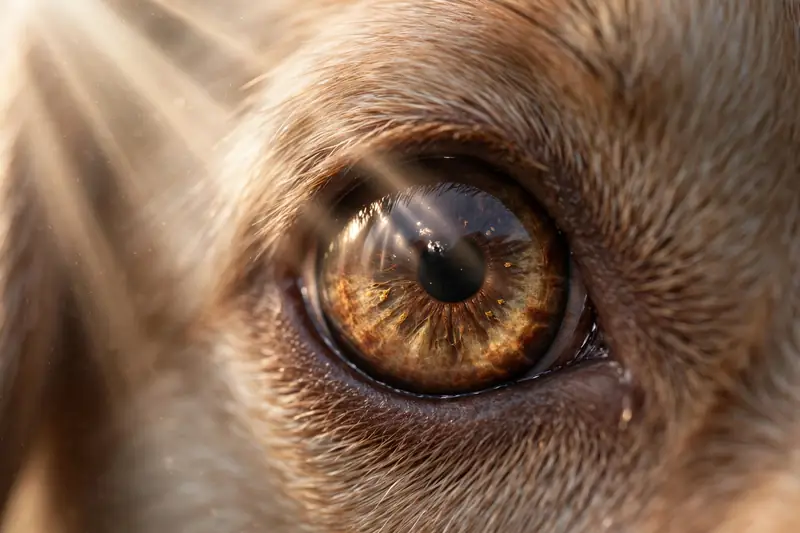
What colors can dogs see? The short answer
Dogs can see blue, yellow, and combinations of those colors, along with grays, browns, black, and white. They cannot tell red from green, and both look like shades of gray or brown. Purple looks blue to a dog, orange looks brownish yellow, and pink looks like a muted beige.
The reason is the retina, the light sensitive layer at the back of the eye. People have three types of cones, the cells that detect color, while dogs have two. That difference is called dichromatic vision, and it is normal for dogs. Dogs trade color range for better night vision and better motion detection, and for a hunter that trade is a good one.
The black and white myth
The idea that dogs see only in black and white is false, and it has been false for a long time. The myth spread from early assumptions about animal vision, and it stuck because it is simple and easy to picture.
The American Kennel Club states it plainly: the popular notion that dogs only see in black and white is false.
The turning point came in 1989, when vision scientists Jay Neitz, Timothy Geist, and Gerald H. Jacobs ran controlled behavioral experiments with dogs and showed that dogs have working color sensing cone cells and can tell certain wavelengths apart. Dogs chose colors over brightness in the tests, which proved they were seeing the color itself, not just a lighter or darker shade.
Russian researchers confirmed it with a simple test. They put four pieces of paper, light yellow, dark yellow, light blue, and dark blue, on feed boxes, with meat only in the box under the dark yellow paper. Most dogs went straight for the yellow paper most of the time, showing they had learned the color, not the brightness. The myth should have died then, but it still shows up in conversation today.
Dichromatic vision: two cones, not three
Dogs are dichromatic, which means they have two types of cones in the retina. People are trichromatic, with three types. Each cone type registers a different light wavelength, and the red and green cone is the one dogs are missing. That is why their color vision looks like red green color blindness in people.
Cones are only half the story. The retina also holds rods, the cells that detect light and motion, and dogs have more rods than people do. More rods means better vision in dim light and faster motion detection, and fewer cones means a narrower color range. The eye is built for dawn and dusk hunting, not for admiring a sunset.
Dogs have only about 20 percent as many cones as people, so colors also look less bright to them. A blue ball looks blue, though softer and less vivid than the blue a person sees. The world is a softer, duller version of ours, with blue and yellow standing out most. The Merck Veterinary Manual guide to eye structure in dogs explains the rods and cones and how they work together.

Blue and yellow: the colors dogs see best
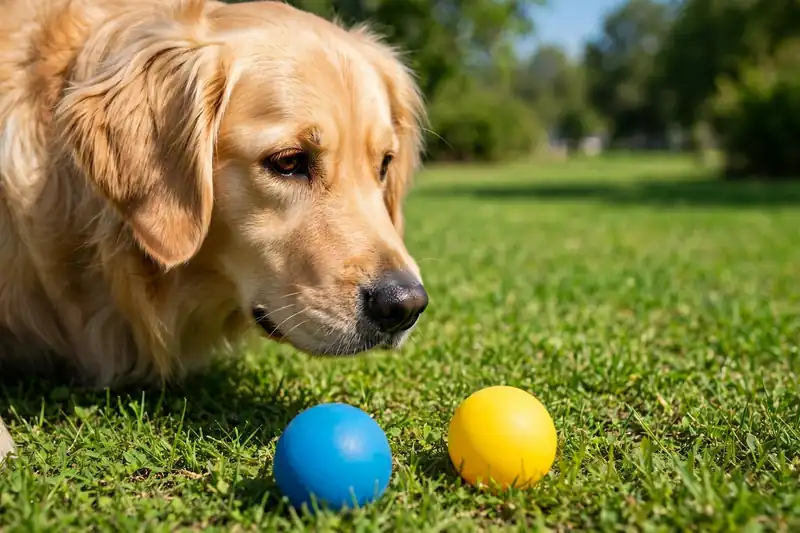
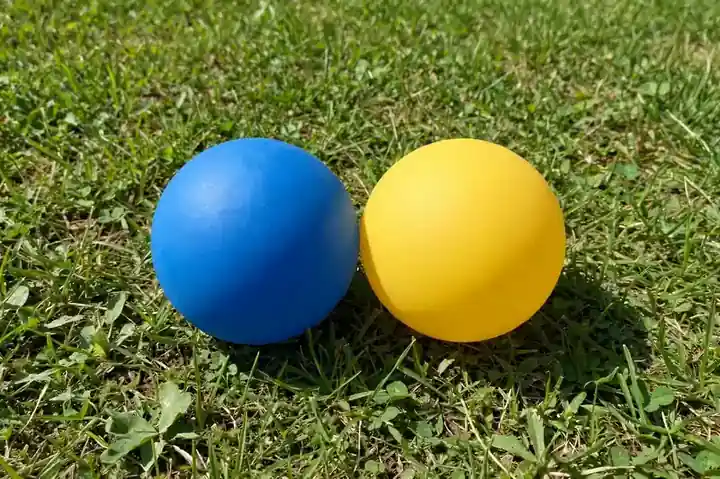
Blue and yellow are the colors dogs see best, because their two cone types are tuned to blue and yellow wavelengths. A blue toy on green grass stands out clearly to a dog, and a yellow toy on a gray floor is easy to find.
Those are the colors to buy when you want the dog to spot the toy fast.
Yellow is one of the colors dogs see most clearly, alongside blue. Blue skies and blue objects stand out, and the dog can tell blue from yellow without trouble. That is why trainers and toy makers who know dog vision pick blue and yellow for training gear, agility equipment, and fetch toys. The dog sees the target, and the training goes faster.
Food colors follow the same rule. Blueberries are blue, bananas are yellow, and both stand out to a dog in a way a red strawberry does not. The dog finds the treat by smell anyway, but the color helps it spot the piece on the floor.
Red and green: what dogs miss
Red and green are the colors dogs miss. Without the red green cone, reds and greens look muted, and they often appear gray, brown, or yellowish. A red toy on green grass, which looks obvious to a person, can vanish into the background for a dog, because both the toy and the grass look like similar shades of brownish gray.
Orange is a mix of red and yellow, so it looks brownish yellow to a dog. Carrots and sweet potatoes both look that way, and a red apple looks dark gray brown rather than bright red. Pink is a lighter version of red, so it looks like a muted beige. Purple looks blue, because the blue in it is the part the dog can see. Dogs also struggle to tell shades of the same color apart, like light blue from dark blue, because they have fewer cones to split the difference.
The most popular colors for dog toys today are red and orange, which are the hardest colors for dogs to see. That is a human choice, not a dog choice, and it is why a dog sometimes runs past a bright red ball lying in plain sight. The ball sits in plain sight in a color the dog cannot pick out from the grass.

What the world looks like to a dog
The world looks grayish brown to a dog, with blue and yellow patches standing out. Grass looks yellowish brown rather than vivid green. A red rose looks dark brownish gray. A pumpkin looks brownish yellow, not bright orange.
A blue sky looks blue, and a yellow tennis ball looks yellow, but both look softer and less bright than they do to a person.
Dogs also see less detail than people. Their visual acuity is estimated at about 20/75, which means a dog sees at 20 feet what a person with normal vision sees at 75 feet. A dog cannot read a sign across the street, but it can spot a moving rabbit at the same distance without trouble. Detail matters less than movement for a dog.
The Dog Vision website offers a tool that shows photos as a dog sees them, and the difference is striking. The green lawn turns brownish, the red flowers turn gray, and the blue and yellow objects stay clear. Looking at your own garden through that tool is the fastest way to understand the dog’s view.

Night vision and motion: where dogs beat us
Dogs beat people at night vision and motion detection, and the same eye that limits their color range gives them those strengths. Dogs have more rods in the retina, a larger lens and corneal surface, and a reflective layer called the tapetum that bounces light back through the retina.
That tapetum is what makes a dog’s eyes shine green in a photo flash.
The tapetum and the extra rods let dogs see in light far dimmer than people need. A dog can move through a dark room that a person would stumble through, and it can spot movement at the edge of vision that a person would miss. A 2017 study found dogs can see clearly from farther away than humans when something is moving, which is part of why a fast low bounce catches a dog’s eye faster than a still bright toy.
Motion matters more than color for a dog, and that is why a dog chases a moving ball it cannot see well when it stops. The AKC guide to dogs seeing in the dark explains the tapetum and the night vision advantage in full, and the AKC guide to dog color vision covers the color side of the same eye.
Picking toys your dog can actually see
Pick blue and yellow toys, and your dog will find them faster. A blue ball on grass, a yellow rope on a gray floor, and a blue frisbee against the sky all stand out in the dog’s color range. Red and orange toys are the worst picks, because they blend into grass and dirt.
Contrast matters as much as color. A yellow toy on a yellow floor is hard to spot, even though the dog sees yellow well. A blue toy on a blue rug has the same problem. Pick a toy color that contrasts with the ground where the dog plays: blue for grass, yellow for a gray floor, and blue for sand.
Size and movement matter too. A large toy is easier to spot than a small one, and a toy that bounces or rolls is easier to track than a still one. A dog that loses a red ball in the grass looks slow or stubborn, yet it is searching for a color it cannot pick out from the background. Swap the ball for a blue one and the problem often disappears.

Color blindness in dogs: the rare exceptions
Nearly all dogs share the same dichromatic vision, and it is not a spectrum where some dogs see normally and others do not. True total color blindness, called achromatopsia or cone degeneration, is a separate and much rarer inherited condition, where the dog cannot see any color at all, only shades of gray and brown.
Achromatopsia is also called day blindness, because the dog sees worse in bright light, when cones do the work, and better in dim light, when rods take over. It is documented in certain breeds, including Alaskan Malamutes and German Shorthaired Pointers, according to the University of California Davis Veterinary Genetics Laboratory. A dog with the condition squints in sunlight and struggles in bright rooms.
Most dogs never need a vision test, but a dog that bumps into objects in daylight, refuses to go outside in sun, or cannot find a treat placed in front of it should see a vet. The Merck Veterinary Manual guide to nervous system disorders explains how vets test vision and tell eye problems from nerve problems.

How dogs use smell and hearing instead
Dogs do not need full color vision, because smell and hearing carry most of the information. A dog’s nose has up to 300 million scent receptors, against about 6 million in a person, and the part of the brain that processes smell is far larger. A dog finds a treat by smell long before it sees the color.
Hearing fills the rest. Dogs hear higher frequencies than people, and they can tell where a sound comes from with far more precision. A dog that cannot see a red ball still hears it bounce, smells the grass where it landed, and tracks the movement. Color is a small part of a dog’s world. The dog works with smell, hearing, and motion instead.
That is why a blind dog can live a full life in a familiar home. It maps the house by smell and sound, and it moves with confidence once the furniture stays put. A dog with normal dichromatic vision has even more to work with, and it uses all of it at once.

Frequently asked questions about what colors dogs see
Are dogs colorblind?
Dogs see blue and yellow clearly, though they cannot tell red from green. Their vision is similar to a person with red green color blindness, and it is normal for their species.
Can dogs see red?
No, not as red. A red object looks dark brownish gray or even black to a dog. Red toys are hard for dogs to spot, especially on green grass, where both look like similar shades of gray brown.
What color do dogs see best?
Blue and yellow are the colors dogs see best. Their two cone types are tuned to blue and yellow wavelengths, so those colors stand out most clearly against other backgrounds.
Can dogs see in the dark?
Yes, dogs see far better than people in dim light. They have more rods in the retina and a reflective tapetum layer that bounces light back through the eye, which is why their eyes shine in photos.
Do dogs see in black and white?
The black and white idea is a myth. Dogs see blue, yellow, gray, brown, black, and white, and the world looks muted and grayish brown to them, not black and white.
What color toys should I buy my dog?
Buy blue and yellow toys, and pick a color that contrasts with the ground where the dog plays. Blue works on grass, yellow works on a gray floor, and both beat red and orange every time.
Dogs see a narrower world than we do, and a richer one in the ways that matter to them. Blue and yellow stand out, red and green fade to gray, and the night belongs to them. Buy the blue ball, throw it where the dog can track it, and let smell and hearing do the rest. The dog never needed the full rainbow, and it never missed it.
Disclaimer: This article is for general information only and is not veterinary advice. If your dog bumps into objects, squints in bright light, or seems to lose vision, contact your veterinarian.