
The American Kennel Club answers “can dogs drink milk” with a single word: maybe. A few tablespoons of cow’s milk or goat’s milk, on an occasional basis, is a safe treat for most dogs. A whole bowl in one sitting is a different story. Most adult dogs are lactose intolerant to some degree, and dairy products are a leading source of food intolerance in dogs.

The confusion around milk comes from puppyhood. Every puppy starts life drinking milk, so owners assume milk stays appropriate forever. It does not. The enzyme that lets puppies digest milk fades after weaning, and the adult dog that laps up a bowl of milk is running on nostalgia and fat cravings, not digestive equipment. This guide covers the lactase science, the exact portions that stay safe, the puppy rules that are non-negotiable, and the drinks that serve your dog better than milk.
Can dogs drink milk?
Dogs can drink milk in small amounts as an occasional treat, provided they tolerate dairy. The AKC puts the safe quantity at a few tablespoons of cow’s milk or goat’s milk, given occasionally. Larger amounts commonly cause diarrhea, vomiting, and loose stools, even in dogs without diagnosed intolerance. Milk is never a dietary staple for a dog; it is a treat with a low ceiling.

The key variable is the individual dog. Some dogs keep enough lactase into adulthood to handle a splash of milk without incident. Others react to a few licks with gas and loose stool within hours. There is no breed test and no reliable predictor; the only way to know is a careful trial, which the portions section below describes step by step. If your dog shows any digestive upset after milk, the answer for that dog is no, and the question does not need revisiting. For the full picture of what dogs can drink, see our guide to what dogs can drink besides water, and for the gentlest dairy option, our lactose-free milk for dogs guide.
The lactase story: why puppies manage milk and adults don’t
Puppies are born producing large amounts of lactase, the enzyme that breaks lactose, the sugar in milk, into glucose and galactose for absorption. Lactase exists for one job: digesting mother’s milk during the nursing weeks. After weaning, when milk leaves the diet, lactase production drops sharply in most dogs. The adult dog’s gut simply stops manufacturing the tool it needs for the job.

Undigested lactose travels through the intestines drawing water with it, and gut bacteria ferment it, producing gas. The result is the classic intolerance picture: bloating, cramping, flatulence, and diarrhea, usually starting within a few hours of drinking milk. The severity tracks both the dose and the individual dog’s remaining lactase. A tablespoon might pass unnoticed while a bowl causes a disaster, which is why portion discipline matters more than the yes-or-no verdict. PetMD notes that lactose intolerance is extremely common in dogs, and the variation between individuals explains why one owner’s “my dog drinks milk every day, fine” anecdote proves nothing about your dog.
How to tell if your dog is lactose intolerant
Watch the hours after a small milk trial. Gas, loose stools, diarrhea, vomiting, stomach gurgling, or visible abdominal discomfort within 2 to 12 hours point to intolerance. The symptoms are dose-dependent: a little milk may cause mild gas while a lot causes frank diarrhea. If symptoms appear, stop offering dairy and do not repeat the experiment.

Two confusions need clearing up. First, a large volume of milk can cause vomiting and diarrhea even in dogs that are not lactose intolerant, according to the AKC, so a bad reaction to a full bowl does not by itself prove intolerance. The trial has to be small to be informative. Second, intolerance is not allergy. Lactose intolerance is a digestive shortfall with gastrointestinal symptoms. A true dairy allergy is an immune reaction, and PetMD lists its signs as itchy or red skin, skin infections, hair loss, and excessive licking or chewing of the feet. Allergy is rarer, more serious, and a vet conversation; intolerance is common and managed by simply skipping dairy.
Cow’s milk vs goat’s milk vs lactose-free milk
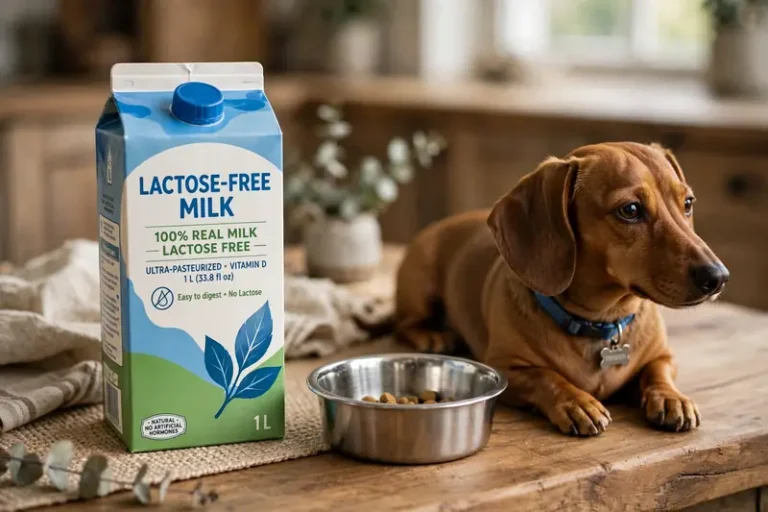
Cow’s milk carries the most lactose of the common options, around 11 to 12 grams per cup, and causes the most trouble. Goat’s milk contains less lactose and has smaller fat globules, which is why many owners report their dogs tolerate it better. It still contains lactose, so “better tolerated” is not the same as safe for an intolerant dog. Lactose-free cow’s milk, with the lactase enzyme added during processing, is the safest milk option for dogs.

The hierarchy for an owner standing in the dairy aisle is straightforward. Lactose-free milk first, goat’s milk second, regular cow’s milk a distant third, and only in the small quantities the portions section allows. Dog-specific milk products sold in pet aisles are usually lactose-free formulations with added flavoring; they are fine as occasional treats but offer nothing nutritionally that water and a balanced diet do not. Skip flavored milks, chocolate milk, and anything sweetened. Chocolate is toxic to dogs, and sweeteners add risk without benefit. The ASPCA’s list of people foods to avoid is the reference to keep for the ingredients that turn a treat dangerous.
Puppies and cow’s milk: the hard no
Puppies under eight weeks should drink only their mother’s milk or a veterinarian-recommended puppy milk replacer. Cow’s milk is too low in protein and too high in lactose compared to dog’s milk, and feeding it to young puppies causes diarrhea, dehydration, and poor nutrition. Cow’s milk is never an acceptable substitute for mother’s milk or replacer, no matter how convenient.

The nutritional mismatch is stark. Dog’s milk is richer in protein and fat and lower in lactose than cow’s milk, built for fast-growing carnivore pups. Cow’s milk reverses that profile. A puppy fed cow’s milk gets the wrong building blocks at the fastest growth stage of its life, and the resulting diarrhea dehydrates a small body with frightening speed. If you find an orphaned puppy or a litter that cannot nurse, buy a commercial canine milk replacer and follow the package directions exactly, or better, call your vet for a feeding plan. Well-meaning owners reach for the cow’s milk because it is in the fridge. The fridge is the wrong pharmacy.
Exact portions if your dog tolerates milk
Start with a trial: one tablespoon of plain milk for a small dog, two for a medium or large dog, offered once. Wait 24 hours and watch for gas, loose stool, or discomfort. If the trial passes clean, the occasional treat ceiling is a few tablespoons, not a bowl, given no more than a few times per week. A few tablespoons occasionally is the whole allowance; there is no larger safe tier.

Scale the treat to the dog. A tablespoon is a meaningful treat for a 10-pound dog and a trivial one for an 80-pound dog, but the intolerance risk does not scale as neatly as body weight, so resist the urge to pour proportionally. Milk also counts against the treat budget: the VCA’s feeding guidelines cap all treats, milk included, at about 10 percent of daily calories. A few tablespoons of whole milk carry real calories and fat, and those add up fast in a small dog’s day. Whole, low-fat, or skim makes little difference to the lactose question; the enzyme shortfall is the same either way.
The costs nobody mentions: pancreatitis, calories, calcium
Milk’s risks go beyond lactose. Whole milk is a high-fat food, and high-fat foods can trigger pancreatitis, a painful and potentially serious inflammation of the pancreas. PetMD’s dairy guidance makes the same point about ice cream: the fat load, not just the lactose, is the hazard. A small dog that laps up a fatty bowl of milk is taking in a significant fraction of its daily fat in one sitting. Fat is the quieter danger in the milk bowl.

Then there is calcium, the nutrient milk is famous for. Adding milk to a balanced commercial diet throws off mineral ratios the food was formulated to maintain. For most adult dogs the effect of an occasional splash is trivial. For large-breed puppies, it is not: excess calcium during rapid growth can push bones to grow too fast, leading to permanent joint and skeletal deformities in breeds like Great Danes and Mastiffs. Growing large-breed puppies should get their nutrition from a properly formulated large-breed puppy food and nothing else. The calories deserve a final note. Milk is energy-dense, dogs do not need the energy, and overweight dogs should skip milk entirely. An obese dog gains nothing from a treat that is mostly fat and sugar water.
Safer dairy options: kefir and plain yogurt
Fermentation changes the dairy equation. Kefir and plain yogurt contain live cultures that digest much of the lactose during fermentation, leaving a product many intolerant dogs handle better than milk. Plain yogurt also delivers probiotics that support gut health. A spoonful of plain kefir or unsweetened plain yogurt is a safer dairy treat than any amount of milk.

The rules still apply: plain, unsweetened, no xylitol, no chocolate, no added fruit syrups. Xylitol, also labeled birch sugar, is extremely toxic to dogs, and it hides in “sugar-free” yogurts. Read the ingredient panel every time, because formulations change. Start with a teaspoon-sized trial as with milk, and keep the portion at treat scale. Our kefir for dogs guide covers the details. Cheese follows the same logic: most hard cheeses are relatively low in lactose, which is why some dogs handle a small cube of cheddar while milk sends them running for the door. The fat content still counts, so keep cheese rare and tiny.
Your dog already drank a bowl: what to do now
Do not panic. A healthy adult dog that drank a bowl of milk will most likely develop gas, soft stool, or diarrhea within a few hours, and it will pass. Withhold food for a few hours if the stomach is actively upset, keep fresh water available, and watch. Call your vet if vomiting repeats, diarrhea lasts more than a day, the dog refuses water, or you see blood in the stool.

Puppies, seniors, and dogs with chronic conditions deserve a lower threshold for calling. A young puppy that drank cow’s milk can dehydrate faster than an adult, and a dog with a history of pancreatitis should not wait out a fatty insult. Note what was in the bowl: plain milk is a digestive upset; chocolate milk, flavored milk, or anything sweetened with xylitol is a potential emergency, and the vet needs to know which one it was. Save the carton or photograph the label. When in doubt, the call costs nothing and buys certainty, which is the cheapest insurance in dog ownership.
Better things to pour than milk
Water remains the only drink a dog needs, at roughly 1 ounce per pound of body weight per day. Beyond water, the useful options are plain bone broth with no onion, garlic, or added salt, which tempts picky drinkers and softens kibble; unsweetened coconut water in small amounts as an occasional treat; and unflavored Pedialyte diluted half-and-half with water, but only with your vet’s approval for a mildly dehydrated dog. Every one of these beats milk for an intolerant dog, and water beats all of them.

The drinks to skip tell their own story. Fruit juice brings sugar without fiber; soda brings sugar, caffeine, or xylitol; sports drinks like Gatorade bring sodium loads designed for sweating humans; almond and soy milks bring little nutrition and occasional additives. Alcohol and anything caffeinated are never acceptable, and xylitol-sweetened drinks are emergencies. Our beverage cluster covers each one: coconut water for dogs, Gatorade for dogs, Pedialyte for dogs, and tea for dogs. PetMD’s ice cream guide is also worth reading, since it covers the same lactose-plus-fat trap in frozen form.
Frequently asked questions about dogs and milk
The answers below assume an adult dog with no diagnosed dairy allergy.
Is milk toxic to dogs?
Milk is a gastrointestinal irritant for most adult dogs rather than a toxin like chocolate or grapes, and the reaction ranges from mild gas to significant diarrhea depending on the dog and the dose.
Can puppies drink cow’s milk?
Puppies need mother’s milk or a vet-recommended milk replacer. Cow’s milk causes diarrhea, dehydration, and poor nutrition in young puppies.
Is goat’s milk better than cow’s milk for dogs?
Goat’s milk has less lactose and is often better tolerated, but it still contains lactose. Lactose-free milk is the safer choice for an intolerant dog.
Can dogs drink chocolate milk?
Chocolate contains theobromine, which is toxic to dogs. Chocolate milk combines that danger with the usual lactose problem.
How soon do lactose intolerance symptoms appear?
Usually within 2 to 12 hours of drinking milk. Gas and soft stool come first; vomiting and frank diarrhea follow with larger amounts.
My dog drinks milk daily with no problems. Should I stop?
If your dog tolerates it without symptoms and stays at a healthy weight, a small daily splash is unlikely to cause harm. But milk adds nothing the diet needs, so water remains the better daily drink.
Can dogs drink milk? A few tablespoons, occasionally, for a dog that tolerates it, and never for puppies. The enzyme fades, the bowl does not get safer with habit, and water plus a balanced diet covers everything milk promises. Pour the milk on your own cereal and keep the dog’s bowl to water.
Disclaimer: This article is for general information only and is not veterinary advice. Every dog’s tolerance differs, and puppies, nursing dogs, and dogs with health conditions need veterinary guidance. If your dog shows symptoms after drinking milk, contact your veterinarian.


4 thoughts on “Can Dogs Drink Milk? Lactose Science, Portions, and Puppy Rules”