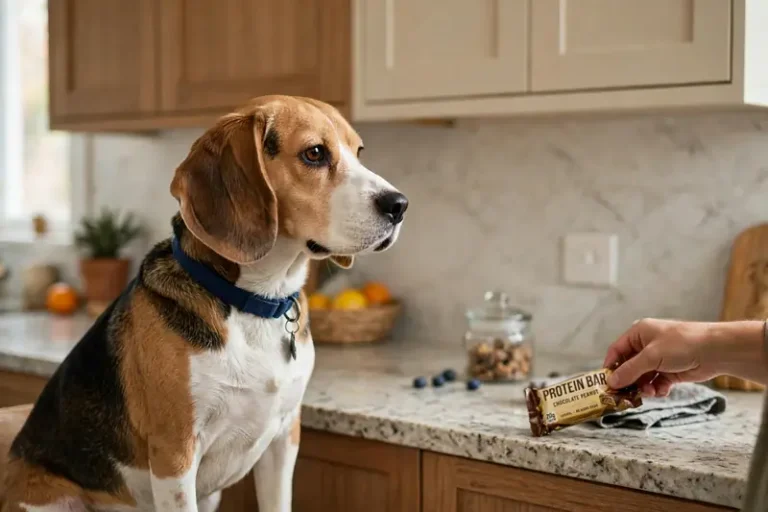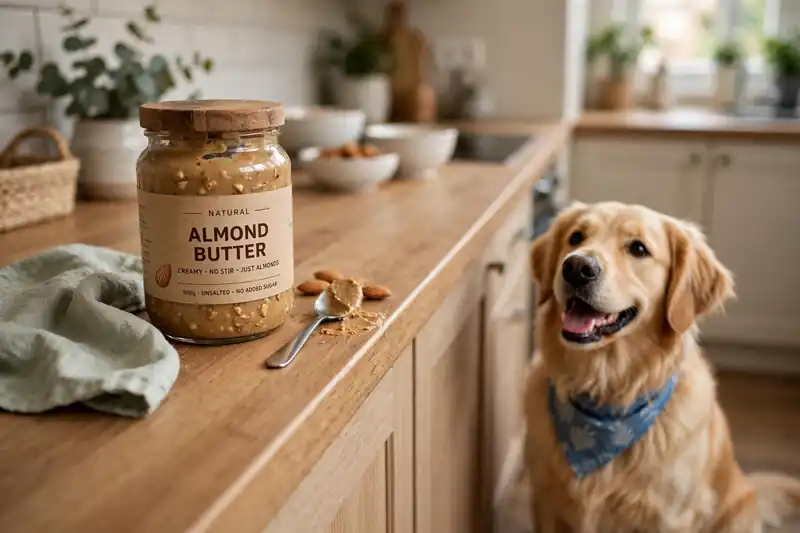
Can dogs have almond butter? Yes, but only a very specific kind, in very small amounts, and only after you have read the label like a detective. Plain, unsalted, unsweetened almond butter with no xylitol is not toxic to dogs. But many jars on the shelf contain the one ingredient that turns this question into an emergency: xylitol, a sweetener that can kill a dog. Add the high fat content, and almond butter becomes a treat with a narrow safe lane. This guide walks that lane exactly, the label check first, then portions, then the dogs who should skip it.
Is almond butter safe for dogs?
Yes, with strict conditions. Almond butter is safe for dogs only when it is plain, unsalted, unsweetened, and completely free of xylitol, given in tiny amounts as an occasional treat. Many commercial jars fail this test, so the label decides everything. When the jar is clean and the portion is small, a lick is fine.
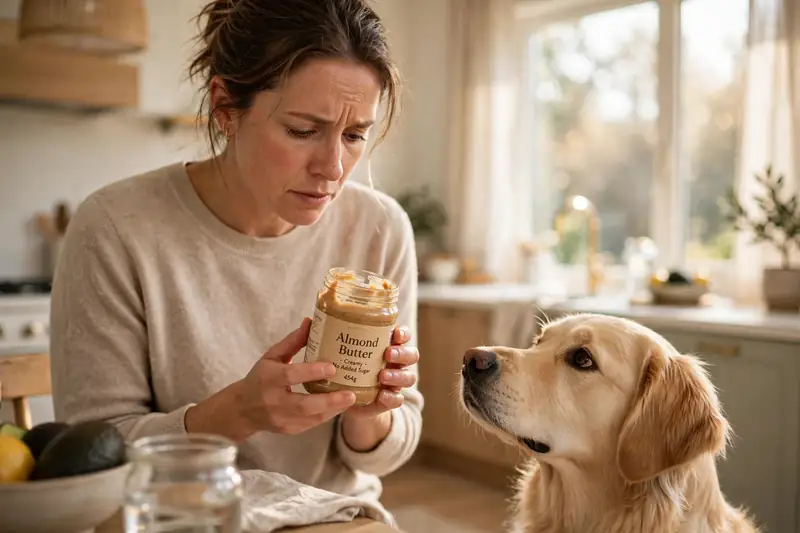
The nut itself is not the problem. Almonds are not poisonous to dogs the way macadamia nuts are, and a butter made from nothing but almonds carries no toxin. The problems arrive through the jar: sweeteners, salt, chocolate flavoring, and above all xylitol. Then there is the fat. At roughly 100 calories per tablespoon, almond butter is one of the most calorie-dense things in a typical kitchen, and that shapes every portion decision. Think of almond butter as a flavoring rather than a food. A smear, a lick, a pill coating. Dogs do not need it, and more is never better. The rest of this guide shows how to keep it in that narrow safe lane.
The xylitol emergency: read this first
Xylitol is a sweetener that is harmless to humans but can kill dogs. It triggers a massive insulin release that crashes blood sugar within 10 to 60 minutes and can cause liver failure. Even small amounts are life-threatening, especially for small dogs. If your dog eats anything with xylitol, call your vet or poison control immediately.

In dogs, xylitol causes the pancreas to release insulin far out of proportion to any actual sugar in the blood. Blood sugar plummets. The dog may vomit, grow weak, collapse, have difficulty walking, tremble, or seize. Liver failure can follow hours later, even in dogs that seemed to recover from the initial crash. That is why waiting to see what happens is the most dangerous response. The only safe move is immediate professional help: your veterinarian, an emergency clinic, or an animal poison control line. When you call, have the product name and your best estimate of how much was eaten. Xylitol turns up in some nut butters, sugar-free gums, candies, and baked goods, so the jar in your pantry deserves the same suspicion as the gum in your bag.
Every name xylitol hides behind
Xylitol rarely appears under its own name. The FDA notes it can be listed as wood sugar, birch sugar, or birch bark extract, and imported products may list it as E967. Words like natural or no artificial sweeteners on the front of the jar tell you nothing. You must scan the entire ingredient list on every jar, every time.

Birch sugar is the most common disguise, and it is a clever one, because xylitol is genuinely derived from birch. Wood sugar is the older traditional name. Birch bark extract sounds like a harmless botanical and acts like a poison. E967 is the European food-additive number, worth knowing if you buy imported products. Marketing language will not warn you: “natural,” “no artificial sweeteners,” and even “sweetened with birch” can all coexist with xylitol on the same label. Scan the whole list, not just the first few ingredients, because sweeteners can appear anywhere in it. And re-check every jar on every purchase. Manufacturers reformulate, store brands change suppliers, and the safe jar you bought last month is not guaranteed this month. This thirty-second habit is the single highest-value safety step in this entire guide. Beyond nut butter, watch sugar-free gum, “light” peanut butters, protein spreads, some baked goods, and certain medications and supplements. If it is sugar-free and made for humans, assume xylitol until the label proves otherwise.
How to read the label before you buy
A jar passes only if it has no xylitol or any of its aliases, no added sugars, no salt, no chocolate flavoring, and a short, honest ingredient list. The simplest safe choice is a single-ingredient almond butter, just almonds. When in doubt, plain xylitol-free peanut butter is the easier, better-studied pick.

Start at the ingredient list and work down it slowly. Unsweetened means no added sugars, honey, or syrups. Unsalted matters because dogs get all the sodium they need from their food. Chocolate-flavored nut butters are an automatic no, chocolate is toxic to dogs on its own. Long additive lists are a reason to choose another jar; every extra ingredient is another thing to verify. The safest choice is a natural almond butter with a single ingredient, or one of the nut butters made specifically for pets with dog-safe formulations. Single-ingredient jars cannot hide xylitol because there is nowhere to hide it. Price is not a safety signal in either direction. Expensive artisan jars and budget store brands both come in clean and contaminated versions. The ingredient list is the only judge.
Safe portions by dog size
Think teaspoon, not tablespoon. Small dogs under 20 pounds get a quarter to half a teaspoon, medium dogs from 20 to 50 pounds get half to one teaspoon, and large dogs over 50 pounds get one to two teaspoons, occasionally. No serving should pass a tablespoon, and almond butter should sit far below the 10 percent treat rule.

Those amounts look absurdly small next to the jar, and that is the point. At roughly 100 calories per tablespoon, even a modest spoonful is a serious calorie event for a small dog. Veterinary guidance converges on the teaspoon scale above, always as an occasional extra rather than a routine. You are using the flavor, not feeding the food. A smear on a toy, a lick from a fingertip, a coating on a pill. If you find yourself measuring in tablespoons, you have left the safe lane. And remember that nut butter is only one line in the day’s treat budget: all extras combined should stay within a tenth of daily calories, and almond butter should realistically sit far below that ceiling.
Why fat is the second problem
After xylitol, fat is the main concern. Almond butter is very rich, and too much can cause vomiting, diarrhea, and in sensitive dogs gastroenteritis or pancreatitis, a painful pancreatic inflammation that needs veterinary care. Dogs with any pancreatitis history should skip it entirely. Fat is also why this can never be a daily habit.

This is why “a little lick” and “a spoonful” are different risk categories. A lick is a taste. A spoonful is a fat load, and in a sensitive dog it can mean a night of vomiting and diarrhea, sometimes with bloody stool. Repeated or large fatty indulgences raise the risk of pancreatitis, which brings repeated vomiting, abdominal pain, and serious illness requiring veterinary treatment. The calories also add up silently. A daily spoonful quietly works against every weight goal, and weight gain brings its own chain of health problems, from joint stress to reduced lifespan. Dogs with any history of pancreatitis or chronic digestive trouble should not get almond butter at all. The risk is not worth a treat the dog does not need.
Smart ways to serve it
Almond butter works best as a delivery vehicle in tiny amounts. A thin smear inside a Kong, optionally frozen, a pea-sized coating to hide a pill, a fingertip lick as a rare training reward, or a thin frozen layer on a lick mat. Always supervise, and never leave a dog alone with the jar.

Used correctly, the stickiness is actually an asset. A thin smear inside a Kong, frozen for extra challenge, turns minutes of licking into real enrichment. A fingertip lick works as a rare high-value training jackpot. Spread thin and frozen on a lick mat, it becomes a calming activity on a stressful day. In every case, the amount is the point. And always supervise: a dog left alone with a jar is a dog that can eat the jar, lid and all, which turns a safe treat into an obstruction emergency.
Almond butter vs peanut butter
Plain xylitol-free peanut butter is usually the more practical choice. It is slightly lower in fat, far easier to find in simple formulations, and has a longer track record as a dog treat. It is even the AKC’s go-to example for nut-butter safety. Almond butter is fine in tiny amounts but offers no real advantage over it.

Owners often ask which spread wins. On nutrition, the differences are marginal and favor peanut butter slightly on fat. On availability, peanut butter wins clearly: single-ingredient jars sit on every supermarket shelf, while clean almond butter takes more hunting. On safety record, peanut butter has decades of use as a dog treat behind it. Whichever you choose, the rules are identical: xylitol-free, unsalted, unsweetened, tiny portions, occasional only. And never assume. Check the label on the peanut butter jar with the same care, because xylitol turns up in “light” and sugar-free peanut butters too.
Dogs who should skip almond butter entirely
Some dogs should get none at all. Dogs with pancreatitis or a history of it, overweight dogs or those on weight-loss plans, puppies under six months, dogs with nut sensitivities, dogs on prescription diets, and dogs with very sensitive stomachs. For them, a blueberry or a carrot coin is the better reward.
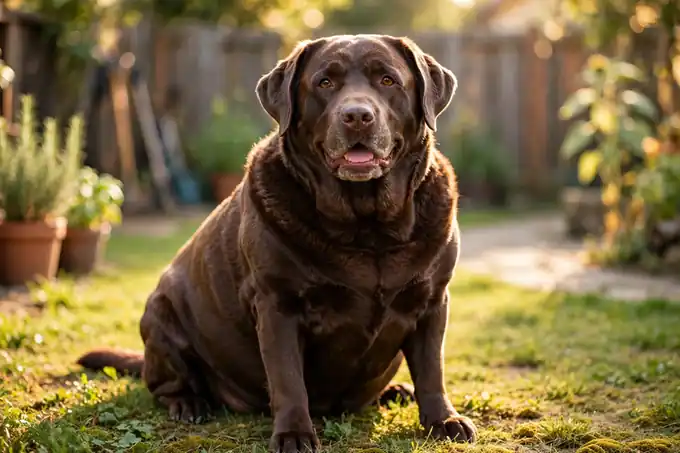
For a dog with pancreatitis, the fat risk is not worth any treat. For an overweight dog, 100 calories a tablespoon works directly against every goal. Puppies under six months have developing digestive systems that do not need rich extras. Dogs with nut sensitivities may show itching, ear inflammation, or digestive upset. Dogs on prescription diets eat precisely balanced food, and extras can undermine the therapy. Dogs with very sensitive stomachs can have a bad day from a single lick. None of these dogs are missing out. The best treat is the one that never causes a vet visit, and a blueberry, a carrot coin, or a piece of plain cooked chicken delivers the reward moment without the risk.
What to do if your dog ate almond butter
Check the jar first. If the ingredients are clean and the amount was small, offer water, skip the next treat, and watch for vomiting or diarrhea over the next day. If the jar contained xylitol, or you are not sure, treat it as an emergency and call your vet or poison control right away.

Mild stomach upset is the likely worst case from a small amount of clean almond butter. Offer water, keep the next meals plain, and monitor. Do not try to make the dog vomit unless your vet specifically instructs it. If the amount was large, watch for pancreatitis signs over the next day or two: repeated vomiting, abdominal pain shown as a hunched posture or reluctance to move, lethargy, or loss of appetite. All of those warrant a prompt vet visit. And if xylitol was in the jar, or the label is gone and you cannot verify, do not wait for symptoms. Call immediately, note the product name and how much was eaten, and follow professional instructions exactly. With xylitol, the clock matters more than anything else.
The honest summary: almond butter is a treat with a locked gate, and xylitol is the lock. Behind the gate, plain, unsalted, unsweetened, xylitol-free, in teaspoon-scale amounts, occasionally, it is a safe and even enjoyable extra. But the gate matters more than the treat. One wrong jar turns a lick into a life-threatening emergency. Read every label, measure tiny, and when in doubt choose the simpler, better-studied option or skip nut butters entirely. Your dog will be just as happy with a carrot.
For the same plain-only, small-portion thinking across the foods dogs meet most often, see our wider guide to what human food dogs can eat. And for another sweet treat that needs the same careful approach, our honey guide covers small-dose safety.
Frequently Asked Questions
How much almond butter can I give my dog?
Very little. Roughly a quarter teaspoon for small dogs, half to one teaspoon for medium dogs, and one to two teaspoons for large dogs, occasionally, never daily, and always xylitol-free.
What happens if almond butter has xylitol?
Xylitol can cause a rapid, dangerous drop in blood sugar within 10 to 60 minutes and potentially liver failure. It is an emergency. Call your vet or poison control immediately, without waiting for symptoms.
Is almond butter or peanut butter better for dogs?
Plain, xylitol-free peanut butter is usually the more practical choice: slightly lower in fat and more widely available in simple recipes. Both require the same label check and tiny portions.
Can puppies have almond butter?
Not recommended under six months. Puppies have sensitive developing digestive systems, and rich, fatty foods are more likely to cause trouble than joy at that age.
Can dogs eat whole almonds instead?
Whole almonds are a worse choice: harder to digest, a choking and obstruction risk, and just as fatty. If you want the almond flavor, the butter (xylitol-free, tiny amount) is the safer form.
What are signs of pancreatitis in dogs?
Repeated vomiting, abdominal pain (hunching, reluctance to move or be touched), lethargy, and loss of appetite after fatty foods. It needs veterinary care. Do not wait it out.
Does natural almond butter guarantee safety?
No. Natural does not rule out xylitol or its aliases (birch sugar, wood sugar). Only the full ingredient list tells the truth. Read it every time.
Can dogs have peanut butter instead of almond butter?
Yes. Plain, xylitol-free, unsalted peanut butter is usually the more practical choice. It is slightly lower in fat, easier to find in single-ingredient versions, and has a longer track record as a dog treat. The same rules apply: check every label for xylitol, keep portions tiny, and treat it as an occasional reward. Many owners keep a dedicated dog-safe jar to avoid mix-ups with the family’s sweetened peanut butter.
This article is general information only and is not a substitute for veterinary advice. If your dog has a health condition, is on a prescription diet, or you are unsure about any food, check with your veterinarian first.