

No. Dogs cannot eat onions, not raw, not cooked, not powdered, not in any amount you should ever offer deliberately. Onions are toxic to dogs in every form, and the danger is more serious than most owners realize: compounds in onions damage dogs’ red blood cells, which can lead to hemolytic anemia, a condition where the body destroys its own red blood cells faster than it can replace them. There is no safe preparation that neutralizes the toxin, no home remedy that reverses it, and symptoms are often delayed by one to three days, which lulls owners into a false sense of security. If your dog has eaten onions, do not wait for symptoms, call your veterinarian immediately. This article covers exactly why onions are dangerous, what poisoning looks like, what to do in an emergency, and where onions hide in foods you would never suspect.
The Toxin: How Onions Attack Red Blood Cells
Onions contain sulfur compounds, principally N-propyl disulfide (the AKC also identifies thiosulfate compounds), that are harmless to humans but toxic to dogs. When a dog eats onion, these compounds cause oxidative damage to red blood cells: they attack hemoglobin, the oxygen-carrying protein inside the cells, causing it to clump into structures called Heinz bodies. The damaged cells become fragile, and the dog’s own spleen and liver destroy them, the process behind hemolytic anemia.
The consequences cascade from there. Fewer red blood cells means less oxygen delivered to tissues. The dog becomes weak and lethargic. In severe cases, organ damage follows from oxygen deprivation, and the condition can be fatal without treatment.
Two facts make this worse than a simple stomach irritant. First, the damage is cumulative, small amounts eaten over several days can add up to a toxic dose. Second, dogs are more vulnerable than many species because their red blood cells are particularly susceptible to oxidative damage, and, unlike humans, dogs lack sufficient levels of the enzyme that would help neutralize these compounds.
Every Form Is Toxic. Including Cooked

This is the misconception that causes the most poisonings. Cooking does not destroy the toxic compounds in onions. Boiling, frying, baking, or slow-cooking an onion leaves its red-blood-cell-damaging compounds intact. Onion soup, caramelized onions on a burger, onions cooked into a stew, all toxic.
Every form and every part carries the risk:
- Raw onions, all varieties: yellow, white, red, sweet, spring onions, shallots.
- Cooked onions, frying, roasting, and boiling do not neutralize the toxin.
- Dehydrated and powdered onion, onion powder is more concentrated than fresh onion, so a small amount of powder can equal a large amount of fresh onion. This is the form behind many accidental poisonings from seasoned foods.
- Onion flakes, onion salt, and seasoning blends, check every label.
- The whole plant, leaves, juice, and even the papery skin contain the compounds.
There is no safe dose to aim for and no preparation trick. The only safe amount of onion for a dog is none.
Garlic, Leeks, Chives, and Shallots: The Whole Family Is Dangerous
Onions belong to the Allium family, and every member of it is toxic to dogs:
- Garlic is the most dangerous of all, estimated at roughly five times more toxic than onions, gram for gram. Even small amounts of garlic can cause poisoning, which is why garlic supplements marketed for pets are controversial among veterinarians.
- Leeks, shallots, scallions, and chives all contain the same class of sulfur compounds and carry the same risk.
- Wild alliums (wild garlic, ramps) are equally dangerous on hikes and in yards.
If you are onion-proofing your kitchen for your dog, proof it against the entire allium family at once.
How Much Onion Is Dangerous?
Toxicity depends on the dog’s size and the amount eaten, but the honest veterinary guidance is: do not try to calculate a “safe” amount, treat any ingestion as a reason to call your vet. Smaller dogs reach dangerous doses with smaller quantities, and as noted, the effect is cumulative over days.
Certain dogs are at higher risk:
- Japanese breeds. Akitas and Shiba Inus are documented as more susceptible to allium-induced red blood cell damage, likely due to a hereditary red blood cell trait.
- Dogs with pre-existing anemia or red blood cell disorders, they have less reserve to lose.
- Puppies and senior dogs, less physiological margin generally.
A single bite of onion off the floor is unlikely to cause a crisis in a large healthy dog, but it is still worth a call to your vet, because only your vet can assess the dose against your dog’s weight and history, and because the delayed symptoms mean “he seems fine” proves nothing in the first 24 hours.
Symptoms: What Onion Poisoning Looks Like (and When)
Symptoms are typically delayed 24 to 72 hours after ingestion, one of the most dangerous features of onion toxicity. Early gastrointestinal signs may appear within a day; the anemia signs follow as red blood cells are destroyed.
Early signs (hours to 1 day):
- Vomiting
- Diarrhea
- Abdominal pain
- Loss of appetite
- Excessive drooling
Anemia signs (1-3 days, the critical window):
- Lethargy and weakness, the most common presenting sign
- Pale gums (check by lifting the lip, healthy gums are pink)
- Rapid breathing or elevated heart rate
- Dark or reddish urine (from hemoglobin released by destroyed cells)
- Collapse or fainting in severe cases
Do not wait for the anemia signs to appear before acting. By the time gums are pale and urine is dark, significant red blood cell destruction has already occurred. The entire point of calling early is to act before this stage.
Emergency Steps: What to Do Right Now

If your dog has eaten onions, or food you suspect contained onion, take these steps immediately:
- Call your veterinarian now. Do not wait for symptoms. Tell them what was eaten, how much, and when, plus your dog’s weight. If your vet is unavailable, call an emergency animal hospital.
- Call a poison helpline if needed. The Pet Poison Helpline (855-764-7661) and the ASPCA Animal Poison Control Center (888-426-4435) are staffed by veterinary toxicologists around the clock. (Note: consultation fees may apply.)
- Do NOT induce vomiting unless your vet specifically tells you to. Vomiting is not always appropriate, it depends on timing, amount, and your dog’s condition. Incorrectly induced vomiting can cause aspiration or other harm.
- Bring the evidence. If the onion came from a packaged food, bring the package or a photo of the ingredient list, it helps the vet assess onion powder content and other hazards.
- Follow the vet’s plan. If ingestion was recent, the vet may induce vomiting under controlled conditions or administer activated charcoal. The dog will likely need blood work to monitor red blood cell counts over several days.
There is no home antidote. Activated charcoal, milk, or home remedies you read online do not reverse oxidative red blood cell damage. Veterinary treatment is supportive. IV fluids, oxygen therapy in severe cases, and blood transfusion when anemia is life-threatening, and it works best when started early.
Treatment and Recovery
There is no drug that undoes the red blood cell damage; treatment supports the dog while the body clears damaged cells and produces new ones. Depending on severity, this includes intravenous fluids, anti-nausea medication, oxygen supplementation, and in severe anemia, a blood transfusion. Most dogs that receive prompt veterinary care recover fully within days to weeks as new red blood cells are generated, but severe, untreated cases can be fatal, which is why the “wait and see” approach is the genuinely dangerous choice here.
Your vet will typically want to recheck blood work over several days even if the dog initially seems fine, because the red blood cell count can continue to fall after ingestion. Keep every follow-up appointment.
Where Onions Hide: Foods You Would Never Suspect

Direct onion feeding is rare, most poisonings come from foods where onion is an invisible ingredient:
- Baby food, many meat-based baby foods contain onion powder. Never use them as a dog food topper without reading the label.
- Broth, stock, and gravy, commercial versions almost always contain onion and garlic.
- Pizza, pasta sauce, and takeout leftovers, onion is a base ingredient in most savory sauces.
- Seasoning blends and rubs, onion powder is ubiquitous; check every label.
- Stuffing, meatloaf, meatballs, and casseroles, classic onion-containing dishes.
- “Natural flavors” on pet treat labels, can include allium derivatives; buy from transparent manufacturers.
- Chinese and other restaurant takeout, heavily seasoned, frequently with onion and garlic.
The defensive habit is simple: before sharing any human food with your dog, check the ingredient list for onion, garlic, and their powdered forms. When in doubt, do not share.
Prevention: Onion-Proofing Your Home
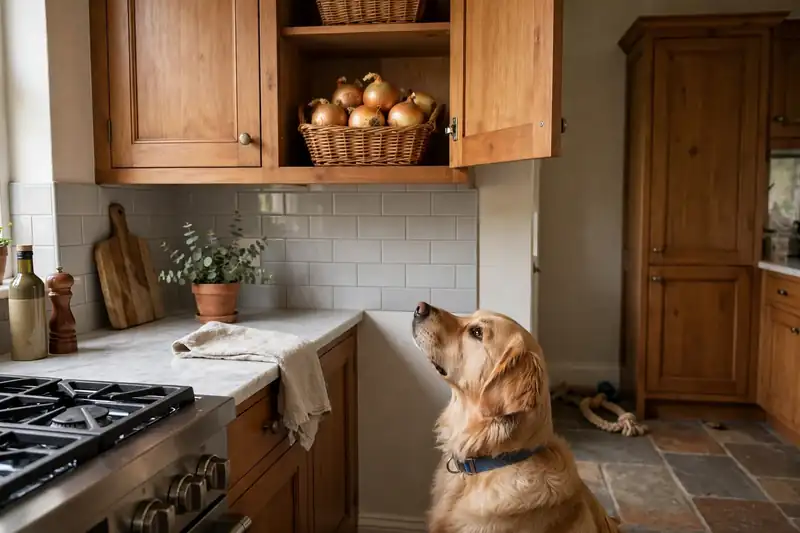
- Store onions where dogs cannot reach, not in low open bins or bags on the floor. Determined dogs will chew through a mesh bag of onions.
- Secure trash cans with locking lids; onion scraps and peels in the trash are a classic poisoning source.
- Clean up cooking scraps immediately, chopped onion that falls on the floor during meal prep is the number-one accidental exposure.
- Brief the whole household, including children and visitors: no sharing onion-containing food with the dog, ever.
- Check pet products too, some treats and “natural” supplements include garlic or onion flavoring.
Safe Alternatives to Onions in Your Dog’s Diet

If you like adding flavor or vegetables to your dog’s food, plenty of safe options exist, and the AKC itself suggests several as alternatives when discussing onion toxicity:
- Carrots, crunchy, sweet, low-calorie, and universally recommended. See our guide on whether dogs can eat carrots.
- Cucumbers, hydrating and gentle. See our article on whether dogs can have cucumbers.
- Green beans, plain, cooked or raw, a classic low-calorie veggie.
- Pumpkin, plain canned pumpkin for fiber and digestion.
- Blueberries, antioxidant-rich training treats.
For the complete framework, our pillar guide on what human food dogs can eat lays out exactly how to evaluate any food before it goes in the bowl.
The Honest Bottom Line
Onions are one of the clearest “never” foods in canine nutrition: toxic in every form, damaging in a way that cooking cannot fix, and deceptive because symptoms arrive days late. The good news is that onion poisoning is almost entirely preventable, it comes down to label-reading, trash security, and a household rule that onion-containing food is never shared. And if prevention fails, speed is everything: call your vet or a poison helpline immediately, do not try home remedies, and let the professionals handle it. Most dogs treated promptly recover completely.
Frequently Asked Questions
Can dogs eat cooked onions?
No. Cooking does not destroy the sulfur compounds that damage dogs’ red blood cells. Boiled, fried, roasted, or slow-cooked onions are just as toxic as raw ones.
Can dogs eat onion powder?
No, onion powder is especially dangerous because it is concentrated. A small amount of powder can contain the toxic equivalent of a much larger amount of fresh onion, and it hides in seasoning blends, baby food, sauces, and processed foods.
What should I do if my dog ate onions?
Call your veterinarian immediately, do not wait for symptoms. If your vet is unavailable, call the Pet Poison Helpline (855-764-7661) or ASPCA Animal Poison Control (888-426-4435). Do not induce vomiting unless your vet instructs you to.
How long after eating onions will a dog get sick?
Gastrointestinal signs can appear within hours, but the dangerous anemia signs, lethargy, pale gums, rapid breathing, dark urine, are typically delayed 1 to 3 days. This delay is why early veterinary contact matters even when the dog seems fine.
Can a small amount of onion kill a dog?
A single small exposure is unlikely to be fatal in a large healthy dog, but toxicity is dose-dependent and cumulative, and small dogs, Japanese breeds (Akita, Shiba Inu), and dogs with existing anemia are at higher risk. Any ingestion warrants a vet call; severe untreated cases can be fatal.
Are onion rings safe for dogs?
No. Onion rings contain onion (toxic in all forms) plus batter, frying oil, and salt, a combination of the allium hazard and a fat/sodium load. Never feed them to dogs.
Can dogs eat garlic instead of onions?
No, garlic is in the same Allium family and is roughly five times more toxic than onions gram for gram. Leeks, shallots, scallions, and chives are toxic as well.
How do vets treat onion poisoning in dogs?
There is no antidote; treatment is supportive. Depending on timing and severity: controlled vomiting or activated charcoal if ingestion was recent, IV fluids, anti-nausea medication, oxygen therapy, blood transfusions for severe anemia, and blood work monitoring over several days. Prompt treatment leads to full recovery in most cases.
This article is for informational purposes only and is not a substitute for professional veterinary advice. Onion ingestion is a veterinary emergency, if your dog has eaten onions, contact your veterinarian, the Pet Poison Helpline (855-764-7661), or ASPCA Animal Poison Control (888-426-4435) immediately.


8 thoughts on “Can Dogs Eat Onions? No — Why Every Form Is Dangerous”