

Yes, dogs can eat raw meat in the sense that their digestive systems are built to handle it better than ours — but “can” is doing a lot of heavy lifting in that sentence. The American Veterinary Medical Association (AVMA) discourages feeding raw or undercooked animal-source protein to dogs, and the FDA’s Center for Veterinary Medicine has flagged raw pet food as carrying a meaningful risk of bacterial contamination. The concern is not whether your dog’s stomach can digest raw beef. It is the bacteria that come with it: Salmonella, Listeria, E. coli, and Campylobacter, among others. Dogs can and do get sick from these pathogens — and even when they do not show symptoms, they can shed the bacteria in their stool and saliva, putting everyone in the household at risk. This article lays out what the experts actually say, where the real dangers lie, and what to do instead.

What the Veterinary Authorities Say
This is one of those topics where the internet is loud and the authorities are unusually aligned. The AVMA has an explicit policy discouraging the feeding of raw or undercooked animal-source protein — including meat, eggs, and unpasteurized milk — to dogs and cats, citing the risk of illness to both pets and people. The FDA’s Center for Veterinary Medicine has published guidance warning that raw pet food is more likely than cooked food to contain harmful bacteria, and that even careful handling does not eliminate the risk.
The American Animal Hospital Association (AAHA) has taken a similar position. The AKC, summarizing the veterinary consensus, notes that while dogs are biologically capable of eating raw meat, the bacterial risk is real and documented — which is why mainstream veterinary organizations land on the side of caution.
None of this is about doubting that dogs evolved eating raw prey. It is about the modern reality of how meat is produced, processed, and transported — and what lives on it by the time it reaches your kitchen.
The Bacterial Risks, Specifically
Raw meat can harbor several pathogens that make both dogs and humans sick. The most commonly cited:
- Salmonella. The best-known risk. Dogs can develop salmonellosis — vomiting, diarrhea (sometimes bloody), fever, lethargy, and loss of appetite. Puppies, senior dogs, and dogs with weakened immune systems are hit hardest.
- Listeria monocytogenes. Less common but serious, particularly dangerous for pregnant dogs and immunocompromised animals.
- E. coli (pathogenic strains). Can cause severe gastrointestinal illness.
- Campylobacter. A leading cause of bacterial diarrhea in dogs, and one of the most common foodborne illnesses in humans — often transmitted from pet to person.
- Clostridium species. Including the bacteria behind botulism and other toxin-mediated illnesses.
Here is the part many raw-feeding advocates underestimate: contamination is not rare. FDA testing of raw pet food products has repeatedly found bacterial contamination at rates far higher than in cooked pet food. A large-scale study published in a peer-reviewed veterinary journal found that a significant percentage of commercial raw dog foods tested positive for pathogens — including antibiotic-resistant strains.
The Shedding Problem: Your Dog Can Be Fine While Your Family Is Not
This is the risk that gets the least attention and arguably matters the most. Dogs fed raw meat can become asymptomatic carriers — meaning they show no signs of illness while shedding Salmonella and other bacteria in their stool and saliva. The AKC highlights this explicitly: even dogs that appear perfectly healthy on a raw diet can spread pathogens around the home.
Think about what that means in practice. A dog that licks its owner’s face after eating raw meat. A toddler who plays on the floor where the dog was just fed. An elderly grandparent or an immunocompromised family member sharing the household. The dog is fine; the humans get sick. This is why the FDA’s guidance focuses not just on the pet’s health but on household safety — and why veterinary organizations are particularly firm about raw feeding in homes with young children, elderly people, or anyone with a weakened immune system.
If anyone in your home falls into those categories, raw feeding is not a personal choice — it is a household risk decision.
Parasites and Other Hazards
Bacteria are the headline risk, but they are not the only one. Raw meat — particularly wild game, pork, and freshwater fish — can carry parasites, including tapeworms and other intestinal parasites. Freezing reduces some parasite risk but, crucially, does not eliminate bacterial risk.
Bones are a separate and serious hazard. Raw bones are often marketed as safe because they are “softer” than cooked bones, but veterinary dentists and emergency vets see the damage regularly: slab fractures of the teeth (especially the large upper premolars), bones lodged across the roof of the mouth or in the esophagus, intestinal blockages, and perforations. Cooked bones are worse — cooking makes bones brittle and prone to splintering — but no bone fed for chewing is risk-free. If bones are part of the plan, they should be appropriately sized, always supervised, and discussed with your vet first.
The Freezing Myth

One of the most persistent claims in raw-feeding circles is that freezing raw meat for a few weeks kills the bacteria and makes it safe. This is false. Freezing slows bacterial growth and kills some parasites, but it does not kill Salmonella, Listeria, E. coli, or Campylobacter. Bacteria go dormant in the freezer and reactivate on thawing. The FDA is explicit on this point: freezing does not make raw meat safe.
The only reliable kill step for these pathogens is heat — cooking meat to a safe internal temperature (above 160°F / 71°C for ground meat, per food safety guidance). If the goal is safety, cooking is the step that actually works.
Nutritional Imbalance: The Quiet Long-Term Risk

Beyond the immediate infection risk, there is a slower problem with homemade raw diets: they are very frequently nutritionally incomplete. Veterinary nutritionists who analyze homemade raw recipes find the same pattern over and over — deficiencies in calcium, zinc, vitamin D, vitamin E, and essential fatty acids, alongside excesses of vitamin A or vitamin D from too much liver.
Dogs fed an unbalanced diet do not get sick overnight. They develop dull coats, poor growth (in puppies), weakened bones, and compromised immunity over months. Commercial dog foods — including commercial raw products that carry an AAFCO nutritional adequacy statement — are formulated to avoid this. A homemade raw diet assembled from internet recipes almost never is. If you are committed to any homemade diet, raw or cooked, it should be formulated or reviewed by a board-certified veterinary nutritionist, not assembled from blog posts.
Commercial Raw: A Middle Ground With Caveats
Not all raw feeding is a bag of grocery-store chicken thighs. Commercial raw pet foods — freeze-dried, frozen, or high-pressure-processed (HPP) — occupy a middle ground. HPP uses extreme pressure rather than heat to reduce bacterial loads, and reputable manufacturers test their products for pathogens.
This is meaningfully safer than DIY raw, but it is not risk-free. The FDA and AVMA positions cover commercial raw products too, because contamination events still occur, and the shedding risk to the household remains. If you go this route, choose products from established manufacturers that publish their testing protocols, carry an AAFCO nutritional adequacy statement, and handle the food with the same hygiene rules below.
If You Feed Raw Anyway: Harm-Reduction Rules

Veterinary organizations discourage raw feeding, but they also recognize that some owners will do it regardless. If that is you, these harm-reduction rules are the minimum:
- Buy from reputable sources and keep meat refrigerated or frozen until use. Thaw in the refrigerator, never on the counter.
- Practice strict kitchen hygiene. Wash hands, utensils, cutting boards, and bowls with hot soapy water after every raw meal. Disinfect food-prep surfaces.
- Serve in stainless steel or ceramic bowls that can be thoroughly cleaned; wash the bowl after every meal.
- Do not let the dog lick faces, especially children’s faces, and wash hands after handling the dog’s food or stool.
- Keep raw-fed dogs away from immunocompromised people, and pick up stool promptly.
- Never feed cooked bones, supervise any bone chewing, and discuss bones with your vet.
- Get the diet formulated by a veterinary nutritionist to avoid the deficiencies homemade raw diets so commonly carry.
- Watch for symptoms — vomiting, diarrhea, fever, lethargy — and tell your vet the dog eats a raw diet if illness occurs, so they test for the right pathogens.
The Safer Alternative: Just Cook It

Here is the simplest resolution to the whole debate: cook the meat. Cooking to a safe internal temperature eliminates the bacterial risk that drives every veterinary organization’s objection, while preserving the nutritional value dogs get from animal protein. A homemade diet of cooked lean meat, formulated with veterinary guidance, gives you the control that attracts people to raw feeding without the pathogen gamble.
For most owners, the practical answer is even simpler: a high-quality commercial dog food as the base, with cooked lean meats as occasional toppers or treats. You get the nutritional completeness, the safety, and a very happy dog — hold the Salmonella.
The Honest Bottom Line
Dogs are biologically capable of eating raw meat, but the veterinary consensus — AVMA, FDA, AAHA — is clear that the bacterial risks to both dogs and their households outweigh the claimed benefits. Dogs can get sick from raw meat, and even healthy-looking dogs can shed dangerous bacteria around the home, which is a particular concern for households with children, elderly people, or immunocompromised members. Freezing does not make raw meat safe; only cooking does. If the appeal of raw is control and quality, a vet-formulated cooked diet delivers both without the pathogen risk.
For a framework on building safe meals and treats around your dog’s regular food, see our guide to what human food dogs can eat. And if you want a protein-rich food that is safe precisely because it is always served cooked, read our article on whether dogs can eat shrimp — it covers the same “cook it properly” principle in action.
Frequently Asked Questions
Can dogs eat raw chicken?
Biologically yes, but it is one of the riskiest raw meats because chicken is so frequently contaminated with Salmonella and Campylobacter. Veterinary organizations discourage feeding raw chicken specifically. If you want to feed chicken, cook it thoroughly — no seasoning, no bones.
Can dogs eat raw beef?
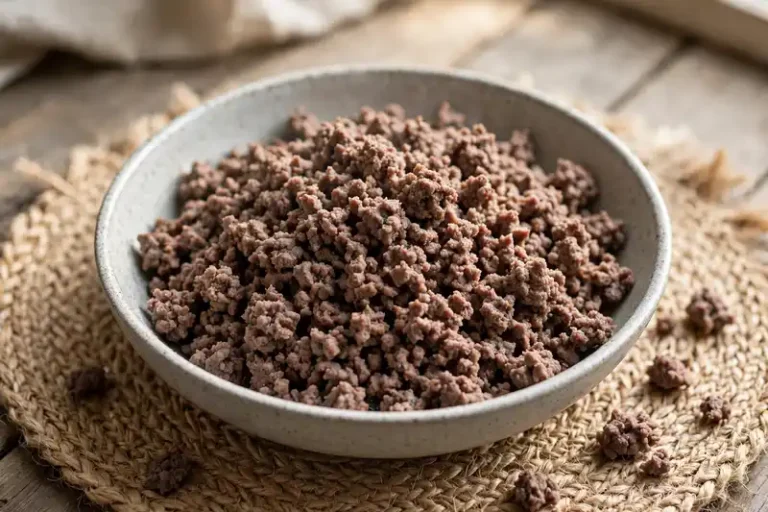
Dogs can digest raw beef, but it carries the same bacterial risks as other raw meats — Salmonella, E. coli, and Listeria. Ground beef is riskier than whole cuts because grinding distributes surface bacteria throughout the meat. Cooking eliminates the risk.
Is a raw food diet good for dogs?
The claimed benefits — shinier coats, cleaner teeth, smaller stools — are widely repeated but not supported by strong scientific evidence. The documented risks — bacterial infection, nutritional imbalance, bone injuries — are. Major veterinary organizations do not recommend raw diets, and recommend cooked or commercial alternatives instead.
Can puppies eat raw meat?
Puppies are among the worst candidates for raw feeding. Their immune systems are still developing, making them more vulnerable to bacterial illness, and their precise nutritional needs make the imbalance risk of homemade raw diets especially dangerous during growth. Puppies should eat a complete, balanced puppy food.
Does freezing raw meat kill bacteria?
No. Freezing slows bacterial growth and kills some parasites, but Salmonella, Listeria, E. coli, and Campylobacter survive freezing and reactivate on thawing. Only cooking to a safe internal temperature reliably kills these pathogens.
Can my dog get Salmonella from raw meat without showing symptoms?
Yes. Dogs can be asymptomatic carriers, shedding Salmonella in their stool and saliva while appearing perfectly healthy. This is one of the main reasons the FDA warns about raw pet food — the risk extends to everyone in the household, not just the dog.
Are raw bones safe for dogs?
Raw bones are marketed as safer than cooked bones, but vets still see broken teeth, choking, intestinal blockages, and perforations from them. Cooked bones are more dangerous because they splinter. No recreational bone is risk-free; always supervise, size appropriately, and discuss with your vet.
What should I do if my dog ate raw meat that was sitting out?
Meat left at room temperature for more than two hours is in the bacterial danger zone. Monitor your dog for vomiting, diarrhea, fever, or lethargy over the next 24–72 hours. If symptoms appear — or if your dog is a puppy, senior, or immunocompromised — call your vet promptly and mention the raw meat exposure.
This article is for informational purposes only and is not a substitute for professional veterinary advice. If your dog shows signs of foodborne illness — vomiting, diarrhea, fever, or lethargy — contact your veterinarian promptly, and mention any raw food in the diet.

4 thoughts on “Can Dogs Eat Raw Meat? What Vets and Food Safety Experts Actually Say”