Dasuquin for dogs is Nutramax Laboratories’ premium joint supplement, positioned one step above its famous sibling Cosequin. It combines glucosamine, chondroitin, and MSM with a patented ingredient called ASU, avocado and soybean unsaponifiables, that research suggests helps protect cartilage from breakdown. Vets often recommend it for dogs with moderate to advanced arthritis. This guide breaks down what is inside, the weight-based dosing, how it compares to Cosequin, and what to realistically expect.
What is Dasuquin for dogs?
Dasuquin is a joint health supplement for dogs from Nutramax Laboratories Veterinary Sciences, the company that also makes Cosequin and Denamarin. Nutramax describes it as its number one veterinarian-recommended joint health supplement brand. It comes in chewable tablets and soft chews, in small/medium and large dog formulas, plus a veterinary-only Advanced line.
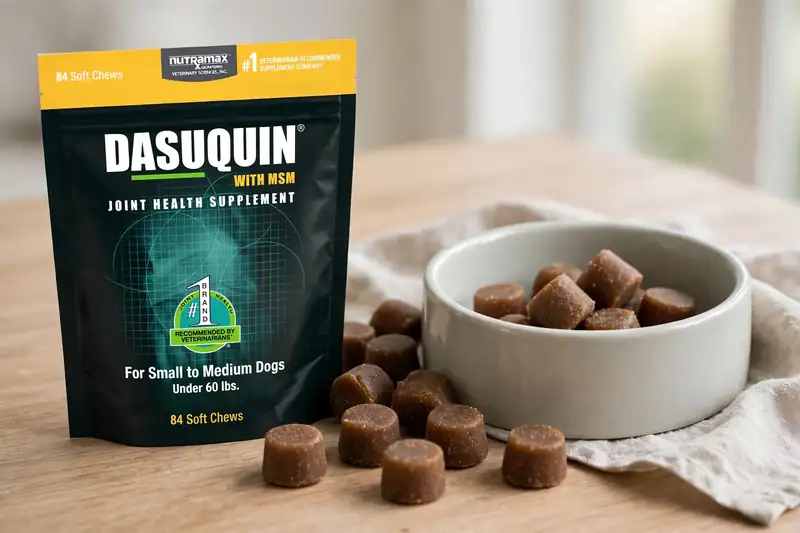
Think of the Nutramax joint lineup as good, better, best. Cosequin is the original and still the most widely used. Dasuquin is the upgraded formula, adding ingredients the research suggests do more for dogs whose joints need serious support. Like Cosequin, it carries the NASC quality seal, is manufactured in the company’s own US facilities, and is sold over the counter except for the Advanced line, which is available only through veterinarians. It is a supplement, not a drug, so it supports joint structure rather than treating pain directly. Owners usually arrive at Dasuquin in one of two ways: their vet recommends stepping up from Cosequin as arthritis progresses, or the vet starts here directly for a dog with an already significant joint diagnosis. Either way, it belongs inside a full arthritis plan with weight control, exercise, and proper pain management.
What is in Dasuquin?
Each small/medium chewable tablet contains 600 mg of glucosamine hydrochloride, 400 mg of MSM, 250 mg of sodium chondroitin sulfate, and 45 mg of ASU (avocado/soybean unsaponifiables). The large-dog formula raises those amounts: 900 mg glucosamine, 800 mg MSM, 350 mg chondroitin, and 90 mg ASU. The label lists exact amounts, which is a mark of a trustworthy product.
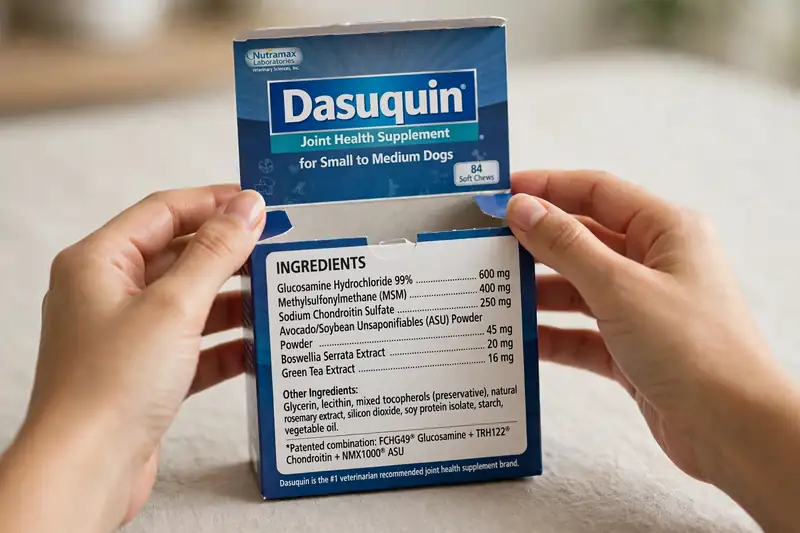
The ingredient panel tells the whole story, so let us read it like a vet would. Glucosamine hydrochloride is the cartilage building block, present at a higher dose per tablet than in Cosequin. MSM, methylsulfonylmethane, is a sulfur compound that supports connective tissue and has mild anti-inflammatory properties. Sodium chondroitin sulfate is the cartilage-protecting partner to glucosamine. And ASU is the differentiator, the ingredient Cosequin does not have. The large-dog version is not just more tablets; it is a more concentrated tablet, so a 90-pound dog is not swallowing a handful. One practical note: the two sizes are formulated for their weight ranges, so do not dose a small dog with large-dog tablets cut up. Buy the size that matches your dog, follow that chart, and let the formulation do what it was designed to do.
What is ASU and why does it matter?
ASU stands for avocado/soybean unsaponifiables, a patented extract (NMX1000) that research suggests helps block the enzymes and inflammatory signals that break cartilage down. While glucosamine supplies building material, ASU works defensively to protect existing cartilage. VCA‘s joint supplement resources list ASU among the ingredients that help prevent cartilage breakdown. It is the main reason Dasuquin costs more than Cosequin.
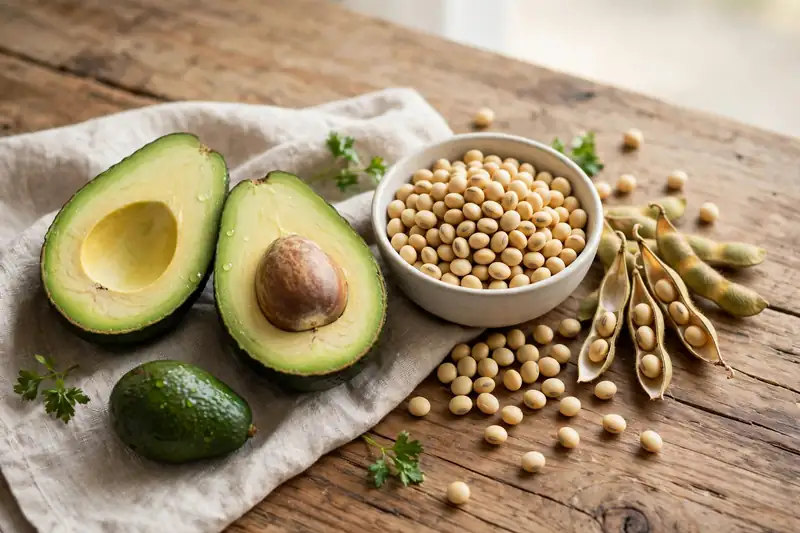
ASU is the ingredient that justifies this product’s existence, so it deserves a clear explanation. The name is chemistry jargon: “unsaponifiables” are the fractions of avocado and soybean oils that do not turn into soap when treated with alkali, and those fractions turn out to contain the biologically interesting compounds. In laboratory and clinical research, ASU has been shown to inhibit the enzymes that degrade cartilage and to dampen some of the inflammatory signaling involved in osteoarthritis. That is a different job from glucosamine’s. If glucosamine is the bricks, ASU is the security guard protecting the wall. The combination is the point: most joint supplements throw a single ingredient at the problem, while Dasuquin pairs a building-block ingredient with a protective one. The research base for ASU is modest but real, which puts it ahead of many supplement ingredients that have no research at all. It does not make Dasuquin a cure, but it makes the premium over basic glucosamine a reasoned one.
Dasuquin vs Cosequin: what is the difference?
Both are Nutramax joint supplements, but Dasuquin adds ASU and MSM to the glucosamine-chondroitin base, with higher per-tablet potencies. Cosequin suits mild or early joint concerns and preventive use; Dasuquin is the formula vets more often choose for diagnosed moderate to advanced arthritis. Do not give both together; pick one.
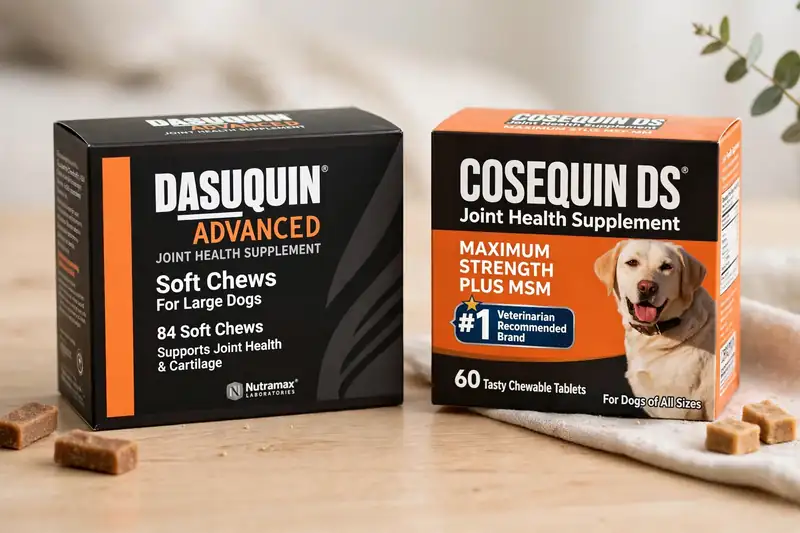
Owners meet this choice constantly, so here is the decision framework vets use. Start with the dog’s situation. A young large breed on preventive support, or a senior with mild stiffness and a clean bill of joint health otherwise, is a Cosequin candidate: proven, affordable, and sufficient. A dog with diagnosed arthritis on x-ray, a cruciate repair graduate, or a senior already showing the classic signs, slow rising, stair reluctance, shortened walks, is where Dasuquin’s extra ingredients earn their price. The cost difference is real, so match the product to the need rather than defaulting to the premium. Switching upward later is always an option; many dogs start on Cosequin for years and move to Dasuquin as the joints age. What you should never do is stack them. They share the same core ingredients, so combining them just doubles the glucosamine at double the cost. One product, the right one, at the right dose.
Dasuquin Advanced: the vet-only version
Dasuquin Advanced is sold only through veterinarians and adds eggshell membrane to the formula. VCA notes that eggshell membrane contains collagen, glucosamine, chondroitin, and over 200 proteins involved in joint structure, and that Dasuquin Advanced with Egg Shell Membrane comes as once-daily soft chews. Your vet decides whether the Advanced line fits your dog’s case.

The Advanced line is Nutramax’s answer to “what is the most complete joint support you can put in a chew.” It takes the standard Dasuquin formula and adds eggshell membrane, a natural source of collagen, elastin, and glycosaminoglycans that research has linked to improved mobility in dogs. The “sold only through veterinarians” label is not just marketing; it means the product is channeled so that a vet is involved in the decision, which makes sense for the dogs it targets: those with significant, diagnosed joint disease already under veterinary care. The once-daily soft chew format is a practical upgrade too, since compliance is everything with long-term supplements. If your vet suggests moving from regular Dasuquin to Advanced, it usually signals that the case needs the fullest support available. Do not seek it out on your own for a dog with mild stiffness; it is designed for the serious end of the spectrum, and the vet’s judgment is part of the product.
Dasuquin dosage chart by weight
Dosing: 4 to 6 weeks at a higher daily amount, then a lower maintenance level. Small/medium chewables: under 10 pounds, half a tablet daily; 10 to 29 pounds, 1 initially then half; 30 to 59 pounds, 2 initially then 1. Large dogs 60 to 120 pounds: 2 soft chews daily initially, then 1. Confirm with your vet.

The two-phase system mirrors Cosequin’s: load the tissues for a month or more, then maintain. The exact numbers depend on which product you hold, because chewable tablets and soft chews have slightly different charts, and the small/medium and large formulas are different strengths. That is why “read the box you bought” is the golden rule of supplement dosing. The tablets are scored for the half-tablet doses, so invest in a pill splitter for accuracy. A few practical cautions: buy the formula sized for your dog rather than improvising with the wrong size, do not exceed the initial-phase amount hoping to speed things up, and let your vet adjust for dogs at the edges of weight bands or with other conditions. If you switch between the regular and Advanced lines, note that the dosing may differ, so recheck rather than carrying the old routine across. And as always, “give as directed by your veterinarian” is on the label because the vet’s input is part of safe use.
When should a dog start Dasuquin?
Most dogs start Dasuquin when arthritis is diagnosed or when joint signs are clearly progressing despite basic support: stiffness, difficulty rising, reluctance on stairs, or slowing on walks. Large breeds with dysplasia, dogs recovering from orthopedic surgery, and athletic dogs with heavy joint wear are common candidates. The vet makes the call based on examination and often x-rays.

Timing the start is a clinical judgment, not a birthday. The dogs that benefit most are the ones with a confirmed joint problem and visible signs. If your senior Lab takes a minute to unfold in the morning, hesitates at the car, or has shortened the evening walk on his own initiative, that is the conversation to have at the next visit. For large and giant breeds, vets sometimes discuss joint support earlier, since their joints carry more load and dysplasia is common. Post-surgical dogs, cruciate repairs especially, often start joint supplements as part of rehabilitation to protect the joint long term. What should prompt the vet visit rather than the supplement aisle is new or worsening lameness. A dog that suddenly will not use a leg needs diagnosis first; arthritis management starts with knowing what you are managing. Dasuquin then becomes part of the plan the vet builds around that diagnosis.
How long before you see results?
Allow 4 to 6 weeks of consistent daily dosing at the initial level before assessing. Joint supplements work gradually as their compounds accumulate in cartilage and joint tissues. Track concrete signs: ease of rising, stair confidence, walk distance, willingness to play. If nothing has changed after six weeks at the right dose, discuss next steps with your vet.

Patience is the price of admission with every joint supplement, and Dasuquin is no exception. The ingredients do not mask pain like a drug; they support tissue over time, and tissue changes slowly. Set up the evaluation properly from day one. Film a short video of your dog getting up from lying down, note how far the usual walk goes before slowing, and record stair behavior. Compare at week six. Small genuine improvements, rising in one motion instead of two, taking the stairs without a pause, are meaningful wins in an arthritic dog. Remember the context matters enormously: a supplement cannot overcome obesity, so the overweight arthritic dog will gain more from weight loss than from any chew. Pair Dasuquin with the proven pillars, healthy weight, consistent gentle exercise, omega-3s, and prescribed pain control where needed, and you give it the fair trial it deserves. Endless continuation without evaluation helps nobody.
Side effects and safety
Dasuquin is considered very safe, with rare and mild side effects, most often temporary digestive upset or loose stool when starting. Serious adverse effects are not a recognized pattern at label doses. As with any supplement, keep the tasty chews stored out of reach, give with food, and tell your vet about everything your dog takes.

The safety story is reassuring and well established over years of use. The most common complaint is the mild stomach adjustment in the first week or two, which usually settles on its own or with a brief step down in amount. Because the chews are flavored to be appealing, the realistic risk is not the ingredient but the packaging: a dog that counter-surfs the whole box will have a miserable digestive night. Store them like medication. Dogs with shellfish allergies should check the glucosamine source, and diabetic dogs should have blood sugar monitored as a precaution with glucosamine products, per veterinary guidance. Dogs on multiple supplements or medications need the combination reviewed, if only to avoid paying twice for the same ingredients. And the standard honesty applies: safe does not mean effective for every dog, so the six-week evaluation still matters. A safe product that is not helping is just an expensive habit.
How to give Dasuquin daily
Most dogs take the flavored chewables or soft chews as treats. For picky dogs, crumble tablets over wet food, hide them in a dab of xylitol-free peanut butter, or use the soft chew format. Give with or after meals to keep the stomach settled, and build it into an existing routine like breakfast so no dose is missed.
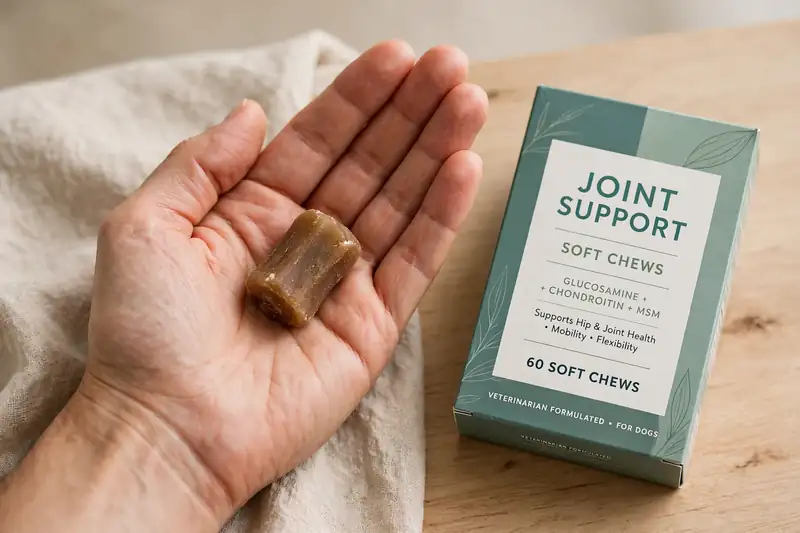
Long-term supplements live or die on routine. The flavored formats do most of the work: the great majority of dogs accept Dasuquin chews willingly, which is by design. If yours is among the skeptics, do not turn dosing into a daily wrestling match. Crumble the tablet into a spoonful of canned food, wrap it in a small ball of peanut butter, or switch to the soft chews, which most dogs find harder to resist. Make sure the full dose is actually swallowed; the dog that eats the peanut butter and spits the tablet behind the sofa is getting nothing. Attach the dose to something that already happens every day, breakfast is the classic, because joint support only works with unbroken consistency. A supplement given five days a week delivers a fraction of the benefit. And keep a simple system for tracking: a checkmark on the calendar, or just noticing the box emptying on schedule. When the routine is invisible, compliance takes care of itself.
Dasuquin earns its premium positioning: transparent labeling, the ASU differentiator, quality manufacturing, and a vet-only Advanced tier for serious cases. It will not cure arthritis, but inside a complete joint plan it is a reasoned choice. For prescription arthritis pain relief, our carprofen dosage guide explains how vets manage pain medically, and bone broth for dogs offers a comforting food-based addition to the routine.
Frequently Asked Questions
What is the difference between Dasuquin and Cosequin?
Dasuquin adds ASU (avocado/soybean unsaponifiables) and MSM to the glucosamine-chondroitin base, with higher per-tablet potencies. Vets often recommend Cosequin for mild or early joint issues and Dasuquin for moderate to advanced arthritis. Do not give both together.
How long does Dasuquin take to work?
Expect 4 to 6 weeks of daily dosing at the initial level before judging. Track concrete signs like ease of rising, stair confidence, and walk distance, and pair it with weight control and exercise for a fair trial.
Can Dasuquin be given long term?
Yes. The maintenance level is designed for ongoing daily use, and many dogs stay on it for years. Your vet should review it at regular checkups along with the rest of the arthritis plan.
What are the side effects of Dasuquin in dogs?
Side effects are rare and mild, usually temporary digestive upset or loose stool when starting. Serious adverse effects at label doses are not a recognized pattern. Store chews securely since dogs find them tasty.
What is ASU in Dasuquin?
ASU stands for avocado/soybean unsaponifiables, a patented extract that research suggests helps block cartilage breakdown and calm inflammatory signals in joints. It is Dasuquin’s key differentiator from Cosequin.
What is Dasuquin Advanced?
A veterinary-only line that adds eggshell membrane, a natural source of collagen and joint-supporting proteins, to the Dasuquin formula. It comes as once-daily soft chews, and your vet decides whether it fits your dog’s case.
Can small dogs take Dasuquin?
Yes. The small/medium formula covers dogs under 60 pounds with its own dosing chart, starting at half a tablet daily for dogs under 10 pounds. Buy the size matched to your dog and confirm the dose with your vet.
This article is general information only and is not a substitute for veterinary advice. If your dog has a health condition, is on medication, or you are unsure about any supplement, check with your veterinarian first.