

Yes, dogs can have olive oil, in small, measured amounts. It is not toxic, and its monounsaturated fats can support skin and coat health and add useful calories for dogs that need them. But olive oil is pure fat at roughly 120 calories per tablespoon, which makes portion discipline the entire game, and for some dogs (the overweight, the pancreatitis-prone), the answer is to skip it. This guide covers the benefits honestly, the dosage by size, and the cautions that matter.
Why owners reach for olive oil
Olive oil’s reputation comes from the human Mediterranean diet, where extra-virgin olive oil is linked to cardiovascular and anti-inflammatory benefits. For dogs, the claimed benefits are narrower but real:
- Skin and coat: the monounsaturated fats and vitamin E in olive oil support skin barrier function and coat condition. Owners of dogs with dry, flaky skin sometimes report improvement, though the evidence is observational, not clinical.
- Mild digestive support: small amounts can help move things along; it is a traditional home remedy for mild constipation (softening stools), used cautiously.
- Palatability: a drizzle makes boring kibble more appealing for picky eaters.
- Calorie boost: for underweight dogs or hard keepers, olive oil adds clean calories without much volume.
Notice what is not on the list: curing disease, replacing veterinary care, or substituting for a balanced diet. Olive oil is a supplement in the literal sense, something added in small amounts, not a therapy.
The calorie catch
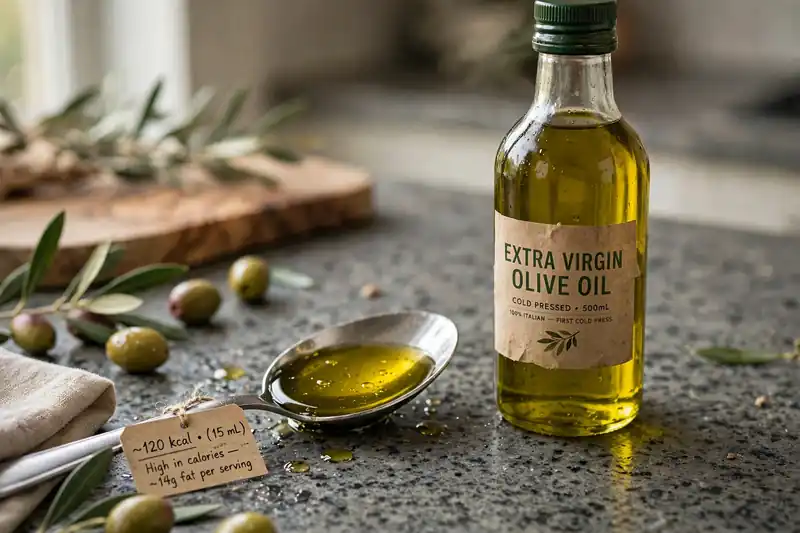
This is the section that matters most. One tablespoon of olive oil contains about 120 calories, nearly all from fat. To put that in a dog’s world: for a 20-pound dog needing roughly 400 calories a day, a single tablespoon is 30% of the entire day’s energy, and the 10% treat allowance is just 40 calories. One careless pour can triple the treat budget.
The consequences of chronic overpouring are the usual suspects: weight gain, and in susceptible dogs, pancreatitis, the painful pancreatic inflammation that high-fat intake can trigger. This is why every olive oil discussion must start and end with measurement. “A drizzle” is not a dose. A measured teaspoon is.
Safe dosage by size

Start low, go slow, and measure with actual spoons. A conservative starting framework, discussed with your vet for your individual dog:
- Small dogs (under ~15 lbs): 1/2 teaspoon, a few times a week.
- Medium dogs (~15-40 lbs): 1 teaspoon daily at most.
- Large dogs (~40-80 lbs): 1-2 teaspoons daily at most.
- Giant breeds (80+ lbs): up to 1 tablespoon daily at most.
Introduce gradually: start with half the target amount for a week and watch the stool. Loose stools or greasy coat mean you have overshot, cut back or stop. If olive oil becomes routine, subtract equivalent calories from meals or other treats; it must fit inside the daily budget, not sit on top of it.
For constipation specifically, some vets suggest a one-off slightly larger dose, but get the dose from your vet, not the internet, and never use oil to treat suspected blockage or severe constipation without professional guidance.
Extra virgin vs refined: does it matter?

For dogs, extra-virgin olive oil (EVOO) is the better choice if you are supplementing. It is the least processed form, retaining the most vitamin E, polyphenols, and antioxidants, the compounds behind most of olive oil’s claimed benefits. Refined or “light” olive oil is not harmful, just less nutritious; there is no canine reason to prefer it.
What matters more than the grade:
- Freshness: rancid oil is worse than no oil. Buy small bottles, store cool and dark, and discard if it smells off or “crayony.”
- Purity: 100% olive oil, no blends with seed oils of unknown quality.
- No infusions: garlic-infused or herb-infused oils are out, garlic is toxic to dogs, and herb oils add unknown variables.
You do not need an expensive bottle. A basic certified extra-virgin olive oil from the grocery store is fine.
Skin, coat, and digestion: what to realistically expect

Set expectations honestly. For dry skin and dull coat, olive oil may help over weeks, the fats support the skin barrier from the inside. But flaky skin has many causes (allergies, low humidity, poor diet, parasites), and oil only addresses the nutritional angle. If the coat does not improve in 3-4 weeks, or if there is itching, redness, or hair loss, see the vet rather than increasing the dose.
For digestion, small amounts can ease mild constipation by softening stool. But persistent constipation, straining, or bloating needs veterinary diagnosis, oil can mask symptoms of blockage or other problems that need real treatment. And for dogs with sensitive stomachs, even small amounts sometimes cause loose stools; the gut gets the final vote.
One thing olive oil does reliably: make food taste better. For the picky eater who sniffs and walks away, a measured teaspoon worked through the kibble is a legitimate appetite trick.
Olive oil vs fish oil
If your goal is omega fatty acids for skin, coat, or joints, know that veterinary nutritionists generally rank fish oil above olive oil for dogs. Fish oil delivers EPA and DHA, the long-chain omega-3s with the strongest evidence for anti-inflammatory and skin/coat benefits, in concentrated, measurable doses. Olive oil’s fats are mostly omega-9 (oleic acid), valuable but different.
Practical take: if you are already giving a vet-recommended fish oil, adding olive oil on top is redundant calories, pick one. If you simply want a kitchen-staple supplement for a healthy dog, olive oil in tiny measured amounts is fine. Do not stack multiple oils without doing the calorie math; fat is fat, and the pancreas keeps score.
Olive oil in homemade dog treats
If you bake treats at home, olive oil can replace butter in most recipes, a straight swap that cuts saturated fat. A few rules for treat-baking with oil:
- Measure the total oil in the batch and divide by the number of treats so you know the per-treat fat load. A batch with a quarter-cup of oil making 40 treats is very different from one making 12.
- Keep treats small. The oil makes them calorie-dense; bite-size keeps portions honest.
- Skip the extras: no sugar, no chocolate chips, no xylitol sweeteners, no macadamia nuts. Oat-peanut-butter (xylitol-free) biscuits with a spoonful of olive oil are a solid basic recipe.
- Store properly: oil-based treats go rancid faster than dry biscuits. Refrigerate and use within a week, or freeze.
Homemade treats are only as healthy as their recipe, an “olive oil dog cookie” loaded with sugar is still a sugar cookie. The oil is the least of it.
How to serve it
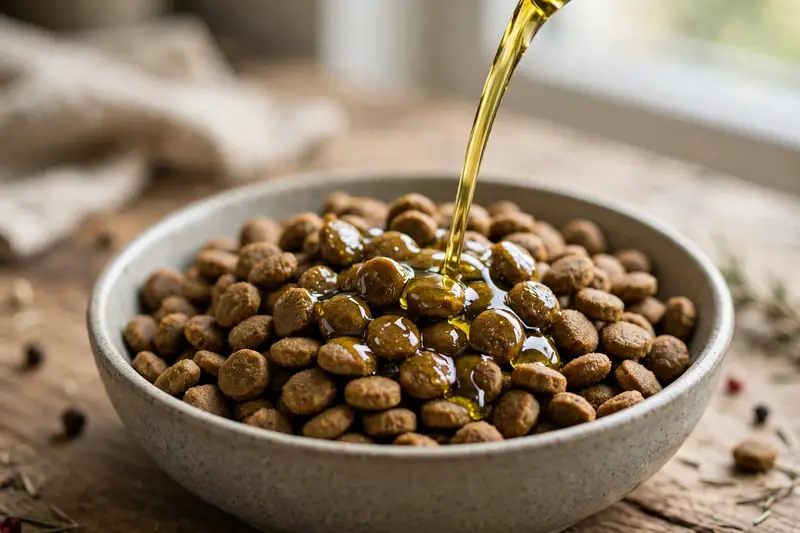
Simple beats clever:
- Measure it, teaspoon, not a glug from the bottle.
- Drizzle over food and mix through so it coats the kibble rather than pooling.
- Start with half-doses for the first week while the gut adjusts.
- Serve at room temperature, no need to heat it, and heating degrades the good compounds.
Do not use olive oil for frying the dog’s food (added heat + more oil = unnecessary calories), do not put it in baked “dog treats” in unmeasured amounts, and do not apply it topically as a skin treatment without vet guidance, ingested small amounts are the studied use; skin application is folk practice with mixed results.
Coconut oil vs olive oil
The two pantry oils owners ask about most. Honest comparison:
- Olive oil: mostly monounsaturated fat (oleic acid), plus vitamin E and polyphenols in extra-virgin. Better evidence base for general health; the AKC discusses it straightforwardly.
- Coconut oil: mostly saturated fat (lauric acid). Marketed heavily for dogs, teeth, coat, digestion, but the veterinary evidence is thinner, and the saturated fat load is higher per spoonful.
Neither is necessary, and neither should be given in large amounts. If you are choosing one oil to keep for the dog, olive oil (extra-virgin, measured in teaspoons) is the more defensible pick on evidence and fat profile. If you already use coconut oil in small amounts without issues, there is no emergency, just do the same calorie math and do not use both at once.
Dogs who should skip olive oil
Olive oil is optional for every dog and wrong for some:
- Overweight dogs or those on calorie restriction: 120 calories a tablespoon is disqualifying.
- Dogs with pancreatitis history or fat sensitivity: even small amounts can be a trigger, veterinary approval required, and often refused.
- Dogs with chronic GI disease: added fat complicates management.
- Dogs on prescription diets: therapeutic diets are precisely formulated; unapproved additions undermine them.
- Puppies: their growth diet is balanced; extras dilute it. Tiny tastes are harmless but pointless.
If your dog is healthy, lean, and tolerates it, a measured teaspoon is a reasonable routine. If any of the above apply, the answer is no, and no dog has ever suffered from missing out on olive oil.
The honest summary: olive oil is a safe, mildly beneficial supplement for healthy dogs, good fats for skin and coat, useful calories for hard keepers, a palatability trick for picky eaters, wrapped around a 120-calorie-per-tablespoon reality that demands a measuring spoon and honest calorie math. Measure it, keep it small, and it earns its place. Pour freely, and it does not.
For the same plain-only, small-portion thinking across the foods dogs meet most often, see our wider guide to what human food dogs can eat. For a related pantry oil comparison, see our coconut guide.
Frequently Asked Questions
How much olive oil can I give my dog per day?
Measured amounts by size: 1/2 teaspoon (small dogs), 1 teaspoon (medium), 1-2 teaspoons (large), up to 1 tablespoon (giant breeds), daily maximums, not targets. Start at half for a week and watch the stool.
Is extra virgin olive oil better for dogs?
Yes. EVOO retains the most vitamin E, polyphenols, and antioxidants. Refined olive oil is not harmful, just less nutritious. Either must be pure, fresh, and unflavored (no garlic or herb infusions).
Can olive oil help my dog’s dry skin?
It may help over several weeks by supporting the skin barrier from the inside, but persistent flaking, itching, or hair loss needs a vet diagnosis. Oil only addresses the nutritional angle; allergies and parasites need real treatment.
Can I use olive oil for my dog’s constipation?
Small amounts can soften stools for mild constipation, but get the dose from your vet, and never use oil for suspected blockage, severe constipation, or bloating without professional guidance. It can mask problems needing real treatment.
Is olive oil or coconut oil better for dogs?
Different tools: olive oil offers monounsaturated fats and vitamin E; coconut oil is mostly saturated fat with its own claimed benefits. Neither is necessary; if supplementing one oil, most veterinary nutritionists would point to fish oil first for omega-3s.
Can puppies have olive oil?
Tiny tastes are harmless, but there is no reason to supplement a puppy, growth formulas are precisely balanced and extras dilute them. Wait until adulthood, and even then keep it minimal.
What are the signs of too much olive oil?
Loose or greasy stools, vomiting, reduced appetite, and abdominal discomfort. Cut back immediately; if vomiting persists or there is notable pain, call your vet, high-fat intake can trigger pancreatitis in susceptible dogs.
Can I put olive oil on my dog’s dry skin directly?
It is sometimes suggested, but ingestion in measured amounts is the better-supported use. Topical oil can attract dirt, mat fur, and prompt excessive licking. For persistent dry skin, flaking, or itching, see the vet for a diagnosis rather than improvising topically. If you do try a tiny amount on the skin, use plain extra-virgin oil and watch for increased licking.
This article is general information only and is not a substitute for veterinary advice. If your dog has a health condition, is on a prescription diet, or you are unsure about any food, check with your veterinarian first.


2 thoughts on “Can Dogs Have Olive Oil? Benefits, Dosage & Cautions”