

Are dogs carnivores? The honest answer has two layers. Taxonomically, yes: dogs belong to the order Carnivora, the same scientific order as wolves, lions, and bears. Nutritionally, though, dogs are not strict carnivores. Thousands of years living alongside humans gave them the ability to digest starches and thrive on a mixed diet, which is why vets describe them as facultative carnivores or omnivores.
The Taxonomy Answer: Yes, Dogs Are in Order Carnivora
In biological classification, dogs (Canis lupus familiaris) sit squarely in the order Carnivora. This is a taxonomic fact, not a diet prescription. The order includes animals with wildly different diets: lions are strict meat-eaters, giant pandas eat almost entirely bamboo, and bears eat whatever they can find.

This is where most of the confusion starts. “Carnivora” with a capital C is the order; “carnivore” with a lowercase c describes an animal that eats mostly meat. A panda proves that membership in the order does not dictate diet. So when someone says dogs are carnivores because they are in Carnivora, they are technically right about the taxonomy and wrong if they mean dogs must eat only meat.
Understanding this distinction settles half the internet arguments on the topic. The real question is not the label but what a dog’s body can actually digest and what it needs to stay healthy.
Obligate vs. Facultative: The Key Distinction
Nutritionists split meat-eaters into two camps. Obligate carnivores must eat meat to survive because their bodies cannot make certain nutrients from plants. Cats are the classic example: they cannot synthesize taurine or arachidonic acid and cannot convert plant beta-carotene into vitamin A, so a meat-free diet will eventually kill a cat.

Dogs are facultative carnivores, meaning meat is their natural preference and their bodies are built around it, but they can digest and use plant foods too. Dogs synthesize taurine on their own, convert beta-carotene to vitamin A, and handle carbohydrates far better than any cat could. The veterinary nutritionists at VCA Hospitals explain this distinction clearly when advising owners on balanced feeding.
Think of it this way: a cat on a vegan diet is a medical emergency waiting to happen, while a dog on a well-formulated plant-inclusive diet can do fine. That gap is the whole story.
What Dog Teeth and Anatomy Reveal
A dog’s mouth still tells the story of a carnivore ancestor. The long canine teeth are built for gripping and tearing, and the shearing carnassial teeth slice meat like scissors. Dogs lack the flat, grinding molars that true herbivores use to pulverize plants, and their jaws move mostly up and down rather than side to side.

Inside, the digestive tract is short compared to a herbivore’s, which suits meat digestion, but it is longer than a cat’s relative to body size. Dogs also produce some salivary amylase, the enzyme that starts starch digestion, which cats barely produce at all. Every anatomical clue points the same way: a carnivore’s body plan with meaningful plant-digesting upgrades layered on top.
None of this means dogs should eat like wolves. It means their hardware runs meat efficiently and handles plants adequately, which is exactly what you would expect from a scavenger that evolved around human settlements.
The AMY2B Gene: Starch Digestion Evidence
The strongest genetic evidence comes from a 2013 study published in Nature comparing dog and wolf genomes. Researchers found that dogs carry many more copies of the AMY2B gene, which produces pancreatic amylase for digesting starch. Wolves typically carry 2 copies; dogs carry anywhere from 4 to 30.

The result is dramatic: dogs digest starch at over 98 percent efficiency in some measures, a massive upgrade over their wolf ancestors. This was not an accident. As dogs hung around human camps eating scraps, tubers, and grains for thousands of years, natural selection favored the individuals that could extract energy from starchy leftovers.
This single gene family is the clearest proof that dogs diverged from wolves nutritionally, not just behaviorally. A wolf fed a grain-heavy diet struggles; a dog handles it routinely. Any article claiming dogs are pure carnivores has to explain away AMY2B, and none do it convincingly.
The AMY2B story has supporting players too. Researchers found matching changes in two other genes, MGAM and SGLT1, which handle the later steps of breaking starch down into usable glucose. Together with AMY2B, they form a complete digestive toolkit that wolves simply do not carry in the same numbers. It is a coordinated upgrade across the whole starch pathway, not a one-gene accident.
This is also why the gene evidence beats the anatomy arguments in debates. Teeth and gut length invite interpretation, but extra gene copies are a measurement. When a trait shows up as a clear numeric difference between dogs and wolves, tied directly to a food source humans provided, the conclusion is hard to argue with.
Wolves vs. Dogs: The Diet Divergence
Gray wolves are true carnivores in practice. Studies of wolf scat and kills show diets dominated by ungulates like deer and elk, with only seasonal berries and vegetation as supplements. A wolf’s gut, enzymes, and metabolism are tuned for a meat-first life.
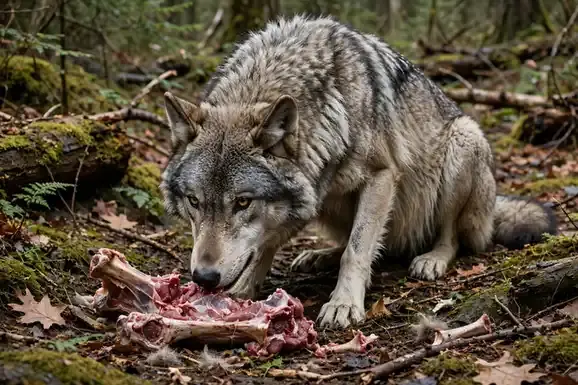
Dogs split from this path somewhere between 15,000 and 40,000 years ago. The dogs that thrived were not the best hunters but the best scavengers: the ones that could live on human refuse, which was heavy in grains, tubers, and cooked scraps. Generation after generation, selection pressure reshaped their digestion toward flexibility.
That is why “feed them like wolves” is a flawed slogan. Your Labrador is not a wolf that moved indoors. It is the product of millennia of adaptation to eating what humans eat, and its digestive system reflects that history. The nutrition experts at AKC consistently frame modern feeding around the dog in front of you, not the wolf behind it.
Digestive Tract Length Tells a Story
Gut length relative to body size is a classic clue to an animal’s natural diet. True herbivores have enormously long intestines to ferment plant fiber. Obligate carnivores like cats have very short guts because meat digests quickly and completely. Dogs land in between, with a tract longer than a cat’s but far shorter than a cow’s.
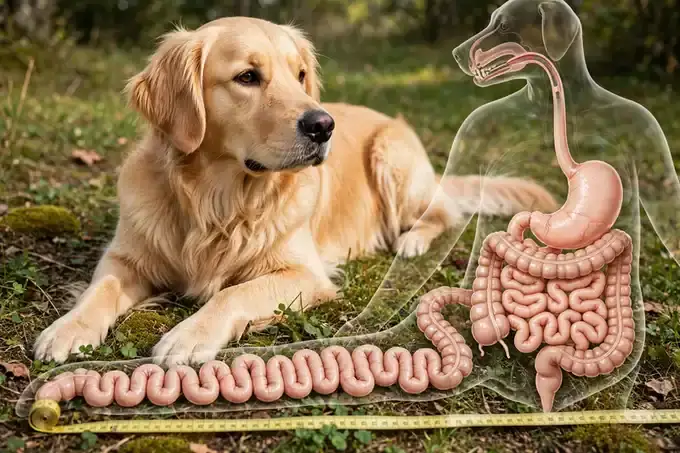
This middle ground matches everything else we have seen: a carnivore chassis with extra capacity for plant matter. It also explains why dogs handle some fiber well but cannot live on forage the way a rabbit does. Their gut can extract nutrients from grains and vegetables, just less efficiently than from meat.
For owners, the practical point is that fiber is not the enemy. Moderate fiber from vegetables and grains supports healthy digestion in most dogs, which is why quality kibbles include them. Dogs with sensitive stomachs often do well on the gentle fibers in our bland diet for dogs guide.
Domestication Changed What Dogs Can Eat
Picture a dog 20,000 years ago lingering at the edge of a human camp. The scraps available were not fresh deer haunches but cooked bones, grain porridge spillings, root vegetable peelings, and whatever else humans discarded. The dogs that survived on this buffet passed on their genes.

This scavenger history is written all over modern dog behavior. Dogs beg for bread, steal vegetables from gardens, and happily eat foods no wolf would touch. Their famously indiscriminate appetite, the same trait that sends owners searching our what human food dogs can eat guide at midnight, is a domestication feature, not a bug.
It also explains breed differences. Breeds from agricultural regions, where dogs lived on grain-heavy scraps for centuries, tend to carry more AMY2B copies than Arctic breeds like Huskies that lived on fish and meat. Diet history shaped the dog, region by region.
What This Means for Your Dog’s Bowl
Here is the practical payoff. Because dogs are facultative carnivores with real starch-digesting ability, a diet does not need to be all meat to be complete. What it needs is the right nutrients in the right amounts, which is what AAFCO standards and vet-formulated foods are designed to deliver.

Meat should still anchor the diet. Animal protein provides the complete amino acid profile dogs use most efficiently, and most vets recommend it as the first ingredient. But grains, vegetables, and other plant ingredients are legitimate contributors, not fillers, in a well-made food. Ingredients like fish oil add specific benefits; our fish oil for dogs guide covers what omega-3s do for skin, coat, and joints.
Be skeptical of any feeding philosophy that leans entirely on the carnivore label to sell you something. “Biologically appropriate” is a marketing phrase, not a scientific one. The science says: meat-first, plant-tolerant, nutrients over ingredients.
In practice, start with the guaranteed analysis panel, not the marketing on the front of the bag. Look for a named animal protein first, an AAFCO statement confirming the food is complete and balanced for your dog’s life stage, and a calorie content that matches your dog’s actual activity level. Those three checks tell you more than any carnivore slogan on the packaging.
And if the omnivore label sounds more accurate to you than carnivore, you are not wrong either. We tackle the other side of the label debate in our are dogs omnivores guide, which walks through the same evidence from the plant-digestion angle. Both articles land in the same place: feed the dog in front of you, and let the slogans sort themselves out.
The Cat Contrast: Why It Matters
Comparing dogs to cats sharpens the whole picture. Cats lost key metabolic pathways over evolutionary time and became locked into meat dependence. They need dietary taurine, arachidonic acid, preformed vitamin A, and high protein just to maintain basic function. A cat cannot adapt around these needs.
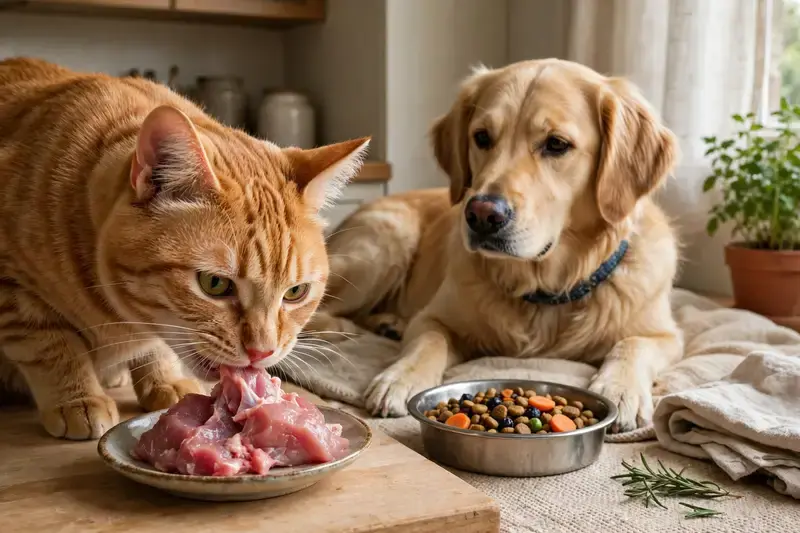
Dogs kept the metabolic flexibility cats lost. They make their own taurine from sulfur amino acids, convert plant precursors into vitamins, and run fine on moderate protein levels. This is why dog food and cat food are not interchangeable, and why feeding a dog like a cat (or a cat like a dog) causes real harm over time.
The team at PetMD has covered this species difference in depth, and it is worth understanding if you share a home with both animals. Same house, completely different nutritional rulebooks.
When the Carnivore Debate Actually Matters
For most owners, this debate is academic. Feed a complete, vet-approved food, and the taxonomy question answers itself. But the debate matters in three real situations: when someone pitches you an extreme diet, when your dog has a medical condition, and when marketing tries to override your vet.

Extreme raw-only or all-meat diets appeal to the “dogs are carnivores” slogan but can miss nutrients or introduce bacterial risks without any evidence of benefit over balanced foods. Medical conditions change the rules entirely: dogs with kidney disease need controlled protein and phosphorus, which has nothing to do with carnivore philosophy and everything to do with lab work.
The Merck Veterinary Manual remains one of the most reliable references for how nutrient requirements actually work across species. When a feeding claim sounds absolute, check it against veterinary sources, not slogans.
Frequently Asked Questions
Are dogs carnivores or omnivores?
Both labels get used because they describe different things. Taxonomically dogs are in the order Carnivora, but nutritionally they are facultative carnivores, which functions like omnivory: meat-optimized bodies that digest plants well. Most vets and textbooks call them omnivores for feeding purposes.
Are dogs obligate carnivores like cats?
No. Cats are obligate carnivores that will get sick without meat because they cannot make taurine or convert plant vitamin precursors. Dogs kept those metabolic abilities, so while they thrive on meat-based diets, they are not locked into meat the way cats are.
Do dogs need meat to survive?
Dogs need specific nutrients, most efficiently supplied by meat, but they do not need meat as an ingredient category the way cats do. Complete vegetarian dog foods exist and are formulated to meet AAFCO standards, though they require careful formulation and vet supervision.
Can dogs digest carbohydrates?
Yes, very well. The AMY2B gene expansion gives dogs far more starch-digesting amylase than wolves, with digestibility measured above 98 percent in studies. Cooked grains and starches are a usable energy source for dogs, which is why they appear in most commercial dog foods.
Should I feed my dog like a wolf?
No. Dogs diverged from wolves thousands of years ago and adapted to digest starches and scraps. A wolf-style all-meat raw diet ignores that evolution and can create nutrient gaps or bacterial risks. Feed the dog you have, following your vet’s guidance.
Why do some people insist dogs are pure carnivores?
Usually it traces back to the order name Carnivora, to wolf ancestry, or to marketing for meat-heavy diets. The anatomy and genetics tell a more nuanced story: carnivore heritage plus thousands of years of adaptation to human-associated foods.
Does being a facultative carnivore mean table scraps are fine?
Not automatically. Dogs can digest many plant and meat scraps, but scraps are often too fatty, salty, or seasoned, and some human foods are toxic. Safe sharing means plain, cooked, unseasoned foods in small amounts; a savory option like bone broth for dogs is a much safer way to spoil them.


1 thought on “Are Dogs Carnivores? The Evolutionary Answer”