

Can dogs have chicken broth? Yes, with one decisive condition: it must be plain, low in sodium, and completely free of onion and garlic. Homemade broth that you control meets this easily and makes a wonderful food topper, hydration helper, and appetite enticer. Store-bought broth, on the other hand, fails the test more often than it passes. Most cartons contain onion or garlic powder and far more salt than any dog needs. This guide shows you the label check, the simple homemade method, and how to serve it safely.
Why dogs love broth (and why it is useful)
Dogs love chicken broth because it smells and tastes like meat, and owners find it useful as a food topper, a hydration aid for reluctant drinkers, a recovery appetizer, a way to hide pills, and a base for frozen enrichment. None of this requires fancy ingredients: the simplest plain broth works best.

Broth’s appeal is simple: it smells like meat, tastes like comfort, and turns boring kibble into an event. It also has genuine uses:
- Food topper. A splash over dry food entices picky eaters and adds moisture to a dry diet.
- Hydration. Dogs that do not drink enough, seniors, post-surgery patients, and dogs in hot weather often accept broth when they refuse plain water. For another hydration helper, see our watermelon guide.
- Recovery support. Vets commonly suggest broth to encourage eating after illness or surgery, when appetite is fragile.
- Pill-giving. A little broth over food can carry medication down unnoticed.
- Enrichment. Frozen in a Kong or spread on a lick mat, broth becomes a long-lasting activity that keeps a dog busy.
None of this requires anything fancy. The simplest broth is the best one for a dog.
The store-bought problem: onion, garlic, and salt
Most store-bought chicken broths are unsafe for dogs because they contain onion or garlic powder, both of which damage a dog’s red blood cells, plus sodium levels far above what a dog needs. Reduced-sodium labels do not solve the onion and garlic problem. Only the ingredient list can clear a carton.

Read a typical supermarket chicken broth label and you will find the problem. Onion powder and garlic powder appear in most recipes, and both are toxic to dogs. They damage red blood cells, and the powdered forms are more concentrated than fresh. The safe amount of onion and garlic for dogs is none.
Then there is sodium. Regular canned or boxed broth can contain several hundred milligrams of sodium per cup, a significant load for a dog, especially a small one or a dog with heart or kidney issues. “Reduced sodium” helps with the salt but does not fix the onion and garlic problem.
The label checklist for any store-bought broth:
- No onion in any form, including onion powder
- No garlic in any form, including garlic powder
- Low sodium, or no salt added
- No xylitol or other sweeteners
- No heavy seasoning blends, “natural flavors” you cannot identify, or MSG-heavy formulas
Broths marketed specifically for pets exist and generally pass this checklist. They are the safest store-bought option. If you use human broth, the ingredient list is the entire decision; when in doubt, make it yourself.
The simple homemade recipe
Homemade chicken broth for dogs is just plain chicken parts simmered in water for several hours, then strained completely, cooled, and skimmed of fat. There is no salt, onion, garlic, or herbs at any step. The result keeps four days refrigerated and freezes in ice-cube trays for easy portions.
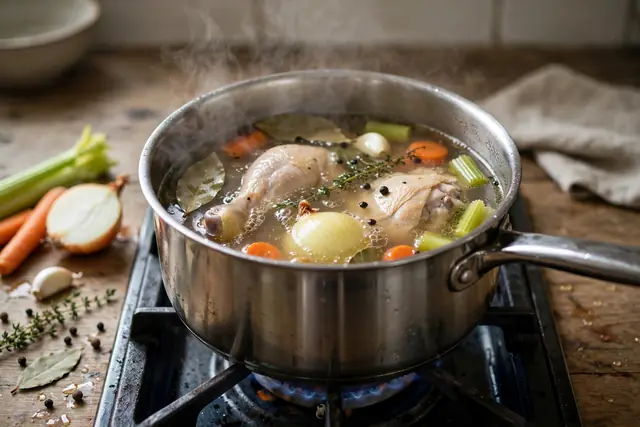
Homemade broth gives you total control and costs almost nothing:
- Start with plain chicken parts: a carcass, backs, necks, or wings all work well. No seasoning on the chicken.
- Cover with water in a pot. Nothing else: no salt, no onion, no garlic, no herbs.
- Simmer gently for several hours, or slow-cook overnight, until the meat falls off the bones.
- Strain thoroughly. Remove every bone, bone fragment, and piece of skin. Bones cooked for hours become brittle and dangerous, so none should reach the dog.
- Cool and skim. Refrigerate the strained broth, then lift off the solidified fat cap. Dogs do not need the grease.
- Store safely. Refrigerate for up to four days, or freeze in portions; ice-cube trays make small, pre-measured servings.
What you get is a plain, gelatinous, mildly flavored broth with no hazards in it. It will not taste like much to you, and that is exactly right for a dog.
Bone broth vs stock vs broth: does it matter?
For dogs, the difference between bone broth, stock, and broth barely matters. What matters is the ingredient list: a plain bone broth and a plain chicken broth are equally safe, while any of them with onion powder or excess salt is equally unsafe. Long-simmered versions need the same plain-only pot and a careful fat skim.
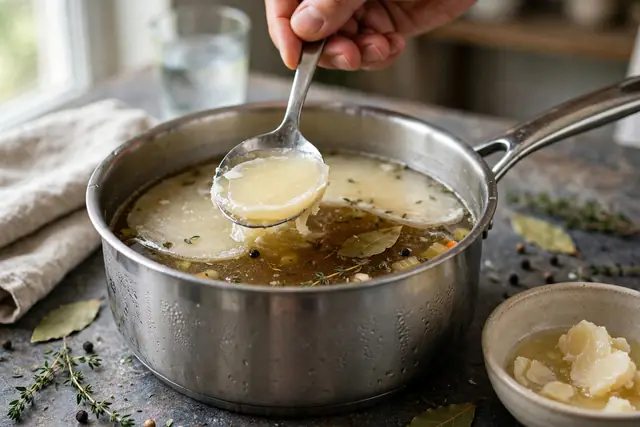
The terms get used loosely: broth is simmered with meat, stock with bones, and bone broth is a long-simmered stock. For dogs, the distinction barely matters in practice. What matters every time is the ingredient list. A plain bone broth and a plain chicken broth are equally fine. A “bone broth” with onion powder is equally bad.
One caution on long-simmered bone broths: extended cooking extracts more from the bones, which is fine, but it also concentrates whatever was in the pot. That is another reason to keep the pot to chicken and water only. Fat-skimming also matters more with rich bone broths, which come out greasier. Chill the batch, lift off the solid fat, and you are left with a clean broth that is easy on the stomach.
How much broth is safe
Broth is a supplement, not a drink, and portions stay small: about one to two tablespoons for small dogs, a quarter cup for medium dogs, and up to half a cup for large dogs, poured over food a few times a week. Keep all extras within the ten percent treat allowance, and introduce broth gradually.

Broth is a supplement, not a beverage. Even homemade broth carries some sodium and calories, so portions stay modest:
- Small dogs (under 20 lbs): 1-2 tablespoons over food, or a frozen cube as a treat.
- Medium dogs (20-50 lbs): 1/4 cup over food.
- Large dogs (over 50 lbs): up to 1/2 cup over food.
A few times a week is plenty. Daily small amounts are fine for healthy dogs too, as long as total extras stay within the ten percent treat allowance.
Serve it at room temperature or lightly warmed, never hot. If broth is new, start small and watch the stools for a day or two, since rich broths can loosen sensitive stomachs.
Broth for sick or recovering dogs
Chicken broth is most valuable during recovery, when a dog refuses food but will accept something warm, meaty, and moist. Vets commonly include broth in recovery feeding plans. Offer small amounts frequently, lightly warmed, over the regular food or on its own, and always follow the vet’s feeding instructions first.
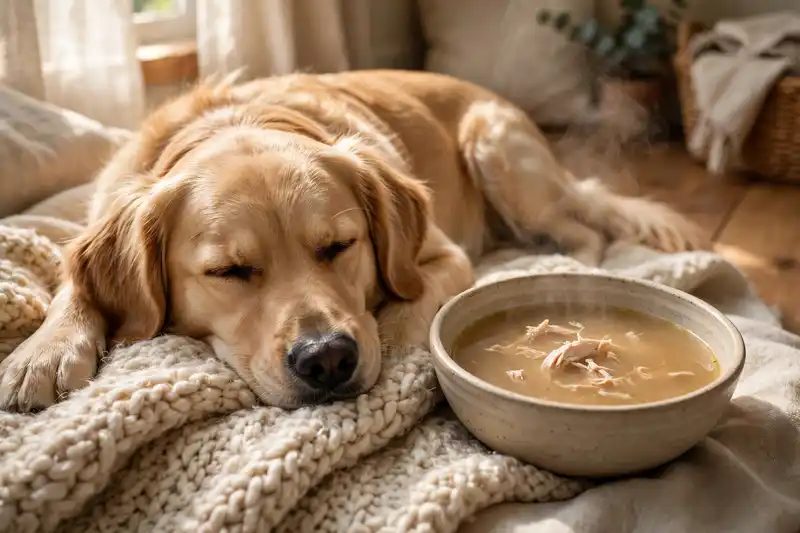
This is broth’s highest-value role. Dogs recovering from surgery, illness, or digestive upset often refuse food but accept broth, and the warmth, smell, and moisture can restart eating when nothing else works. Veterinary guidance commonly includes broth in recovery plans for this reason.
Practical tips for recovery use:
- Offer small amounts frequently rather than one large bowl. A queasy stomach handles little and often better.
- Lightly warmed broth releases more aroma, which does the tempting. It should feel warm to your wrist, never hot.
- If the dog will not drink it plain, pour a little over their regular food.
- For digestive recovery, keep the broth very plain and low-fat, skimming aggressively.
- Follow your vet’s feeding instructions first; broth supports the plan, it does not replace it.
If a dog refuses even broth for more than 24 hours, or shows lethargy, repeated vomiting, or other worrying signs, that is a vet call. Appetite loss is information, not just inconvenience.
Puppies, seniors, and special cases
Puppies can have small amounts of plain homemade broth, and it softens kibble during weaning. Seniors are often the biggest winners, since broth helps dogs with poor appetite, dental trouble, or low thirst. Dogs with heart disease, kidney disease, pancreatitis history, or prescription diets need the vet’s approval first.
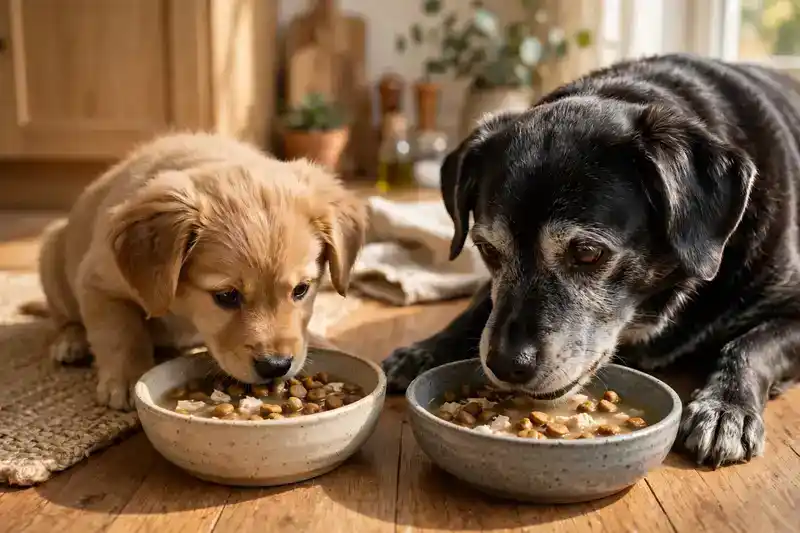
Puppies can have small amounts of plain homemade broth. It is gentle and useful for softening kibble during weaning, when hard pieces challenge tiny teeth.
Seniors are often the biggest beneficiaries. Older dogs with reduced appetite, dental issues, or low thirst drive frequently eat and drink better once broth enters the mix, and a warm splash over dinner can decide whether a senior dog eats or walks away.
Some dogs need caution. Dogs with heart or kidney disease should get homemade, skimmed, minimal broth only, since sodium is the concern. Dogs with a pancreatitis history need the fat skimmed thoroughly. Dogs on prescription diets need a vet’s okay first. The vet who manages the condition makes the call.
Weaning puppies with broth
When puppies move from mother’s milk to solid food, usually around three to four weeks and under breeder or vet guidance, plain warm broth softens kibble into an easy gruel. The familiar meaty smell encourages those first uncertain bites.
Use the same plain homemade broth: no salt, no onion, no garlic, served warm and made fresh each time. Broth-soaked kibble also eases the transition stress of a new home. As the puppy grows, reduce the soaking until they eat dry food confidently.
Storage, spoilage, and common mistakes
Homemade broth is perishable and keeps four days refrigerated, so freeze the rest in portion-sized containers or ice-cube trays. Discard anything that smells off or sat out for hours. The most common mistake is pouring family soup broth, with its onion, garlic, and salt, over dog food. The dog’s batch must stay separate and plain.
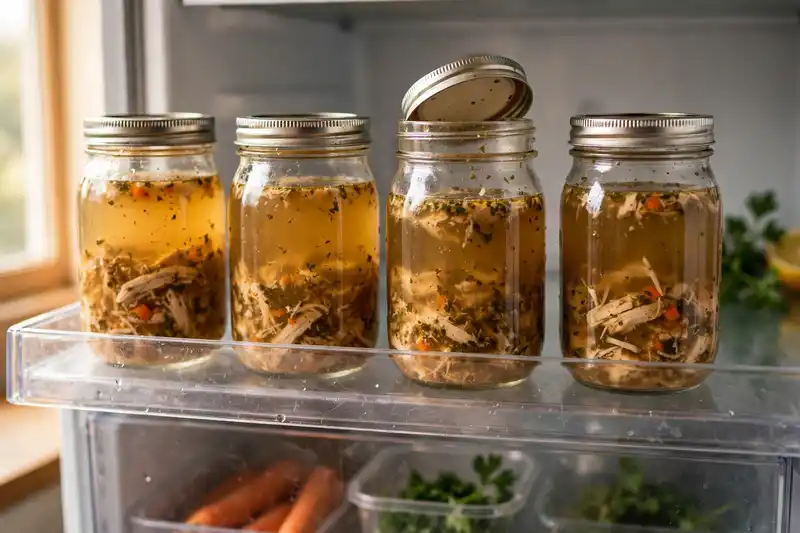
Broth is perishable. Treat it like the meat product it is:
- Refrigerate promptly after cooking, and use within four days.
- Freeze the rest in portion-sized containers or ice-cube trays for ready small servings.
- Discard anything that smells off, looks newly cloudy, or has sat out for hours.
- Never serve broth with cooked bones still in it. Strain completely.
- Do not use broth as a substitute for water. It complements drinking water; it does not replace it.
- Do not assume “organic” or “natural” on the label means onion-free. Only the ingredient list decides.
The most common mistake is the well-meaning shortcut: pouring leftover family soup broth over the dog’s food. That broth contains onion, garlic, salt, and seasonings, everything this guide warns against. The dog’s broth is a separate, plain batch. Always.
Broth enrichment ideas
Once you have plain homemade broth, it becomes a toolkit: frozen broth cubes, a broth-filled frozen Kong, a thin frozen layer on a lick mat, warm broth poured over kibble as gravy, and broth pops with a blueberry or pea hidden inside. Every format keeps the portion small, since the form itself does the measuring.

Five ways to put a plain batch to work:
- Frozen broth cubes. Pour the broth into ice-cube trays and freeze. A cube works as a small-dog treat, a crate reward, or a hot-day cooler, and the portion is pre-measured.
- The broth Kong. Fill a Kong with kibble, pour in a little broth, and freeze it overnight. A five-minute toy becomes a thirty-minute project.
- Lick-mat painting. Spread a thin layer of broth on a lick mat and freeze it. The repetitive licking is genuinely calming for anxious dogs, and the flavor keeps them engaged.
- Kibble gravy. Warm a few tablespoons, never hot, and pour over dry food just before serving. The aroma bloom makes the same old kibble exciting for picky eaters and seniors.
- Veggie broth pops. Drop a blueberry or a pea into each cube compartment before freezing. The dog gets a treasure hunt with a built-in reward.
All of these keep portions naturally small, since the format does the measuring, and the plain homemade broth means nothing unvetted goes in.
Frequently asked questions
Below are quick answers to the questions dog owners ask most about chicken broth: store-bought safety, bone broth comparisons, the homemade recipe, portions, use during illness, onion and garlic risk, puppies, and whether broth can replace water. Each answer follows the same rule: plain, low-sodium, and completely free of onion and garlic.
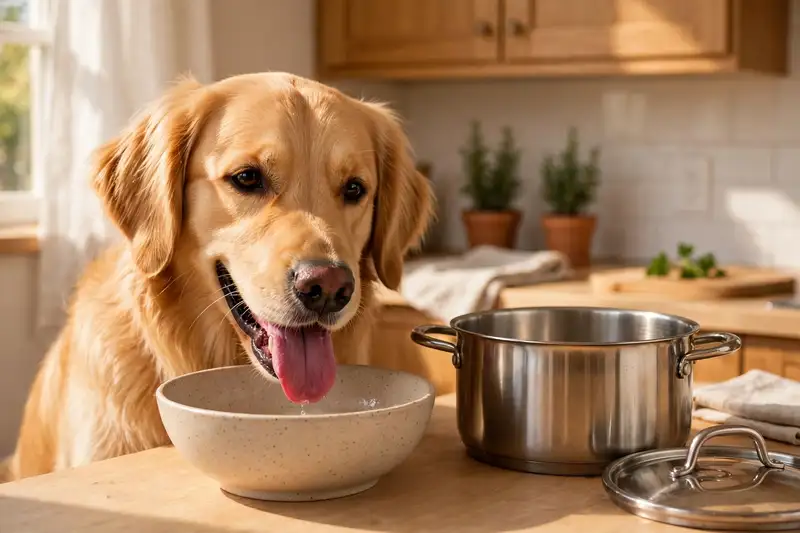
Can dogs have store-bought chicken broth?
Only if the label passes the checklist: no onion or garlic in any form, low sodium, no xylitol or heavy seasonings. Most regular broths fail, so pet-specific or homemade broth is safer.
Is bone broth better than regular broth for dogs?
Not meaningfully. What matters is that it is plain, with no onion, garlic, or excess salt. A plain bone broth and a plain chicken broth are equally fine for dogs.
How do I make chicken broth for my dog?
Simmer plain chicken parts in water only, with no salt, onion, garlic, or herbs. Strain out all bones, refrigerate, skim the fat, and serve small portions.
How much chicken broth can I give my dog?
Roughly 1-2 tablespoons for small dogs, 1/4 cup for medium dogs, and up to 1/2 cup for large dogs, over food, a few times a week, within the ten percent treat allowance.
Can chicken broth help a sick dog eat?
Yes. Vets commonly suggest broth to entice appetite during recovery. Offer small, lightly warmed amounts frequently, and follow your vet’s feeding plan.
Why is onion and garlic bad in broth for dogs?
Both damage dogs’ red blood cells and can cause anemia, and powdered forms are concentrated. There is no safe amount, so broth must be completely free of them.
Can puppies have chicken broth?
Yes, in small amounts. Plain homemade broth is gentle and useful for softening kibble during weaning. Introduce it gradually, like any new food.
Can dogs drink broth instead of water?
No. Broth complements water but never replaces it. Even homemade broth contains some sodium, and dogs need free access to fresh water at all times.
The honest summary: chicken broth is one of the genuinely useful extras in a dog owner’s toolkit, but only in its plain form. The homemade pot of chicken and water is the safest standard, pet-specific broths are the safe shortcut, and most human broth cartons are disqualified by onion, garlic, and salt. Make it plain, skim the fat, portion it sensibly, and store it like the perishable it is.
For the same plain-only, small-portion thinking across the foods dogs meet most often, see our wider guide to what human food dogs can eat.
This article is general information only and is not a substitute for veterinary advice. If your dog has a health condition, is on a prescription diet, or you are unsure about any food, check with your veterinarian first.

3 thoughts on “Can Dogs Have Chicken Broth? The Label Makes the Difference”