

Can dogs eat strawberries? Yes. Fresh or plain frozen strawberries are safe for most dogs in small, sliced portions, and the ASPCA lists the plant as non-toxic. Problems come from gulped whole berries and from strawberry products made with syrup, chocolate, or xylitol.
The sections below cover serving sizes by weight, what one berry contains, safe prep, and what to do if your dog just finished the carton. For other kitchen foods, see our guide to which human foods dogs can eat.
The five rules that matter most:
- Take off the green cap, leaves, and stem.
- Cut berries into ¼-inch slices, or mash them for toy breeds and puppies.
- Keep strawberries and all other treats under 10% of your dog’s daily calories.
- Serve fresh or plain frozen berries. Skip canned, syrup-packed, candied, and chocolate-dipped ones.
- Never share a sugar-free strawberry product unless you’ve confirmed it has no xylitol.
Are strawberries good for dogs? What one berry actually contains
Strawberries are a good low-calorie treat for most dogs, but they are not a superfood your dog needs. One medium berry has about 4 calories, under a gram of sugar, and a little fiber and vitamin C. The main benefit is swapping out richer treats.
These numbers are for one medium strawberry (about 12 grams), worked out from USDA FoodData Central values for raw strawberries:
| Nutrient | One medium strawberry |
| Calories | About 4 |
| Natural sugar | About 0.6 g |
| Fiber | About 0.25 g |
| Vitamin C | About 7 mg |
| Water | About 91% |
Some benefits you’ll read elsewhere need context. Dogs make their own vitamin C in the liver, so the vitamin C here is a small bonus. Strawberries do carry antioxidants (anthocyanins and ellagic acid), but research on strawberries alone in dogs is thin. We’d call that benefit plausible and modest.
The clearest win is the swap. Trading a calorie-heavy biscuit for a few watery berry slices keeps treats light for a dog that needs to lose weight.
What about the teeth-whitening claim?
Strawberries won’t clean your dog’s teeth in any proven way. The “enzyme” many sites mention is really malic acid, an organic acid, and we haven’t seen a published study showing it whitens dog teeth. Brushing with dog toothpaste and vet dental checks do that job.
USDA data puts malic acid at about 0.2 grams per 100 grams of strawberries. If you brush, use dog toothpaste; the FDA warns some human toothpastes contain xylitol.
How many strawberries can a dog eat? Serving sizes by weight
A few thin slices is plenty for most dogs. PetMD’s vet-reviewed chart suggests 1 to 2 quarter-inch slices for dogs up to 20 pounds and a handful for large dogs. Keep all treats, strawberries included, under 10% of daily calories.

Chart from PetMD’s strawberry guide, reviewed by Molly Price, DVM. Start at the low end the first time.
| Dog size | Serving (¼-inch slices) |
| Extra-small (2 to 20 lb) | 1 to 2 slices |
| Small (21 to 30 lb) | 2 to 3 slices |
| Medium (31 to 50 lb) | 5 to 6 slices |
| Large (51 to 90 lb) | A handful of slices |
| Extra-large (91 lb and up) | A large handful of slices |
A real example: the treat budget for a 20-pound dog
A 20-pound adult dog typically needs roughly 450 to 650 calories a day, so its treat budget is about 45 to 65 calories. Three medium strawberries add up to only about 12 calories. For strawberries, your dog’s stomach sets the limit long before calories do.
We used the resting energy formula vets commonly use (70 × body weight in kg to the 0.75 power). A 20-pound dog is about 9 kg, so its resting need is roughly 365 calories, and typical adult multipliers put the daily total at 450 to 650. Your food bag’s feeding guide or your vet can give your dog’s exact number.
How to prepare strawberries for your dog
Wash the berries, cut off the green tops, and slice them about a quarter inch thick. Mash them for toy breeds and puppies. For the first try, give one or two pieces and watch your dog for 24 hours for stomach upset.
- Rinse under running water. Conventional strawberries appear on the Environmental Working Group’s “Dirty Dozen” pesticide-residue list year after year. Most residues test below EPA limits, but rinsing takes ten seconds.
- Cut off the cap, leaves, and stem. The plant is non-toxic, so a swallowed leaf isn’t an emergency, but the greens are fibrous and can cause mild stomach upset. Small dogs may also gag on them.
- Slice to about ¼ inch. For toy breeds, puppies, and dogs that inhale their food, mash or puree the berry instead.
- Start with one or two pieces. Check stools and watch for itching or vomiting over the next day before you offer more.
Slicing matters more than it looks. In a TikTok clip covered by DogTime, a rescue French Bulldog named Emmett swallowed his very first strawberry whole in one gulp, to his owner’s surprise. It’s a sweet video, and a clear picture of how fast a flat-faced breed can take in a choking-size piece.
Can dogs eat strawberries in every form? Fresh, frozen, freeze-dried, and canned
Fresh and plain frozen strawberries are the best choices. Plain freeze-dried strawberries are fine in small amounts. Skip canned or syrup-packed berries, jam, sweetened dried berries, strawberry ice cream, and any sugar-free strawberry product, which may contain xylitol, a sweetener that is toxic to dogs.
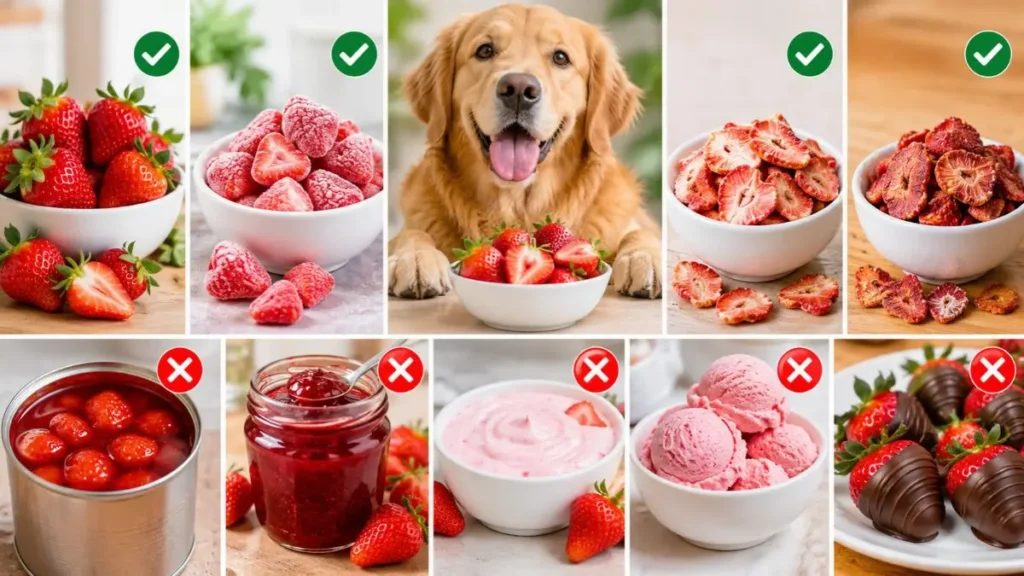
| Form | Safe for dogs? | What to know |
| Fresh | Yes | The best option. Wash, remove the tops, and slice. |
| Plain frozen | Yes | Slice first, or let store-bought pieces soften for a few minutes. Good on hot days. |
| Freeze-dried (strawberries only) | Yes, in small amounts | The water is gone, so each light, crunchy piece carries the sugar of a whole fresh berry. |
| Dried or dehydrated | Only if unsweetened | Many dried berries are coated in sugar. Read the label. |
| Canned or in syrup | No | Packed in added sugar. |
| Jam, jelly, or preserves | No | Very high in sugar. Sugar-free versions may contain xylitol. |
| Strawberry yogurt | Not recommended | Usually sweetened. Mix fresh berries into plain, unsweetened yogurt instead. |
| Strawberry ice cream | No | Sugar and dairy fat. Sugar-free kinds may contain xylitol. |
| Chocolate-covered strawberries | No | Chocolate is toxic to dogs. |
The real danger: xylitol in strawberry products
Xylitol (also called birch sugar or wood sugar) makes a dog’s blood sugar crash and can cause liver failure. The FDA lists sugar-free jams, jellies, desserts, and some nut butters among the products that may contain it. Treat xylitol ingestion as an emergency.
According to the FDA, signs of xylitol poisoning include vomiting, weakness, trouble walking or standing, collapse, seizures, and liver failure, and they can begin quickly. If you think your dog ate something with xylitol, call your vet, an emergency clinic, or the ASPCA Animal Poison Control Center at (888) 426-4435 (a consultation fee may apply).
Don’t wait for symptoms to show up.
Before sharing anything strawberry-flavored, check the ingredients for xylitol, birch sugar, or wood sugar. If there’s no label to check, keep it for yourself.
Which dogs should skip strawberries or eat fewer?
Dogs with diabetes, dogs on a strict weight-loss plan, and dogs with food or environmental allergies need a vet’s okay first. Dogs with sensitive stomachs and very small breeds can usually have strawberries, but in tinier portions and introduced slowly.
Diabetic dogs do best on a steady routine matched to their insulin, so even low-sugar fruit is your vet’s call. For dieting dogs, strawberries are one of the better treats if they count toward the daily budget.
PetMD notes that some veterinary dermatologists believe fruit may cross-react with pollen, grass, or dust allergies. If your dog itches seasonally, offer one slice and watch for extra scratching. Senior dogs with sore teeth do better with mashed berries.
My dog ate a whole box of strawberries. What now?
Plain fresh strawberries usually mean a day of loose stool or some vomiting, then recovery. Don’t induce vomiting unless a vet says so. Call a vet now if they were chocolate-dipped, part of a sugar-free product, or from a treated garden.

Here’s what a raid adds up to. Using USDA values, a 1-pound (454 g) clamshell holds about 145 calories, 22 grams of sugar, and 9 grams of fiber. A 60-pound Labrador may get off with a gassy afternoon. A 10-pound dog just ate a tenth of its body weight in fruit, so loose stools are likely.
One owner described this exact situation on the vet-chat service Dial A Vet: the dog got into the kitchen, finished a whole box of fresh strawberries, and seemed fine so far. The vet’s advice was to watch for vomiting and diarrhea, keep fresh water out, and not induce vomiting unless a vet says to.
Call your vet if you notice any of these:
- Vomiting more than once, or your dog can’t keep water down
- Diarrhea that lasts more than a day, or blood in vomit or stool
- Weakness, wobbliness, collapse, or seizures
- A swollen, tight belly, or retching that brings nothing up
- Gagging, pawing at the mouth, or trouble breathing
Garden raids need one more check. The strawberry plant itself is non-toxic, but slug pellets, fertilizer, and weed killer are not, so find out what was put on that bed.
Easy strawberry treats you can make at home
Two simple ideas work for most dogs: frozen strawberry and plain yogurt bites, and a strawberry-banana smear on a lick mat or in a Kong. Use plain, unsweetened, xylitol-free ingredients and count each serving toward your dog’s daily treat allowance.
Frozen strawberry yogurt bites. Mash 4 or 5 hulled strawberries into ½ cup of plain, unsweetened yogurt. Spoon into a small silicone mold and freeze for 3 to 4 hours. Give one bite to small dogs, two to large dogs. Skip this one if dairy gives your dog loose stools.
Strawberry-banana lick mat. Mash 2 strawberries with a few slices of ripe banana and spread it thinly on a lick mat, or pack it into a Kong-style toy and freeze for an hour. Banana adds sugar too, so keep it small. If you add peanut butter, check the label for xylitol first.
Watch: vets on feeding strawberries to dogs
If you’d rather watch than read, these short videos from vets and pet-care companies walk through sharing strawberries with dogs. They’re handy to send to family members who hand out treats, so everyone in the house follows the same rules.
- Can Dogs Eat Strawberry? A Vet Answers: Pet Circle’s vet, Dr Olivia, explains how to share strawberries safely.
- Can Dogs Eat Strawberries? Rover’s Complete Safety Guide for Pet Parents: a longer safety walkthrough from Rover.
- Vet approved: Can dogs eat strawberries: a quick vet answer for the moment a strawberry hits the kitchen floor.
Other fruits dogs can eat, and two to avoid
Blueberries, raspberries, and blackberries are also safe in small amounts, and so are seedless watermelon and cored apple slices. Grapes and raisins are the big exception: they can cause kidney failure in dogs, so keep them out of reach entirely.
Purina also lists cranberries as safe, though many dogs refuse them for the bitterness. For the full list, see our guide on what human food dogs can eat.
Can dogs eat strawberries? Your questions answered
These are the strawberry questions dog owners ask most, based on common searches and the owner questions we read while researching this guide. Each answer is short enough to scan, and the sections above go deeper when you need the detail.
Can dogs eat strawberries every day?
Yes, most healthy dogs can have a few strawberry slices daily, as long as all treats stay under 10% of daily calories. Daily isn’t required, though. Mixing in other low-calorie options like green beans or cucumber slices gives variety without adding much sugar.
Can puppies eat strawberries?
Yes. Puppies can have a small mashed or finely chopped piece once they’re eating solid puppy food. Keep it tiny, because nearly all of a puppy’s calories should come from a complete puppy diet. Watch for loose stools after the first taste.
Can dogs eat strawberry tops and leaves?
The ASPCA lists the strawberry plant as non-toxic to dogs, so an eaten leaf isn’t an emergency. Still, remove the tops before serving. The leaves and stems are tough to digest, can cause mild stomach upset, and small dogs may gag on them.
Can dogs eat strawberry yogurt?
Most flavored strawberry yogurts aren’t a good idea because they contain added sugar, and some sugar-free versions may use xylitol. Make your own instead: mix mashed fresh strawberries into plain, unsweetened yogurt, and skip it if dairy gives your dog loose stools.
Can dogs eat strawberry ice cream?
No. Strawberry ice cream is high in sugar and dairy fat, which often upsets dogs’ stomachs, and sugar-free versions can contain xylitol. The FDA has received a xylitol poisoning report linked to sugar-free “skinny” ice cream. Frozen yogurt bites are a safer swap.
Can strawberries give dogs diarrhea?
Yes, if a dog eats too many or isn’t used to them. The fiber and natural sugar can draw water into the gut, which loosens stools. It usually clears within a day. Diarrhea lasting longer, or any blood in the stool, needs a vet.
Can dogs be allergic to strawberries?
It’s possible but uncommon. Signs include itching, hives, facial swelling, vomiting, or diarrhea after eating them. PetMD notes some veterinary dermatologists think fruit can cross-react with pollen allergies. Facial swelling or trouble breathing needs emergency care; milder itching means stop and call your vet.
Can dogs eat strawberries if they have diabetes?
Ask your vet first. One medium strawberry has only about 0.6 grams of natural sugar, but diabetic dogs do best with consistent meals that match their insulin schedule. Some vets allow a slice or two at a set time; others prefer no fruit.
Are wild strawberries safe for dogs?
The ASPCA lists wild strawberry as non-toxic to dogs, so the plant itself isn’t the worry. The catch is that you can’t tell whether a roadside or park patch was sprayed, and look-alike plants grow in the same places. We’d let those berries be.
How we researched this guide
We compared the top-ranking guides against primary sources: the ASPCA plant database, the FDA’s xylitol warning, USDA nutrition data, and PetMD’s vet-reviewed serving chart. The per-berry nutrition and calorie examples are our own math from USDA numbers. This guide doesn’t replace your vet’s advice.
Search results for “can dogs eat strawberries” repeat many of the same claims, like the teeth-whitening “enzyme,” so we checked each against its original source. Sources reviewed September 2026.
4 thoughts on “Can Dogs Eat Strawberries? Yes, Here Are 5 Easy Safety Rules, Serving Sizes by Weight, and the Strawberry Foods to Avoid”