A 1 year old dog is about 15 in human years, a 2 year old is about 24, and after that each year adds about 4 human years for small dogs and up to 7 for giant breeds. Size decides the pace, so a 10 year old Chihuahua is about 56 in human years while a 10 year old Great Dane is about 79. The old multiply by 7 rule gets it wrong at both ends.

How old is my dog? The short answer
Your dog’s human age depends on its real age and its size. The American Veterinary Medical Association guideline, published by the American Kennel Club, counts 15 human years for the first year of a medium sized dog’s life, about 9 for the second year, and about 5 for each year after that.
Size adjusts the last number: small dogs add about 4 a year, large dogs 5 to 6, and giant breeds about 7.
That means a 5 year old small dog is about 36 in human years, a 5 year old medium dog about 39, a 5 year old large dog about 42, and a 5 year old giant dog about 45. The chart below gives the numbers year by year, and the sections after it explain why the numbers work that way and where they break down.
The 15-9-5 rule
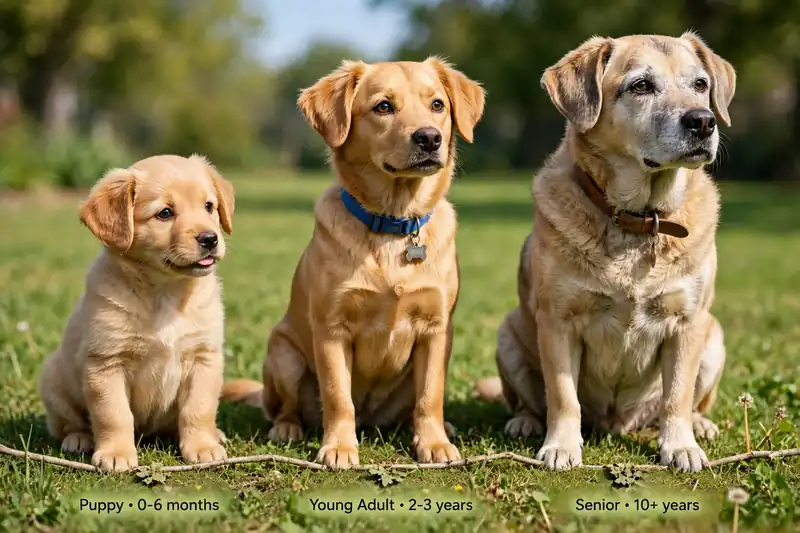
The 15-9-5 rule is the simplest honest way to age a dog. Year one counts as 15 human years, because a 1 year old dog is already sexually mature and fully grown, much like a 15 year old person. Year two adds 9, bringing the total to 24, because the dog finishes maturing into an adult.
Every year after that adds about 5 for a medium sized dog.
The rule is written for a medium sized dog, and size changes the last step. Small dogs age more slowly after year two, so they add about 4 human years per year. Giant breeds age faster, so they add about 7. The American Kennel Club publishes this guideline, and vets use it as the standard shorthand in clinics.
The rule is a guideline, not a measurement. It tells you where your dog sits in life, not how many years it has left. A 7 year old medium dog at about 47 in human years is middle aged, with senior years ahead. A 7 year old giant dog at about 56 is already a senior, and its care should reflect that.
The size chart: small, medium, large, giant
The size chart turns the rule into numbers you can look up. Find your dog’s weight class, then read across to its age. Small dogs weigh 20 pounds or less, medium dogs 21 to 50, large dogs 51 to 100, and giant dogs over 100.
The human year figures below come from the widely used chart based on American Kennel Club and American Veterinary Medical Association guidance.
At 5 years old, a small dog is about 36 in human years, a medium dog about 39, a large dog about 42, and a giant dog about 45. At 7 years, the numbers are 44, 47, 50, and 56. At 10 years, they are 56, 60, 66, and 79. At 15 years, they are 76, 83, 93, and 114. The gap between a small dog and a giant dog grows every year, which is why a giant dog ages out of its prime so much faster.
Weigh your dog before you use the chart, and use its adult weight, not its puppy weight. A dog between two weight classes sits between two columns, so read both and split the difference. The AKC guide to calculating dog years gives the method behind the chart and the size adjustments in full.

Why the multiply by 7 rule is wrong
The multiply by 7 rule dates from the 1950s, when people lived about 70 years and dogs about 10. It was never a biological finding, just neat arithmetic. The American Veterinary Medical Association states plainly that dogs do not age seven human years per dog year, and the American Kennel Club calls the rule outdated.
The rule fails worst in the first years. A 1 year old dog is about 15 in human years, not 7, because it is already an adult that can reproduce. A 2 year old is about 24, not 14. The rule also fails late in life for small dogs: a 15 year old small dog is about 76 in human years, while the times seven rule would say 105, which is older than any person has lived.
The rule survives because it is easy to remember, and easy is not the same as right. Use the 15-9-5 rule instead. It takes five seconds longer and it matches how dogs actually grow, fast in the first two years and slower after, with size setting the pace.

The DNA clock: a different answer
A 2019 study by researchers at the University of California San Diego gave a different answer, based on DNA rather than birthdays. The team compared DNA methylation, the chemical marks that change as bodies age, in 104 Labrador Retrievers with human samples. They derived a formula: human age equals 16 times the natural logarithm of the dog’s age, plus 31.
The formula says a 1 year old dog is about 31 in human years, a 2 year old about 42, a 5 year old about 57, and a 10 year old about 68. Those numbers run much higher than the 15-9-5 rule in the early years, and lower in the late years. The two methods cross near 11 years, which is a coincidence of the arithmetic rather than a meaningful threshold.
The DNA study used one breed, so its numbers may not fit your dog. Labradors are large dogs with their own aging pattern, and a Chihuahua’s DNA clock may run differently. The formula is useful science, not a better birthday calculator. Use the 15-9-5 rule for daily life, and treat the DNA clock as a reminder that aging is a biological process, not a multiplication table.

Puppy age: the fast first year
The first year of a dog’s life moves faster than any other. An 8 week old puppy is roughly equivalent to a 9 month old human baby, according to the University of California San Diego study, and by 1 year the dog is about 15 in human years. Puppies grow, learn, and mature at a pace no later year matches.
That speed is why puppy care is so concentrated. Vaccines, socialization, and training all happen in the first months, because the window for them is short. A puppy that misses socialization in its first 16 weeks carries the gap for life. Food matters too: a puppy needs food made for growth, with the right calcium and calories for its size, and giant breed puppies need food that supports slow steady growth rather than maximum speed.
Puppy months are the hardest to convert, because the 15-9-5 rule is written for whole years. A 6 month old dog is roughly a 10 year old child in development, though the exact number depends on breed and size. Do not worry about the precise figure. Worry about the vaccines, the training, and the food, because those decide the adult dog.

Adult years: the slow middle
The adult years are the slow middle of a dog’s life, and they are the longest stretch. A medium dog is an adult from about 2 to about 7, a small dog stays adult longer, and a giant dog leaves adulthood earlier.
During these years the dog adds about 4 to 7 human years per calendar year, depending on size, and the changes are gradual.
Adult care is maintenance care. Keep the weight steady, keep the teeth clean, keep the exercise daily, and keep the vet visits yearly. The adult years are when weight gain creeps in, because the dog eats the same amount while moving less than it did as a youngster. A dog that gains a pound a year for five years is five pounds overweight, and that weight shortens its life.
Watch for the small shifts that mark the end of adulthood. The dog sleeps more, takes longer to get up, and loses interest in long walks. Those shifts arrive at different ages by size, and the chart above tells you when to expect them. The AKC lifespan guide gives the size ranges that set the length of the adult stretch.
Senior years: when old starts
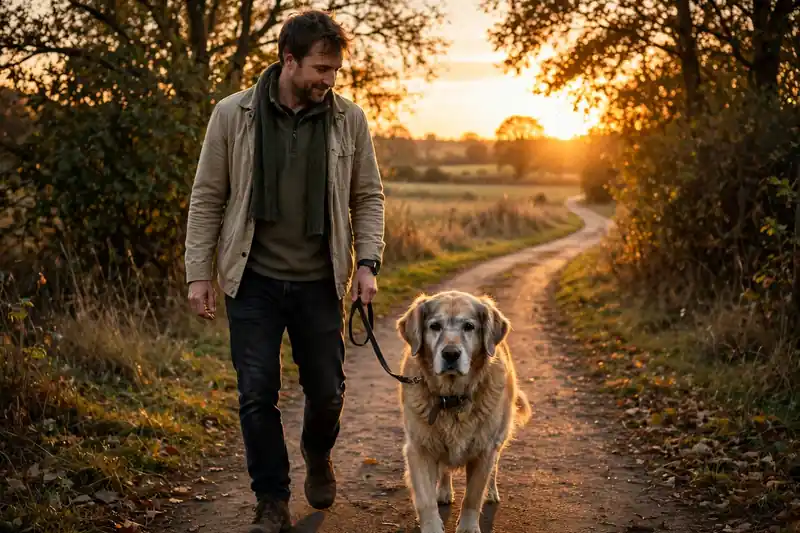
Senior years start at different ages by size. Small dogs are generally considered senior around 7 years old, and larger breeds around 5 to 6. The American Animal Hospital Association defines senior as the last 25 percent of a dog’s estimated lifespan, so the exact age depends on size and breed, and giant breeds can be seniors at 5.
Senior care means more vet visits, blood work, and attention to the small changes. Kidneys, liver, heart, and joints all wear with age, and the diseases that hit seniors are easier to treat when caught early. The kidney disease guide and the liver disease guide show the early signs, and both are worth reading before a problem appears.
Food should change with age too. Senior dogs often need fewer calories and more joint support, and the best dog food for small dogs guide and the glucosamine guide cover the diet and supplement questions that come up. The Merck Veterinary Manual guide to nervous system disorders explains the nerve and brain changes that can appear in older dogs.

How to tell a rescue dog’s age
Rescue dogs often arrive with no birthday, and the vet estimates the age from the body. Teeth are the best clue in young dogs: puppy teeth give way to adult teeth by about 6 months, and tartar builds with age after that.
A dog with clean white teeth is usually young, and a dog with heavy tartar is usually older, though diet and chewing change the picture.
Eyes give another clue. Young dogs have clear bright eyes, while older dogs often develop a blue haze in the lens, called nuclear sclerosis, which looks cloudy but does not block vision much. Gray fur on the muzzle appears with age, though some dogs gray early and some never gray much at all. Muscle tone, joint stiffness, and energy level fill in the rest.
The vet’s estimate is a range, not a date. A dog estimated at 3 to 5 years old could be anywhere inside that window, and the chart will give a different human age at each end. Pick the middle, use it for care planning, and let the vet refine it at the next visit. The exact birthday matters less than the life stage, and the life stage is what the vet can see.

Why your dog’s human age matters
Your dog’s human age matters because it sets the care schedule. A 5 year old giant dog is a senior, and it needs senior screening now, while a 5 year old small dog is a young adult with years before senior care starts. Food, exercise, and vet visits all follow the life stage, not the calendar age.
Human age also sets expectations. A 10 year old large dog at about 66 in human years will slow down, sleep more, and need shorter walks, and that is normal aging, not a problem to fix. A 2 year old dog at about 24 that sleeps all day is not normal, and it needs a vet visit. The chart gives you the baseline to judge what is normal for your dog.
Use the number as a planning tool, not a countdown. The chart says where your dog sits in life, and the care you give decides how well it lives the years it has. The VCA feeding guidelines lay out the daily food rules that support every life stage, and the fish oil guide and the joint supplements guide cover the two most common senior supplements.

Frequently asked questions about how old your dog is
How old is a 1 year old dog in human years?
A 1 year old dog is about 15 in human years, or about 12 for a giant breed that matures more slowly. The dog is already sexually mature and fully grown at that age.
How old is a 7 year old dog in human years?
A 7 year old small dog is about 44, a medium dog about 47, a large dog about 50, and a giant dog about 56 in human years. Size makes a large difference by this age.
How old is a 10 year old dog in human years?
A 10 year old small dog is about 56, a medium dog about 60, a large dog about 66, and a giant dog about 79 in human years. A 10 year old giant dog is very old, while a 10 year old small dog still has years ahead.
Is the 7 year rule true?
The 7 year rule is not true. The American Veterinary Medical Association states plainly that dogs do not age at a rate of seven human years for each year, and the American Kennel Club calls the rule outdated and inaccurate. It dates from the 1950s and was never a biological finding.
How do vets tell a dog’s age?
Vets estimate age from teeth, eyes, coat, muscle tone, and overall condition. Teeth are the best clue in young dogs, and the blue haze in the lens and gray muzzle help in older dogs. The result is a range, not an exact birthday.
Does the DNA clock give a better answer?
The DNA clock from the University of California San Diego study is useful science, but it used only Labradors, so it may not fit your dog. Use the 15-9-5 rule for daily planning, and treat the DNA formula as a second view, not a replacement.
Your dog’s age in human years is a planning tool. Count 15 for year one, 9 for year two, then 4 to 7 a year by size, and check the chart for the exact number. Forget the times seven rule, and remember that a giant dog ages out of its prime years before a small dog leaves middle age. Feed for the life stage, screen at the right age, and judge your dog against its own size, not against the dog next door.
Disclaimer: This article is for general information only and is not veterinary advice. Age charts are estimates based on population averages. If you are unsure about your dog’s age or life stage, ask your veterinarian.