
Yes, dogs can eat hard boiled eggs. The conditions are simple: a fully cooked egg, nothing added, served cool and in moderation, because the egg conversation changes completely the moment the word raw enters it. Dogs can eat hard boiled eggs when the eggs are fully cooked and plain, cooled and served in moderation. Hard boiling is the cleanest way to meet every condition at once. No pan, no oil, no seasoning decisions, just a pot of water and a timer.

Eggs sit in an odd spot in dog nutrition. They are one of the most nutritious foods in the kitchen and one of the most argued about in raw-feeding circles. The veterinary consensus is boring and clear: cook them, keep them plain, and keep portions small. Everything below follows from that.
Can dogs eat hard boiled eggs? The short answer

Yes, dogs can eat hard boiled eggs as an occasional treat. Boil the egg until both white and yolk are completely firm. Cool and peel it, then serve plain with no salt, butter, oil, or seasoning. Cut it into pieces for small dogs and gulpers.
PetMD’s egg guide lists boiled and scrambled eggs as safe options when served plain, with poached in the same safe group, and names hard boiling among the simplest preparations. The egg should be fully cooked through, since the risks live in the raw and undercooked versions. Dogs with a history of pancreatitis, obesity, or egg allergy need a vet’s word first. The published eggs guide covers eggs broadly; this article focuses on the hard boiled form.
What hard boiled eggs offer nutritionally
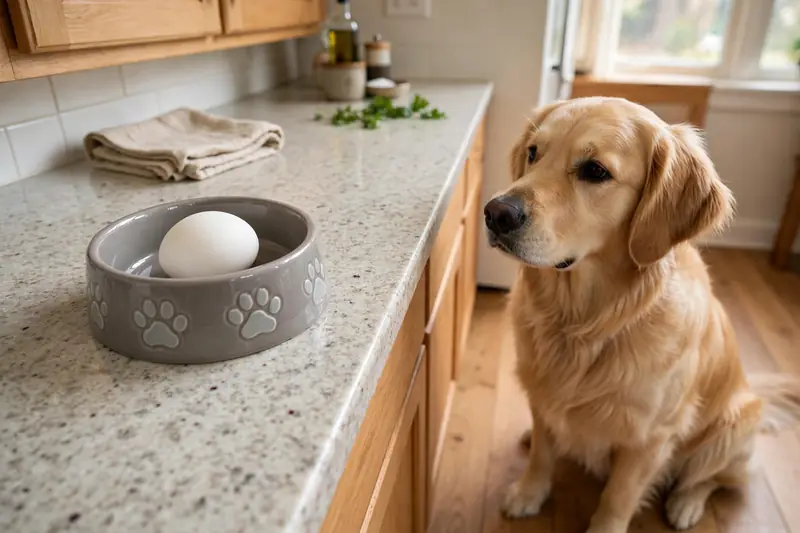
Eggs deliver complete protein, meaning they contain all the essential amino acids a dog needs, in a form the body digests easily.
They also bring riboflavin and selenium, plus vitamin A, vitamin B12 and iron, and healthy fats. For a single-ingredient food, the resume is strong.
The numbers keep portions honest.
A medium dog eating a full egg takes in roughly the same calories as a bundle of small training treats, which is why the twice-a-week ceiling matters more than the per-serving number. One large egg carries about 74 calories and 5 grams of fat, while the white alone carries about 19 calories and almost no fat.
Most of the fat and calories sit in the yolk, which is why the yolk drives both the nutrition and the portion caution. A hard boiled egg is a protein-rich extra, not a free one.
None of this makes eggs necessary. A complete dog food already supplies every nutrient on the list in the right balance. Eggs are a high-quality bonus with a calorie cost, and the cost deserves the final word on portion size. Owners comparing protein treats can read the cheese guide for the other dairy-aisle favorite, which carries a similar rich-treat profile.
Why cooked beats raw: salmonella and avidin

Raw eggs carry two problems that cooking erases. The first is salmonella, the bacteria behind vomiting and diarrhea, plus dehydration, in dogs as well as people. The contamination risk lives in commercial egg supplies long before any dog bowl enters the picture: the 2010 recall of half a billion shell eggs over salmonella Enteritidis, cited by the FDA, proves it.
The second is avidin, a protein in raw egg white that binds biotin, a B vitamin, and blocks the body from absorbing it.
Heat deactivates avidin. That single fact settles the raw-versus-cooked debate that raw-feeding forums keep alive.
A hard boiled egg delivers the protein without the biotin interference. Heat destroys the bacteria that make raw eggs a gamble, so the salmonella risk drops to near zero when the egg is cooked through and the white sets fully around the yolk. PetMD’s dangerous foods list puts raw eggs in the avoid column for exactly these reasons, alongside raw meat.
The biotin fear deserves proportion. An occasional raw egg will not cause a deficiency; the problem comes from regular raw-egg feeding over time. But since cooking removes the issue entirely at no nutritional cost worth naming, there is no reason to run the experiment. The raw eggs guide covers the raw side in full for owners who want the details.
The shell question: skip the shell

Eggshells are the internet’s favorite calcium hack, and the hack backfires. Eggshells contain very high levels of calcium, and adding them to a balanced diet throws the dog’s mineral intake out of balance. Too much calcium causes its own problems, particularly in growing puppies, where skeletal development is sensitive to mineral excess.
The physical risk comes first. Shell fragments have sharp edges that can scratch the throat or irritate the digestive tract on the way down.
PetMD allows shells only as a fine powder and only when a vet has said the dog needs extra calcium. The AKC warns about the sharp edges. For the ordinary owner with an ordinary dog on complete food, the shell belongs in the compost, not the bowl.
Dogs that crunch a dropped shell occasionally are not in danger. The warning is about deliberate, repeated shell feeding as a supplement strategy. Calcium supplementation is a vet’s decision with bloodwork behind it, not a kitchen project.
How to serve: boiled, scrambled, or fried

Hard boiling wins for simplicity and safety. Lower eggs into boiling water and cook until fully firm.
Cool in cold water before peeling and chopping. No fat, no seasoning, no judgment calls. The egg is either done or it is not. The timer decides.
Scrambled takes second place with one condition: a nonstick pan and no oil, butter, salt, or seasoning. Plain scrambled eggs are safe, but the moment butter hits the pan the dish stops being dog-appropriate.
Poached eggs work the same way, with no vinegar or salt in the water. Fried eggs never qualify. The oil alone disqualifies them, and fried eggs arrive with exactly the fat load that sensitive dogs cannot handle.
Cooling is the step owners skip. A freshly boiled egg holds serious heat in the yolk, and an eager dog will not wait. Cool the egg completely, chop it for small dogs, and serve at room temperature. The whole preparation takes fifteen minutes, most of it unattended.
How much egg is safe to feed

PetMD’s serving guide scales the egg to the dog: about a quarter egg for the smallest dogs, half an egg for small dogs, a full egg for medium dogs, and up to two eggs for giant breeds, once or twice a week. Eggs count toward the 10 percent treat budget that the VCA’s feeding guidelines set for all extras combined.
| Dog size | Safe amount | Frequency |
|---|---|---|
| Extra small (under 10 lbs) | Quarter egg, chopped | Once or twice a week |
| Small (10 to 20 lbs) | Half egg, chopped | Once or twice a week |
| Medium (20 to 50 lbs) | One egg, chopped | Once or twice a week |
| Large (over 50 lbs) | One to two eggs, chopped | Once or twice a week |
The first serving should be smaller than the chart, with a full day of watching after. Eggs are rich, and rich foods loosen stools in sensitive dogs. Once or twice a week is the ceiling for most dogs, not a target. Daily eggs push calories and fat past the treat budget without adding anything the regular food lacks.
Dogs that should skip or limit eggs

Dogs with a history of pancreatitis should skip eggs or get whites only on the vet’s word. Most of the egg’s fat sits in the yolk, and fat is the trigger that pancreatitis-prone dogs cannot afford. Overweight dogs face the same math: 74 calories is a real dent in a small dog’s treat budget.
Egg allergies are uncommon but real. The signs look like other food allergies: itchy or inflamed skin around the ears, paws, or face, repeated ear infections, vomiting, or diarrhea. A dog that itches after eggs and clears up when they stop has given its answer. Dogs on prescription diets should not get eggs at all unless the vet approves, since the diet’s balance is the treatment.
Dogs with chronic digestive disease sit in the vet-decides category. Eggs are gentle for most stomachs, but “most” is doing heavy lifting in that sentence. When the gut is already compromised, every new food is a question for the professional who knows the case.
Puppies and senior dogs
Puppies can have small amounts of hard boiled egg once they eat solid food well. Keep the pieces tiny and the portion well under the adult chart, since puppies are still calibrating their digestion. Egg is a reasonable early protein: soft and plain, easy to chew.
Senior dogs usually love eggs, and a little chopped egg can tempt a picky older eater the way few foods can. The cautions are the familiar ones for age. Keep portions smaller and textures softer, and get vet approval for seniors with kidney disease, pancreatitis history, or chronic digestive trouble. Older dogs gain weight easily, so the 74-calorie math matters more, not less.
The standing rule covers both ends of life. For puppies under eight weeks, nursing dogs, or any dog with a diagnosed condition, new foods wait for the vet’s word. There is no developmental window that requires eggs, so there is no reason to rush the introduction.
When to call the vet

Call your vet if your dog eats raw eggs in quantity and then vomits repeatedly, shows bloody diarrhea, or becomes unusually tired or dehydrated. Those signs point to salmonella, which needs professional treatment rather than home watching. A dog with a known egg allergy that breaks out in hives, facial swelling, or breathing trouble needs emergency care.
A single plain hard boiled egg needs no action beyond normal watching. Mild soft stool after a first taste usually resolves on its own, and a bland diet for a day or two settles most minor upsets. Repeated vomiting or diarrhea points to gastroenteritis, which deserves a vet’s input rather than another home remedy.
Prevention is mostly about the raw-egg habit. Keep raw eggs out of the dog’s reach, cook eggs fully before sharing, and keep portions inside the chart. The ASPCA’s people foods to avoid is worth a skim for the broader kitchen list. Owners who share table foods often should keep the human foods dogs can eat list handy as a quick reference.
Frequently asked questions about dogs and hard boiled eggs

Owners usually ask about yolks first, then about daily feeding. Shells and raw eggs round out the usual questions. The answers below cover the questions that come up most often.
Can dogs eat hard boiled egg yolks?
Yolks are fine. They hold most of the egg’s fat and fat-soluble vitamins, and they are safe in the portion sizes above. Dogs prone to pancreatitis or on low-fat diets should get whites only, or skip eggs on the vet’s advice.
Can dogs eat hard boiled eggs every day?
Daily eggs are too much for most dogs. The calories and fat add up, and eggs can unbalance the diet over time. Once or twice a week keeps eggs in the treat category where they belong.
Can dogs eat eggshells?
Skip them. Shells are sharp, and their very high calcium content can unbalance a complete diet. Powdered shells have narrow veterinary uses, but only with a vet’s explicit guidance.
Can dogs eat raw eggs?
They should not. Raw eggs can carry salmonella, and raw egg white contains avidin, which blocks biotin absorption. Cooking removes both problems, so there is no reason to feed eggs raw.
Are hard boiled eggs good for dogs with upset stomachs?
Plain cooked egg is a gentle protein that vets often include in bland diets for recovery. Serve a small amount, watch the response, and call the vet if vomiting or diarrhea persists beyond a day.
My dog ate an entire hard boiled egg, shell included. What should I do?
Watch for vomiting or straining, since shell fragments can irritate the gut. Most dogs pass a single shell without drama. Call your vet if vomiting repeats, the belly swells, or your dog seems distressed.
Hard boiled eggs earn a solid yes with a short rulebook. Cook them. Cook them fully, serve them plain, keep portions inside the chart, and skip the shells.
The raw-egg debate, the shell-supplement trend, and the daily-egg habit all fail the same test: cooking is easy, and easy wins. Keep a few eggs in the fridge, and the occasional protein treat is always fifteen minutes away.
Disclaimer: This article is general information, not veterinary advice; call your vet if your dog has a health condition or shows symptoms after eating eggs.