
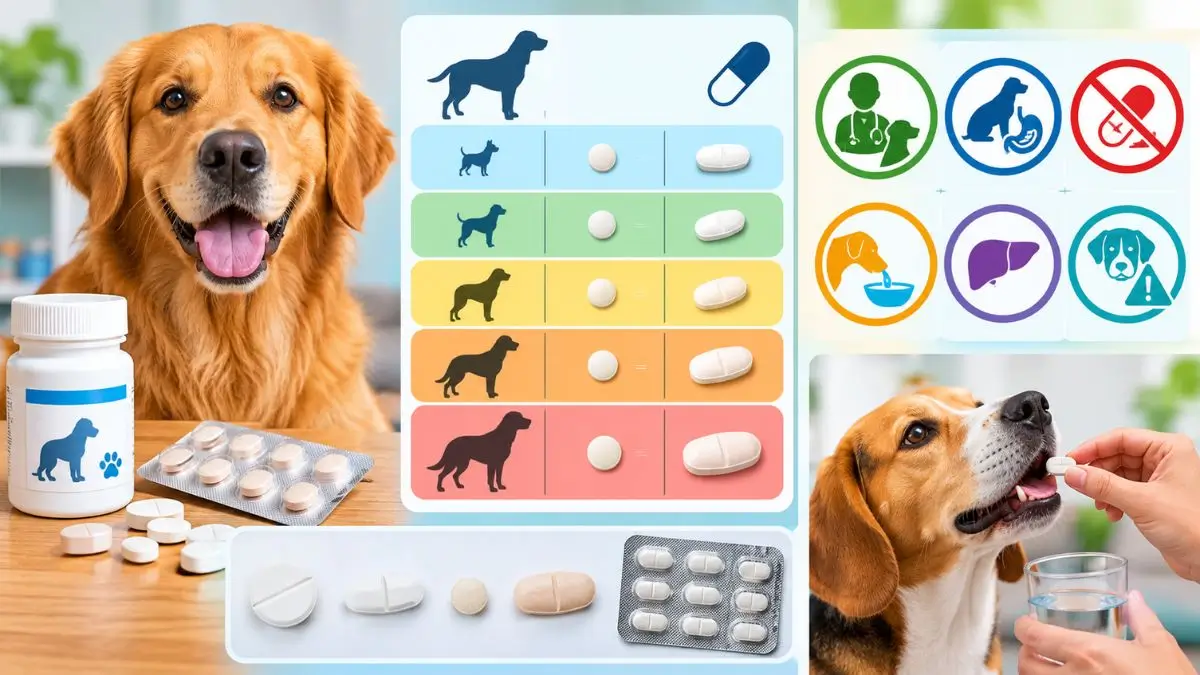
Carprofen dosage for dogs is based on body weight. Under the US label, the dose is 2 mg per pound (4.4 mg/kg) per day, given once daily or split into two doses. The number is simple. The details around it are where owners get stuck: tablets come in fixed sizes, the US and UK labels use different figures, and the drug cannot be mixed with some common medicines.
Carprofen is a prescription drug. Use this page to understand your dog’s prescription and to ask your vet better questions, not to choose a dose on your own.
Carprofen dosage for dogs: the quick answer
The FDA-approved carprofen dose for dogs is 2 mg per pound (4.4 mg/kg) per day. Your vet can prescribe it as 2 mg/lb once daily or 1 mg/lb every 12 hours. Never give 2 mg/lb twice a day, because that doubles the daily dose.
- Once daily: 2 mg per pound (4.4 mg/kg)
- Twice daily: 1 mg per pound (2.2 mg/kg), about 12 hours apart
- Rimadyl chewable tablet strengths: 25 mg, 75 mg and 100 mg, scored for halving
- Prescription only, from a licensed veterinarian
What is carprofen and why do vets prescribe it?
Carprofen is a non-steroidal anti-inflammatory drug (NSAID) made for dogs. Vets prescribe it to ease pain and swelling from osteoarthritis and to control pain after soft tissue or orthopedic surgery. Rimadyl is the original brand, and several generics contain the same drug.
Carprofen belongs to the same chemical family as ibuprofen and naproxen, but it is approved for dogs and those human drugs are not. It works by blocking COX enzymes, which make the prostaglandins that drive pain and inflammation. In lab tests on canine cells, it blocked COX-2 (linked to inflammation) more than COX-1 (which helps protect the stomach and kidneys). The label adds that the real-world importance of this finding has not been proven.
You may see it sold as Rimadyl, Novox, Vetprofen, Carprieve, Quellin or Carprovet. It comes as caplets, flavored chewable tablets, and an injectable solution (50 mg/mL) that vets give around the time of surgery.
Standard carprofen dosage for dogs on the US label
The US Rimadyl label recommends 2 mg/lb (4.4 mg/kg) each day, given once or split into two 1 mg/lb doses. For surgery, the first dose is given about 2 hours before the procedure. The label also tells vets to use the lowest effective dose.
The official Rimadyl label on DailyMed includes a few details that most dose charts leave out:
- The 2 mg/lb figure is the total for the whole day, not the amount per dose.
- Chewable tablets are scored, and the dose should be worked out in half-tablet steps. To halve one, set it on a hard surface and press down on both sides of the score.
- Vets are told to use the lowest effective dose for the shortest time that matches the dog’s response.
- The injectable form uses the same daily total, given under the skin.
How the UK label differs, and why kilograms matter
The UK Rimadyl tablet label, approved in December 2025, starts dogs at 2 to 4 mg per kilogram per day. After 7 days, the vet may lower it to 2 mg/kg once daily. That maintenance dose works out to about 0.9 mg per pound.
So the starting carprofen dosage for dogs is close in both countries (up to 4 mg/kg in the UK, 4.4 mg/kg in the US), but the UK maintenance dose is less than half the US daily total. A 20 kg (44 lb) dog on the UK maintenance dose gets about 40 mg a day. The same dog on the US label gets about 88 mg.
Neither figure is wrong. They come from separate approvals, and your vet follows the rules where you live. If you read a foreign website or move countries, do not mix the two. You can read the full UK Rimadyl tablet product information from the Veterinary Medicines Directorate.
Carprofen dosage for dogs by weight (chart)
This chart shows US label math at 2 mg per pound per day, plus the twice-daily split. Use it to check a prescription, not to set one. Real doses are rounded to half-tablet steps, so your dog’s bottle may differ a little.
| Dog weight | Total per day | Twice-daily split | What to watch |
|---|---|---|---|
| 10 lb (4.5 kg) | 20 mg | 10 mg every 12 hours | Needs the 25 mg tablet or a vet-made fraction |
| 20 lb (9.1 kg) | 40 mg | 20 mg every 12 hours | Ask whether your vet rounded up or down |
| 30 lb (13.6 kg) | 60 mg | 30 mg every 12 hours | A full 75 mg tablet is 25% too much |
| 40 lb (18.1 kg) | 80 mg | 40 mg every 12 hours | Half a 75 mg tablet is 37.5 mg, just under the split dose |
| 50 lb (22.7 kg) | 100 mg | 50 mg every 12 hours | One 100 mg tablet, or half of one twice daily |
| 60 lb (27.2 kg) | 120 mg | 60 mg every 12 hours | Often needs two tablet sizes |
| 75 lb (34 kg) | 150 mg | 75 mg every 12 hours | One 75 mg tablet per dose matches exactly |
| 100 lb (45.4 kg) | 200 mg | 100 mg every 12 hours | Never add tablets to make up a missed dose |
The formula: weight in pounds multiplied by 2 gives mg per day. Weight in kilograms multiplied by 4.4 gives the same answer.
How to work out the dose: real tablet examples
Multiply your dog’s weight in pounds by 2 to get the daily total, then compare it with the tablet sizes your vet dispensed. These examples use the real 25, 75 and 100 mg strengths and show why vets often round the dose up or down.
Working out carprofen dosage for dogs at home is easy when the numbers line up and confusing when they do not.
A 50 lb dog needs 100 mg a day. This one fits neatly: one 100 mg tablet once a day, or half a 100 mg tablet every 12 hours.
A 30 lb dog needs 60 mg a day. A single 75 mg tablet would be 25% over. One 25 mg tablet twice a day gives 50 mg, a little under. One and a half 25 mg tablets twice a day gives 75 mg, a little over. Your vet decides which way to round based on pain level and bloodwork.
A 15 lb dog needs 30 mg a day. One 25 mg tablet once daily comes to about 1.7 mg per pound, below the label figure. For small dogs like this, vets sometimes prescribe a compounded liquid made to an exact strength.
A Labrador prescribed 120 mg a day at 60 lb who slims down to 52 lb is now getting about 2.3 mg per pound. Weight loss is good news for sore joints, but it means the dose needs a recheck.
A dog moving from meloxicam (Metacam) to carprofen cannot simply start the new drug the next morning. That would put two NSAIDs in the body at once. Your vet will set a gap first, as explained in the washout section below.
7 essential safety rules for giving carprofen
These seven rules come from the Rimadyl label, the UK product information and FDA guidance. They cover the dose itself, missed doses, drug mixing, safe storage, the first week, bloodwork and warning signs, which are the points where owners make the biggest difference.
- Give exactly the dose on your dog’s bottle, even if a chart or website says something different.
- Never double a dose to make up for one you missed.
- Never combine carprofen with another NSAID, such as aspirin or meloxicam, or with a steroid such as prednisone.
- Store the bottle where your dog cannot reach it. Chewables are flavored to taste like a treat, and the label warns that eating large quantities can cause severe reactions.
- Watch your dog closely in the first week. The UK label notes that typical NSAID stomach signs usually show up then.
- Keep up with blood tests if your dog takes carprofen for more than a short course.
- Stop the medicine and call your vet if you see black stool, vomiting, yellow gums, or a change in drinking or urination.
How to give carprofen: food, pill wraps and timing
The Rimadyl label allows carprofen with or without food, and PetMD notes a meal may lower the chance of stomach upset. Give doses at the same times each day. If you hide a caplet in food, make sure the food is safe for dogs.
Most dogs eat chewable tablets straight from your hand. Caplets taste plainer, so many owners hide them in a small bite of food. Keep the wrap small and simple:
- A thin slice of banana works for many dogs. Bananas are safe in small amounts but high in sugar, as our guide on whether dogs can eat bananas explains.
- A small cube of apple works too, as long as you remove the core and seeds. See our guide on feeding apples to dogs.
- Peanut butter is the classic pill wrap, but the FDA warns that some nut butters contain xylitol, which is poisonous to dogs. Read the label every time, or check the ingredients with our Dog Treat Ingredient Checker before you use it.
Not sure whether a food is safe? Our list of human foods dogs can eat covers the common ones.
Watch your dog swallow the whole dose. The label says to make sure the dog eats the complete tablet. For twice-daily dosing, space the doses about 12 hours apart, such as 8 am and 8 pm.
During the first week or two, avoid adding new foods. If your dog gets loose stool, you want to know whether the medicine or a new treat caused it. Even safe fruits like oranges can upset some dogs’ stomachs.
What if you miss a dose of carprofen?
Give the missed dose when you remember, unless the next dose is almost due. In that case, skip the missed one and return to the normal schedule. Never give two doses together, and call your vet if your dog has missed several doses.
Missed doses can let pain creep back, especially in dogs with arthritis. The Rimadyl owner information notes that pain and inflammation may return if the drug is stopped or not given as directed.
How long does carprofen take to work, and how long does it last?
Carprofen reaches peak blood levels 1 to 3 hours after an oral dose, and its half-life in dogs averages about 8 hours. The Rimadyl owner sheet says most dogs show improvement within a few days, although the response varies from one dog to another.
The label gives a half-life range of 4.5 to 9.8 hours after single doses. That is why the daily total can be given once or split into two doses. If the effect seems to wear off before the next dose, tell your vet. Do not add an extra dose on your own.
Long-term carprofen use and bloodwork
Many dogs take carprofen for months or years. The label says vets should consider blood tests before treatment starts and at intervals during it. The FDA also advises owners to ask about baseline bloodwork before a dog starts any long-term NSAID for osteoarthritis.
In the US label studies, a twice-daily course was repeated as needed in 244 dogs, some for as long as 5 years. Long-term use is common, but it needs monitoring, and the right carprofen dosage for dogs can change as a dog ages or loses weight.
Schedules vary by clinic. A common pattern is a complete blood count and chemistry panel before starting, a recheck within the first few weeks, and repeat tests every few months after that, often more frequently for older dogs or dogs on other medicines.
Breed is worth a mention. In voluntary reports collected after Rimadyl’s approval, about one in four liver-related reports involved Labrador Retrievers. These reports do not prove Labs are at higher risk per dog, since Labs are a very common breed, but it is one more reason to keep up with liver tests.
The Rimadyl owner sheet also lists weight control and exercise as part of managing osteoarthritis. If you use treats during a long course, low-calorie fruit adds far less weight than biscuits. Good options include blueberries, seedless watermelon without the rind, and sliced strawberries in small amounts.
Carprofen side effects in dogs
Most side effects involve the stomach: poor appetite, vomiting and diarrhea. Serious problems are rare but include ulcers, liver damage and kidney injury. In the US field studies, vomiting and diarrhea occurred about as often in dogs given a placebo as in dogs given carprofen.
Stop carprofen and call your vet if you notice any of these signs from the label’s owner information:
- Less appetite, more appetite, or vomiting
- Diarrhea, or black, tarry or bloody stool
- Yellow gums, skin or whites of the eyes
- Pale gums
- Drinking or urinating more than usual, or a change in urine color or smell
- Low energy, wobbliness, seizures or behavior changes
- Red, scabby or itchy skin
- Facial swelling or hives
The UK label, revised in December 2025, rates stomach ulcers, liver problems and kidney problems as rare, affecting 1 to 10 dogs per 10,000 treated. It adds that typical NSAID stomach signs usually appear in the first week and often clear once treatment stops.
The US label warns that serious reactions can happen without warning and, in rare cases, have been fatal. It also states that most dogs recover when the signs are spotted early, the drug is stopped and the dog gets veterinary care.
Which dogs should not take carprofen?
Dogs that reacted to carprofen before should never take it again. The labels also warn against it, or advise great care, for dogs with liver, kidney or heart disease, bleeding disorders, ulcers or dehydration, and for young puppies and pregnant, nursing or breeding dogs.
- A past allergic reaction to carprofen. This is the only absolute contraindication on the US label.
- An allergy to aspirin or another NSAID. The owner sheet says these dogs should not be given Rimadyl.
- Bleeding disorders such as von Willebrand’s disease.
- Liver, kidney or heart disease. The UK label says not to use it in these dogs.
- Dehydration, low blood pressure, or diuretic use, all of which raise the risk of kidney damage.
- Puppies under 6 weeks old, and pregnant, nursing or breeding dogs, because safety has not been established.
- Older dogs. The UK label says aged dogs may need a lower dose and careful monitoring.
The US label also points out that an NSAID can bring hidden kidney disease to the surface in a dog that seemed healthy. That is why a physical exam and blood tests come before the first dose.
Carprofen drug interactions and washout periods
Never give carprofen with other NSAIDs or steroids, because the mix raises the risk of stomach ulcers. When switching, vets leave a gap called a washout. The US label leaves its length to the vet; the UK label sets 24 hours between NSAIDs.
Medicines to tell your vet about before starting carprofen:
- Other NSAIDs, including aspirin, meloxicam, deracoxib, firocoxib and etodolac
- Steroids, including prednisone, dexamethasone, cortisone and triamcinolone
- Diuretics such as furosemide, and any drug that can stress the kidneys
- Heart, seizure and behavior medicines, which the US label says need close monitoring when given with carprofen
- Supplements and over-the-counter products of any kind
Washout advice varies. The US label only tells vets to allow appropriate washout times. A veterinary pharmacology review notes that an ideal washout between steroids and NSAIDs has never been firmly set, and many clinics use about 5 to 7 days when switching. Your vet chooses the gap for your dog.
If your dog still needs more pain control on the full daily dose, the label says vets should add a different type of pain medicine, not a second NSAID. Gabapentin is one drug that is often prescribed alongside carprofen. Only your vet should add it.
Carprofen overdose in dogs: what to do right now
Treat any suspected carprofen overdose as an emergency. Call your vet, an emergency clinic or a pet poison hotline straight away, even if your dog seems fine. Have the bottle, tablet strength, number of missing tablets and your dog’s weight ready when you call.
- Call your vet or the nearest emergency clinic first.
- If you cannot reach them, call ASPCA Animal Poison Control at (888) 426-4435 or Pet Poison Helpline at (855) 764-7661. Both may charge a consultation fee.
- For Rimadyl, the label also lists the maker, Zoetis, at 1-888-963-8471.
- Do not make your dog vomit unless a vet or poison expert tells you to.
- Bring the bottle with you to the clinic.
The UK label states there is no specific antidote, so treatment is supportive care. The US label’s safety data shows why speed matters. Healthy Beagles given 10 times the daily dose for 14 days showed low blood protein in 2 of 8 dogs and reddened gut lining in 5 of 8. A sick or older dog that eats a whole bottle is a far riskier case than a controlled study.
Carprofen vs human painkillers, and why cats are different
Never swap carprofen for ibuprofen, naproxen, aspirin or acetaminophen. The FDA warns that human pain relievers can cause ulcers, liver damage and kidney damage in pets. Carprofen tablets are not for cats either, and the US label says plainly not to use them in cats.
The FDA’s guide to pain relievers for pets also notes that no over-the-counter NSAID is approved for dogs or cats. An NSAID sold for pets without a vet prescription is an unapproved drug that the FDA has not reviewed.
The UK tablet label explains the cat problem: cats clear carprofen more slowly than dogs, and the margin between a helpful and a harmful dose is narrower. If your cat eats one of your dog’s tablets, call your vet straight away.
Can you buy carprofen without a prescription?
No. US federal law limits carprofen to use by or on the order of a licensed veterinarian, and the UK also classes it as a prescription veterinary medicine. A seller offering it without a prescription skips the exam that makes the dose safe.
An online calculator can do the multiplication, but it cannot see your dog’s bloodwork, other medicines or recent weight change.
Questions to ask your vet before starting carprofen
Ask what dose and schedule your dog needs, which blood tests come first, how often to recheck, which side effects mean you should stop, and whether any current medicine clashes. The Rimadyl owner sheet also suggests asking about weight control and exercise for arthritis.
- What strength, and how many tablets or pieces per dose?
- Once a day or twice a day, and at what times?
- Which blood tests do we need now, and when is the next check?
- Does anything my dog takes now clash with carprofen?
- Which signs mean I should stop and call you?
- If we switch pain medicine later, how long is the gap?
- What else could help, such as weight loss, controlled exercise or physical therapy?
How we checked this guide
Every dose and warning here was checked against the US Rimadyl label on DailyMed (updated February 2024), the UK Rimadyl tablet label (approved December 2025), FDA guidance and a vet-reviewed PetMD article. The chart figures were calculated from the label, not copied from other sites.
Where the US and UK labels disagree, we show both and say which is which. Each carprofen dosage for dogs figure on this page is a reference for checking a prescription. If a newer label is published, the label on your dog’s bottle and your vet’s instructions take priority over this page.
Frequently asked questions about carprofen dosage for dogs
How much carprofen can I give my dog per pound?
Under the US label, the total is 2 mg per pound of body weight per day. That can be one 2 mg/lb dose or two 1 mg/lb doses about 12 hours apart. Your vet may round the amount to fit the tablet sizes available.
Can I give my dog carprofen twice a day?
Yes, if your vet prescribes it that way. The twice-daily schedule is 1 mg per pound every 12 hours, which adds up to the same 2 mg/lb daily total. Giving 2 mg per pound twice a day would double the labeled dose.
Can carprofen be given on an empty stomach?
The Rimadyl label says it can be given with or without food. If your dog vomits or has soft stool after doses, giving it with a meal may help. Tell your vet about any stomach upset, because it can also be an early warning sign.
How long does carprofen stay in a dog’s system?
The label lists an average half-life of about 8 hours, with a range of 4.5 to 9.8 hours after single doses. That short half-life is why the daily total can be split in two. Your vet decides how long to wait before switching medicines.
What happens if my dog eats too many carprofen tablets?
An overdose can cause vomiting, stomach ulcers, bleeding, and kidney or liver damage. Call your vet or ASPCA Animal Poison Control at (888) 426-4435 right away, even if your dog seems normal. Do not make your dog vomit unless told to.
Can dogs take carprofen long term?
Yes. Many dogs with osteoarthritis take it for months or years under veterinary supervision, and in the US label studies some dogs were treated on and off for up to 5 years. Long-term use needs baseline bloodwork and regular liver and kidney checks.
Is carprofen the same as Rimadyl?
Yes. Rimadyl is the original brand name for carprofen, made by Zoetis. Generics such as Novox, Vetprofen, Carprieve and Quellin contain the same active drug. Tablet sizes, flavors and inactive ingredients can differ, so check the strength on every new bottle.
Is carprofen the same as ibuprofen?
No. Both are NSAIDs from the same chemical family, but carprofen is approved for dogs and ibuprofen is a human drug. Ibuprofen can cause serious poisoning in dogs, even in small amounts. Never give a human painkiller in place of carprofen.
Does carprofen make dogs sleepy?
Sleepiness is not a typical effect, and a dog in less pain may simply rest more comfortably. Lethargy that comes with poor appetite, vomiting or yellow gums is different. It is on the label’s list of warning signs, so call your vet.
Can I cut a carprofen tablet in half?
Yes, if your vet prescribes half tablets. Rimadyl chewables are scored, and the label says to halve them by pressing down on both sides of the score on a hard surface. Do not cut them into smaller pieces unless your vet says so.
Can I give my dog carprofen and gabapentin together?
Vets often prescribe these two together because they relieve pain in different ways. Gabapentin is not an NSAID, so it is not in the group of drugs the label warns against combining. Even so, only your vet should add it, with its own separate dose.
The bottom line on carprofen dosage for dogs
Carprofen dosage for dogs comes down to 2 mg per pound per day under the US label, given once or split in two. Safe use depends on the right tablet, no NSAID or steroid overlap, regular bloodwork and quick action on warning signs.
This article is for education and does not replace advice from your veterinarian. Never start, change or stop a prescription medicine without talking to your vet first.
Sources used in this guide:
- Rimadyl (carprofen) chewable tablets label, DailyMed, US National Library of Medicine
- Rimadyl Palatable Tablets 50 mg for dogs, Summary of Product Characteristics, UK Veterinary Medicines Directorate
- Get the Facts about Pain Relievers for Pets, US Food and Drug Administration
- Paws Off Xylitol; It’s Dangerous for Dogs, US Food and Drug Administration
- Carprofen (Rimadyl) for Dogs: Uses and Side Effects, PetMD
- Glucocorticoids and NSAIDs: Why, Why Not, and Washout, CVC proceedings
1 thought on “Carprofen Dosage for Dogs: Safe Rimadyl Dose Chart by Weight, 7 Essential Safety Rules and Real Tablet Examples”