
When a senior dog starts moving stiffly after naps or hesitates before jumping onto the couch, plenty of vet visits now end with the same suggestion: Librela. The monthly injection is one of the most widely used osteoarthritis treatments in veterinary medicine, and one of the most debated, especially since the FDA reviewed adverse event reports and the US label was updated in February 2025.
This guide covers what the clinical data and post-market reports actually show: which reactions are common and self-resolving, which are rare but serious, how long they last, and how to tell a drug reaction apart from ordinary arthritis.
What Are the Most Common Side Effects of Librela in Dogs?
Librela’s active ingredient, bedinvetmab, is a canine monoclonal antibody, and it works nothing like carprofen or grapiprant. Rather than blocking inflammation, it neutralizes nerve growth factor (NGF), the protein that carries pain messages from damaged joints to the brain. NGF has jobs elsewhere in the body too, which is why Librela’s side effects look unfamiliar to owners used to NSAIDs.
The reactions reported most often in the pre-approval clinical study were:
- Urinary tract infections — the most frequently reported issue in the trial data
- Bacterial skin infections and dermatitis — rash, irritation, itchiness
- Injection site reactions — brief swelling, tenderness, or warmth
- Digestive upset — vomiting, soft stool, or a short-lived drop in appetite
- Lethargy — a day or two of lower energy
A typical first dose looks like this: Bella, a nine-year-old Labrador with hip arthritis, is quiet the day after her injection and picks at breakfast, then is back to normal by day three, moving better than she has in months.
Why Librela’s Side Effects Differ From Traditional Arthritis Drugs
Owners who’ve managed a dog on NSAIDs expect to watch liver values and worry about ulcers. Librela sidesteps those risks: it doesn’t affect prostaglandins and isn’t processed by the liver or kidneys at all, but is broken down into amino acids like any other antibody. That’s exactly why vets reach for it in dogs who can’t tolerate NSAIDs.
The trade-off is that NGF also supports nerve signaling, bladder function, and bone and cartilage maintenance. When problems appear, they surface in the urinary tract, skin, nervous system, or joints rather than the gut.
How Long Do Librela Side Effects Last After Treatment?
Bedinvetmab has a half-life of roughly 9 to 12 days, which is why one injection covers a month and why side effects don’t behave like a pill wearing off by bedtime. Once the shot is given it can’t be flushed out or reversed. It leaves only as the body breaks it down.

Short-term reactions like injection site swelling, mild lethargy, and brief appetite loss usually settle within 24 to 72 hours. Longer problems run their own course. A urinary tract infection rarely clears on its own and typically needs antibiotics, taking one to three weeks. Skin infections and dermatitis can stretch over several weeks in allergy-prone dogs. Neurological signs are least predictable: some ease as levels fall over four to eight weeks, others linger well beyond that.
There’s a cumulative dimension too. Blood levels build toward a steady state across the first few monthly doses, so a reaction barely noticeable after the first injection can become obvious after the second or third. “He was fine last time” isn’t a guarantee. Recovery also depends on your dog’s age, overall health, and how early the problem was caught.
When Persistent Symptoms Need a Vet Visit
As a working rule: lethargy or appetite loss beyond three to four days, urinary symptoms that don’t improve once antibiotics start, or skin irritation that keeps spreading should prompt an appointment. One quiet day or a single loose stool, by contrast, sits in the monitor-and-wait category. Your vet may lengthen the dosing interval, treat the symptom, or decide Librela isn’t the right fit.
What Serious or Rare Side Effects Have Been Reported With Librela?
In December 2024, the FDA’s Center for Veterinary Medicine issued a Dear Veterinarian Letter summarizing its review of adverse event reports received since Librela’s US approval in May 2023. In February 2025 the label was updated with a post-approval experience section and a Client Information Sheet that vets now review with owners before treatment starts.

The events described in those reports include:
- Neurological signs — ataxia (wobbliness), paresis (partial weakness or paralysis), recumbency (inability to get up), and seizures
- Urinary changes — incontinence, along with increased thirst and urination
- Rapidly progressive osteoarthritis (RPOA) — accelerated joint deterioration instead of relief, a recognized concern for anti-NGF drugs since human trials of the same class
- Other musculoskeletal events — a 2025 analysis found ligament and tendon injuries, fractures, and polyarthritis reported more often than with comparator arthritis drugs
- Death, including euthanasia, in a number of reports
Two things have to be held together here. Adverse event reports show that something happened after treatment, not that the drug caused it, and older arthritic dogs develop neurological and joint problems on their own schedule. At the same time, the manufacturer reports around 25 million doses distributed worldwide as of December 2024, with no single adverse event sign above the European Medicines Agency’s “rare” threshold of fewer than 10 per 10,000 animals treated.
| Side Effect Category | Typical Onset | Duration | When to Seek Vet Care |
| Injection site reaction | 24–48 hrs | 1–3 days | If swelling spreads or lasts past a week |
| Urinary tract infection | Days to weeks | 1–3 weeks with treatment | Straining, blood in urine, accidents |
| Skin infection / dermatitis | Days to 2 weeks | Weeks, can recur | If itching is severe or spreading |
| Increased thirst or urination | Weeks post-dose | Variable | Next visit; sooner if marked |
| Neurological signs | Any point in cycle | Variable | Immediately, do not wait |
| Severe allergic reaction | Minutes to hours | Needs urgent care | Emergency vet visit |
Speed and severity separate “mention it next visit” from “go now.” Mild UTI symptoms two weeks after a dose are manageable. A dog who suddenly can’t stand or whose face is swelling needs same-day care.
Can Librela Cause Lethargy, Fatigue, or Behavioral Changes?
It helps to separate “tired” from “different.” A dog who sleeps more and skips a play session is showing a well-documented, low-concern response. A genuine shift in temperament is less common and more noteworthy.

Some of this is biology rather than mood. NGF is active in parts of the nervous system, not only in joints, which may explain why a few dogs seem subdued beyond ordinary post-injection tiredness. Owners describe dogs becoming clingier or losing interest in toys for several days; others report the opposite, with restlessness and pacing.
One pattern gets mistaken for a side effect constantly, and it isn’t one. Dogs who’ve quietly lived with chronic pain for years often seem like different dogs once it lifts. A reserved senior suddenly initiating play isn’t reacting badly; that’s what a dog looks like when discomfort stops running the show. The distinction is direction: positive shifts bring engagement and confidence, concerning ones bring withdrawal, disorientation, or visible distress.
Does Librela Affect a Dog’s Mobility, Walking, or Balance?
Two very different scenarios get lumped together here, and telling them apart matters.
The first is a good problem. Dogs who feel dramatically better sometimes overdo it on joints and muscles that haven’t been conditioned in years, and soft tissue strain can follow. That’s activity management rather than a drug reaction, which is why vets advise reintroducing exercise gradually.
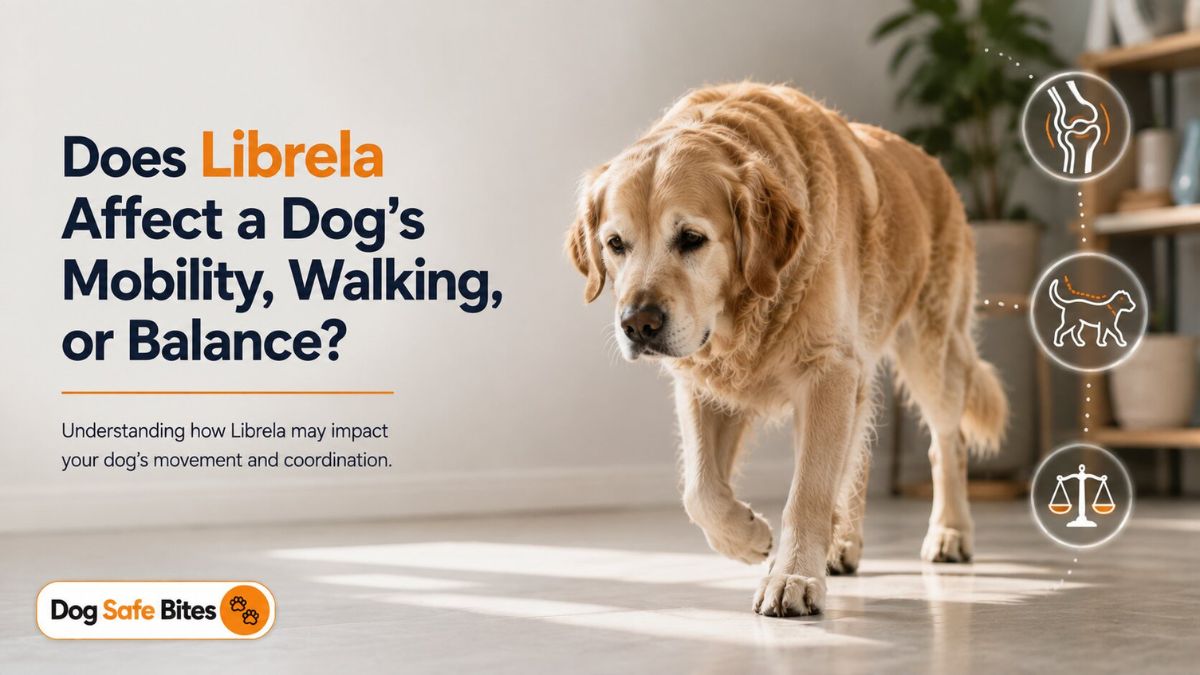
The second is genuinely different: coordination problems unrelated to joint pain. Hind limbs buckling or dragging, knuckling of the paws (the top of the foot touching the ground instead of the pad), or a dog unsteady on flat, familiar ground rather than on stairs. That doesn’t look like an arthritic dog moving carefully. It looks like something is interfering with the nerve signals that control movement, and it can appear at any point in the cycle.
| Sign | Improved Mobility (Expected) | Concerning Balance Issue |
| Movement style | Confident, purposeful, faster | Wobbly, uncertain, hesitant |
| Stairs and jumping | Increased willingness | Avoidance or sudden inability |
| Paw placement | Normal | Knuckling or dragging |
| Onset | Gradual, over days to weeks | Can appear suddenly |
| Consistency | Improves with rest, stays stable | May fluctuate or worsen |
Bruno, a ten-year-old Rottweiler, is the second pattern: three weeks after his second dose his back legs began sliding out from under him on the kitchen floor. Sudden, surface-independent unsteadiness warrants a same-week evaluation.
Which Dogs Are More Likely to Experience Librela Side Effects?
Senior dogs managing several conditions carry the most risk, mainly because there’s less physiological reserve and because new symptoms are harder to attribute when other things are already in play. Baseline bloodwork before the first dose gives your vet a reference point.

Dogs with allergic or atopic skin disease appear more prone to the dermatitis and skin infection reactions, and dogs who’ve reacted to other biologic products are worth flagging, since Librela belongs to that category. The label is explicit on two points: it shouldn’t be given to dogs with known hypersensitivity to bedinvetmab, and it isn’t for breeding, pregnant, or lactating dogs. It’s licensed from 12 months of age.
Dogs already carrying advanced joint damage matter most to the RPOA discussion, since accelerated deterioration has the least room to spare there. A healthy middle-aged Border Collie treated for early hip changes is low-risk. A thirteen-year-old with advanced joint disease, skin allergies, and two daily medications is a different case: not a no, but a reason for closer monitoring.
What Should You Do If Your Dog Has a Reaction to Librela?
For mild, common reactions, calm observation beats alarm. Keep your dog comfortable and write down what you see, with the date. A note on your phone (“day 2: skipped breakfast, tired, otherwise normal”) is far more useful on a vet call than reconstructing the week from memory.
For anything serious — wobbliness, hind-limb weakness, facial swelling, breathing changes, collapse, or a dog who seems distressed rather than simply tired — don’t wait it out. Call the same day, or go to an emergency clinic if it’s after hours and symptoms are progressing. Video helps here: gait changes are hard to describe and often don’t show up during a brief exam, so ten seconds of your dog walking across a flat surface gives your vet far more to work with.
Vets also submit significant adverse events to the manufacturer and to regulators, which is how the safety picture keeps sharpening. Finally, resist deciding alone about stopping or continuing: with mild reactions the usual answer is adjustment rather than discontinuation, while severe or neurological symptoms may call for a different pain strategy altogether.
Librela Side Effects vs Arthritis Symptoms: How to Tell the Difference
Librela is given to dogs who already have stiffness, reluctance to move, and post-activity tiredness, symptoms that overlap with several side effects above. That overlap makes this the trickiest judgment owners face.
Arthritis symptoms follow a rhythm tied to rest and activity: stiffest in the morning or after a nap, looser once moving, tracking with weather and exercise. They’ve usually been present for months before Librela entered the picture, and they affect the same joints consistently. Side effects have a clearer relationship to the injection. They appear within days of a dose, often involve something genuinely new, and don’t reliably improve as a dog warms up.
| Aspect | Arthritis Symptom Pattern | Librela Side Effect Pattern |
| Onset | Gradual, present before treatment | Appears within days of an injection |
| Timing | Worse after rest, improves with movement | Doesn’t reliably improve with movement |
| Symptom type | Stiffness, soreness, specific joints | Often new: skin, urinary, digestive, balance |
| Consistency | Predictable, tied to activity and weather | Can appear suddenly, unrelated to exertion |
| What helps | Warming up, gentle movement | Rest doesn’t reliably fix it; may need vet care |
A dog slow to get up three weeks into treatment but trotting normally twenty minutes later is behaving like an arthritic dog. The same dog unsteady on flat ground mid-afternoon is a different signal. Timing relative to the last injection, and whether the symptom is truly new, are the most reliable clues.
What Do Veterinarians and Clinical Studies Say About Librela Safety?
Librela occupies an unusual position among vets: widely regarded as a valuable option, especially for dogs who can’t safely take NSAIDs, and also watched more closely than older arthritis drugs. Opinion within the profession is more divided than for most drugs.
Pre-approval field studies found that most dogs tolerated bedinvetmab well, with reactions falling mainly into the mild categories above. Because the mechanism is new to veterinary medicine, regulators have continued active post-market surveillance well past approval, which is why safety information keeps accumulating.
The RPOA question remains genuinely unsettled. Concerns about accelerated joint destruction with anti-NGF antibodies first emerged in human trials of the same class, and veterinary case series have raised similar suspicions; the manufacturer disputes that evidence. What’s consistent across the profession is the advice to report anything unusual promptly rather than wait to see whether it resolves.
Conclusion
Librela has given many arthritic dogs a level of comfort their owners hadn’t seen in years. It has also accumulated a safety record that regulators took seriously enough to change the label and require a conversation before the first dose. Both are true, and a good decision holds both.
Stay observant without becoming anxious about every small change. Keep a short record of how your dog responds to each dose, film anything that looks like a gait change, and share it with your vet. Ask for the Client Information Sheet if you weren’t given one.
Frequently Asked Questions About Librela for Dogs Side Effects
How soon after a Librela injection do side effects appear?
Most common reactions, such as mild lethargy or injection site tenderness, appear within 24 to 72 hours.
Are Librela side effects the same in every dog?
No. Age, existing conditions, allergy history, and other medications all influence how a dog responds.
Can Librela be reversed if my dog reacts?
No. It clears only as the body breaks it down over weeks, so reactions are managed supportively rather than reversed.
Is lethargy after a Librela injection normal?
Yes, mild tiredness for a day or two is common and usually resolves on its own.
What should I do if my dog seems wobbly after Librela?
Contact your vet promptly, since balance problems are among the signs regulators have flagged.
Can Librela be stopped if my dog has a reaction?
Yes, but the decision to stop, pause, or adjust should be made with your vet, based on severity.
Does Librela interact with other arthritis medications?
It isn’t known to interact directly, but dogs on several drugs should be watched more closely.